
 IB Docs (2) Team

2. Castro: Consolidation and maintenance of power
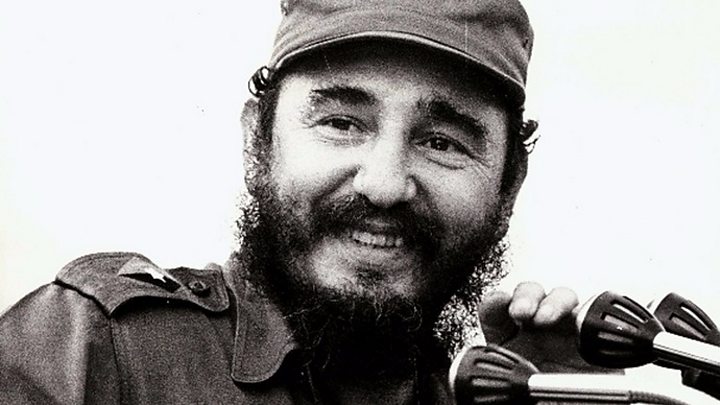 During its first four years, Castro consolidated the new government's political position, began radical social and economic reforms and established a new pattern of foreign relations.
Theme Two: Consolidation and maintenance of power
1. Treatment of opposition
2. Use of of propaganda
3. Use of ideology
3. Foreign policy
1. Treatment of opposition
Castro signaled his determination to tolerate no dissent almost immediately after taking power in 1959. He eliminated hundreds of members of the toppled government of Fulgencio Batista in a series of show trials and summary executions.
In response to the international outcry over the executions, Castro answered: "Revolutionary justice is not based on legal precepts, but on moral conviction...we are not executing innocent people or political opponents," he said. We are executing murderers and they deserve it."
In pairs read through the chart below and discuss the ways in which opponents were treated by Castro’s regime. Compare and contrast the treatment of opposition in Cuba with another case study you have studied of an authoritarian regime.
.png)

You will have already seen examples of how Castro used propaganda to firstly gain control and then to maintain power. His speeches, use of the radio, film, television, newspapers and magazine were key to his establishment of the revolutionary state. During the civil war period Che Guevara had set up Radio Rebelde to broadcast rallying calls for support of the 26 July movement and the rising against Batista. Once in power, the state newspaper, the Granma (which replaced Revolución in 1965) and the magazine Bohemia fostered the myth of the revolution and the cult of Fidel. As the state increased literacy these written sources were important propaganda to maintain support for government policies.
Research 5 propaganda posters from Castro's Cuba. Identify what symbols and themes are similar and what message is conveyed in each example.
You will have found in exploring the role of propaganda in Cuba that there was a focus on the role and leadership of Castro himself. Indeed, if you reflect back on the ‘History will absolve me’ speech, his interviews with the foreign press and his other speeches and broadcasts, it is clear that Castro was a charismatic speaker.
In small groups watch the following clips of Castro’s speeches and discuss the ways in which he engages with his audience.
Discuss in your group the extent to which you agree that: ‘Castro’s charismatic leadership style was the main reason he maintained control in Cuba.’
Castro in 1959, 'I will never be against any right'
Fidel Castro shares his political ideology, 1959
Contemporary opinion, and historians, have disputed the extent to which Castro’s revolution was on a road towards Marxism or whether his ideology was shaped by US policies and pressure on his regime.
Those who argue that Castro was not a Marxist before he declared himself a ‘Marxist Leninist’ at the end of 1961 put forward the following evidence:
Castro argued for the overthrow of tyranny and the establishment of democracy.
Castro emphasized a ‘social justice agenda’ and a ‘planned economy’ but did not reference explicitly Marxist or Soviet ideas
The provisional government initially included many moderates and liberals
26 July movement was mainly a guerrilla army and worked with the PSP as it needed the political experience offered by the communist party
Castro wanted to promote a nationalist program of modernization based on state control of the economy.
Castro believed that a centrally planned economy would work in Cuba and a state program of industrialization
1. Read the sources below and answer the questions which follow regarding the role of ideology in Castro's consolidation of power.
2. In pairs discuss the role of ideology in Castro’s overthrow of Batista’s regime and his establishment of a single party state.
Source A
Extract from Castro’s ‘History will absolve me’ speech at his trial in October 1953. Cuba.
The famous French Declaration of the Rights of Man willed this principle to the coming generations: 'When the government violates the rights of the people, insurrection is for them the most sacred of rights and the most imperative of duties.' 'When a person seizes sovereignty, he should be condemned to death by free men.'
…How can Batista's presence in power be justified when he gained it against the will of the people and by violating the laws of the Republic through the use of treachery and force? How could anyone call legitimate a regime of blood, oppression and ignominy? How could anyone call revolutionary a regime which has gathered the most backward men, methods and ideas of public life around it? How can anyone consider legally valid the high treason of a Court whose duty was to defend the Constitution? With what right do the Courts send to prison citizens who have tried to redeem their country by giving their own blood, their own lives? All this is monstrous to the eyes of the nation and to the principles of true justice!
… Still there is one argument more powerful than all the others. We are Cubans and to be Cuban implies a duty; not to fulfill that duty is a crime, is treason. We are proud of the history of our country… We were born in a free country that our parents bequeathed to us, and the Island will first sink into the sea before we consent to be the slaves of anyone…
… I cannot ask freedom for myself while my comrades are already suffering in the ignominious prison of the Isle of Pines. Send me there to join them and to share their fate. It is understandable that honest men should be dead or in prison in a Republic where the President is a criminal and a thief.
… I know that imprisonment will be harder for me than it has ever been for anyone, filled with cowardly threats and hideous cruelty. But I do not fear prison, as I do not fear the fury of the miserable tyrant who took the lives of 70 of my comrades. Condemn me. It does not matter. History will absolve me.
Source B
Castro's ‘five revolutionary laws’ part of a manifesto he wrote during his imprisonment after his trial in 1953.
I] The reinstatement of the 1940 Cuban constitution
II] Land reform
III] Industrial workers to have 30% share of profits
IV] Sugar workers to have 55% share of profits
V] Confiscation of property of those guilty of fraud
Source C
Castro's Sierra Maestra Manifesto. July 1957.
Do the Sierra Maestra rebels not want free elections, a democratic regime, a constitutional government? It is because they deprived us of those rights that we have fought since March l0. We are here because we want them more than anyone else. To demonstrate it, there are our fighters dead in the mountains and our comrades murdered in the streets or secluded in prison dungeons. We are fighting for the beautiful ideal of a free, democratic, and just Cuba. What we do not do is to agree with the lies, farces, and compromises of the dictatorship.
We want elections, but with one condition: truly free, democratic, and impartial elections.
Source D
A letter written by Che Guevara. December 1957. Cuba.
Because of my ideological background, I belong to those who believe that the solution of the world’s problems lies behind the so-called iron curtain, and I see this movement [26 July] as one of the many inspired by the bourgeoisie’s desire to free themselves from the economic chains of imperialism. I always thought of Fidel as an authentic leaderof the leftist bourgeoisie, although his image is enhanced by personal qualities of extraordinary brilliance that set him above his class.
Source E
A speech by Fidel Castro. Santiago de Cuba. 3rd January 1959
We will not forget our peasants in the Sierra Maestra and those in the interior of the country… I as soon as I have a free moment we will see about building the first school city with seats for 20,000 children. We will do it with the help of the people and the rebels will work with them there… There will be freedom for all men because we have achieved freedom for all men. We shall never feel offended; we shall defend ourselves and we shall follow a single precept that of respect for the rights and feelings of others.
Source F
A press conference by Castro. Havana. Cuba. February, 1959.
The 26 July movement is one with radical ideas, but it is not a communist movement and it differs basically from communism on a whole series of basic points. And those in the 26 July movement, both Raul and Guevara, like all the others, are men who agree very closely with my political thinking, which is not communist thinking. The thinking of the July 26 movement is not communist thinking.
Source G
Extract from writing by Manuel Urrutia. In exile in the US. 1970.
The first time I heard the promise of elections repudiated was when Castro and I attended the opening of the library at Marta University at Las Villas. At the end of the meeting, Castro mentioned elections and a large number of his listeners shouted against them. After the speech, Castro asked, ‘Did you notice how they spoke against elections?’
Source H
A speech by Castro at the first official meeting of the PCC. 1965.
Since we feel that we have already reached a stage in which all types of labels and things that distinguish some revolutionaries from others must disappear once and for all and forever and that we have already reached the fortunate point in the history of our revolutionary process in which we can say that there is only one type of revolutionary, and since it is necessary that the name of our party says, not what we were yesterday, but what we are today and what we will be tomorrow, what, in your opinion, is the name our party should have? The Communist Party of Cuba! Well, that is the name that the revolutionary conscience of its members, and the objectives of our revolution, our first central committee adopted yesterday and that is quite proper.
Source I
An interview between Castro and a US journalist. 1963. Cuba.
At the time of Moncada I was a pure revolutionary but not a Marxist revolutionary. In my defense at the trial [see the History will absolve me speech] I outlined a very radical revolution, but I thought then that it could be done under the constitution of 1940 and within a democratic system. That was the time I was a utopian Marxist… it was a gradual process, a dynamic process in which the pressure of events forced me to accept Marxism as the answer to what I was seeking.
- How consistent is Castro’s promotion of a ‘social justice’ agenda in these sources?
- What do these sources reveal about Castro’s position towards ‘democracy in Cuba’?
- What factors might have led Castro towards pursuing a ‘communist’ ideology after 1959?
- Compare and contrast the views expressed by Castro in Source B, Source C and Source H.
- With reference to the origin, purpose and content, analyse the value and limitations of Source A for historians studying Castro’s ideology.
- With reference to the origin, purpose and content, analyse the value and limitations of Source H for historians studying Castro’s ideology.
Read through the attached timeline of Cuban and US actions and discuss with a partner the extent to which US pressure pushed Castro into aligning with Marxism and the USSR.
 Cuban timeline
Castro faced opposition from the US to his domestic reforms, in particular his economic reforms which included, as you have seen, the nationalization of key businesses. As the US believed that Castro’s reforms were in line with a ‘communist agenda’ relations between Washington and Havana deteriorated. The US embargo had been tightened on Cuba after Castro took over US banks operating in Cuba in 1960. As the US pressurized other countries to withhold aid and assistance from Cuba, Castro moved closer to the USSR. In 1960, full diplomatic relations were established with the Soviet Union. The Soviet agreed to buy sugar and signed other trade agreements with Cuba including loans for industrial plant and weapons. As hostility from the US grew in response to the strengthening of relation between Cuba and its superpower rival, so Castro urged the Soviets to defend Cuba from a possible US attack.
Castro believed world was divided between developed and underdeveloped countries. He believed Cuba was in a position to be a role model and to lead other undeveloped countries in Latin America and Africa out of imperialist oppression and poverty.
Note that the Cuban Missile crisis is also covered under Paper 2, Cold War: 3. Theme 3 - Cold War Crises (ATL)
Videos on the Cuban Missile crisis can be found here: Videos and questions: Cold War videos
There is also an excellent BBC video on Cuba in Africa, 'Cuba and African Odyssey'. The first half of this video which can be accessed here on YouTube, is on the impact of events in the Congo.
The BBC aired two useful programmes on this theme in August 2020 which is currently available on iplayer:
Cuba: Castro vs the World - Series 1: 1. The Armed Struggle (BBC iPlayer)
Spies, revolutionaries and diplomats reveal the secrets of how Cuba challenged the world.
In groups research significant themes and events in Castro’s foreign policy outlined in the chart below (the videos above will help also with the third theme). You need to gather information regarding what Castro’s specific aims were, the course of events and the results. After you have completed your research your group will need to use the material you have investigated to answer the following questions:
- How successful was Castro's foreign policy?
- To what extent did Castro's foreign policy support his consolidation and maintenance of power?

 Twitter
 Facebook
 LinkedIn