
 IB Docs (2) Team

3. The growth of militarism and nationalism in Japan

Despite the moves towards democracy and internationalism in the 1920s, external pressures ensured that the underlying problems which still existed in Japanese government and society would lead to a growth of militarism and nationalism.
This section provides the background for Paper 1: Move to Global War
Guiding questions:
What was the impact of the Great Depression on Japan?
How did events in China impact on militarism and nationalism?
Why did Japan descend into 'the Dark Valley'?
1. What was the impact of the Great Depression on Japan?
Reischauer and Craig write that 'Had Japan not been subject to new outside influences after 1929 it might have continued its earlier pattern of slow gains in a parliamentary direction within the framework of the constitution'. (245)
They go on to argue that the three most important of these influences were:
- The Depression of 1929 which started in America and had a huge impact on Japan's economy
- The growth of nationalism within China which threatened Japan's position in Manchuria
- The rise Hitler and of Mussolini in Europe
Note that a useful video to watch at this point for review of the 1920s and an overview of why Japan become more nationalistic and militaristic is Road to War: Japan which can be found on this page with timings and questions: 4. Japanese expansion in East Asia: Videos and activities
Task One
ATL: Thinking skills
Watch this video from 24 minutes 30 seconds for two minutes only
According to the Japanese views shown here:
- What impact does the economic depression have on people's views regarding the existing system?
- How did the Depression impact on the lives of the Japanese?
Task Two
ATL: Thinking skills
Read the following account of the Depression.
- What, according to this source, was the impact of the Depression on Japan?
- In what ways did the depression threaten the 'liberalism' of the 1920s?
- Why was the rise of fascism in Europe significant to many Japanese?
Since Japan was almost entirely dependent upon foreign trade, the effects of the collapse of the world market were devastating. Japanese farmers who in the 1920s had taken up silkworm-raising were now ruined by the collapse of the American market for silks. Peasants were deeply in debt and millions of industrial labourers were put out of work. Many resented the Zaibatsu which had a stranglehold on finance and which had crushed most small industries by 1925 Japanese students also resented the fact that they had no chance for advancement in a government controlled by the political and financial elites.
Meanwhile the politicians and Zaibatsu were also despised by the army who blamed them for the depression; indeed the depression called into question the validity of the international economic order which in turn cast doubts on on the credibility of democratic nations and Japan's parliamentary government. It seemed significant to many that Germany, the most admired of Western states and the constitutional model for Japan, had turned its back on democracy and was now looking to authoritarian and militarist policies.
Meanwhile, military service in Manchuria confirmed the radical views of army officers who saw the conquest of Asia's resources and markets as a remedy for the chaos caused by the Depression.
Task Three
ATL: Thinking skills
Read this contemporary account of the impact of economic depression from 1929
In what ways did the economic crisis encourage the growth of militarism?
In this climate of economic despair and political decline, the military emerged as a seemingly shining and pure example of the true spirit of the nation. Aided in part by decade of indoctrination, the military found its most fervent support in the down-trodden rural areas. For many rural youths, military service was their escape from poverty and degradation. Military leaders and organisations such as the Imperial Reservists' Association promoted the idea that the 'soldiers were the arms and legs of the empire..' and better than civilians. It stated that young peasant men struggling to survive 'consider it to be the greatest honour attainable once they enter the army to become a private superior class.'
2. How did events in China impact on militarism and nationalism?
For more information and ATL on events in China at this time including the Northern Expedition and its results go to this page: 3. Rise of Communism in China (ATL)

The area in green is the territory controlled by the warlord Zhang Zuolin
Reischauer and Craig also point to the impact of growing nationalism in China at this time as being important for growing militarism. Before the 1920s, China had been disunited with no strong government - dominated by the warlords; this had allowed Japan to establish a foothold in Manchuria. However, in the 1920s the Nationalist Party in China, the Guomindang (GMD), led by Jiang Jieshi, began a campaign of national unification. This included demands to end the unequal treaties that China had signed with great powers, including Japan, With the new communist party, the CCP, Jiang launched a Northern Expedition to consolidate government control and destroy the power of the warlords. This was viewed with concern by the Japanese government. The Japanese had backed the warlord in Manchuria, Zhang Zuolin. However, Zhang had become very powerful and was expanding outside of Manchuria which made him a target for Jiang. If Jiang defeated Zhang this could stop Japan's special interests in Manchuria. The Japanese government intended to get Zhang to retreat to Manchuria so that Jiang would leave him alone and Japan could remain in Manchuria. However, the army decided to assassinate Zhang and also to force Jiang's Northern Expedition to halt at Jinan (see map above). When Japan's Prime Minister Tanaka tried to enforce discipline in the army on the orders of the Emperor, the General Staff refused to act. Tanaka was forced to resign in 1929 thus highlighting that the army could ignore the government with impunity.
Note that developments in Manchuria are key for the growing importance of the army; these are covered in the next section 4. Japan's foreign policy 1931 to 1945
Task One
ATL: Thinking skills
Using all of the sources and information so far on this page, create a mind map or other infographic to show how the depression encouraged the growth of nationalism and militarism within Japan.
3. Why did Japan descend into 'the Dark Valley'?
'The dominant theme of the thirties in Japan is the ever-increasing assertiveness and power of the army'
Richard Storry
Continue watching the video Road to War: Japan. (4. Japanese expansion in East Asia: Videos and activities)
Start from 20 minutes in to see the rise of militarism in domestic politics
The popular actions of the military in Manchuria, who were seen as 'heroes' in Japan, undermined the government at home which was divided on what to do. By the end of 1931 the MInseito party government of Wakatsuki had resigned.
The military now increased its influence over the government; however there were also divisions within the military itself which further destablised the political situation within Japan.
These two groups were the Koda-ha or Imperial Way faction and the Tosei-ha or Control faction; their different views are summarised below. Both were imperialist and both wanted Japanese expansion; however the Koda-ha was generally the more radical of the two. Historian Richard Storry writes that Kodo '..may be summed up , rather inadequately perhaps as the ideal of perfect loyalty and self-surrender to the Emperor. It was an ideal embracing the belief that if all political and economic power were placed in the Emperor's hands every domestic and foreign difficulty would be overcome' (Fascism in Japan, History Today, 1956).
Tosei-ha was equally determined to seize control of national policy - but was more prepared to co-operate with the great business houses and their affiliated political parties in the Diet. 'The leaders of the Tosei-ha had a genuine horror of the radical ideas cherished by many of the junior officers...broadly speaking the Tosei-ha was more conservative and cautious than the Kodo-ha'. (Storry)
As part of this internal contest for power, three major assassination plots destabilised the government between 1932 and 1936.

Task One
ATL: Thinking skills
In pairs, consider the implications for Japan and its foreign policy of each of the two factions of the army shown in the diagram above.
Wakatsuki's successor as Prime Minister, Inukai (leader of the Seiyukai) was assassinated in May 1932 by ultra-nationalists; this was a grave blow to the political parties. As the table below indicates, there was now a power struggle between two army factions. In 1936 the Koda-ha faction staged a coup in Tokyo. Martial law was declared and the coup defeated. However it resulted in a strengthening of army control - now under the Tosei-ha faction.
The new Prime Minister Hirota Koki was weak and made compromises with the military, including agreeing to pursue a strong foreign policy. In May 1936, he agreed that the ministers for the army and navy had to be serving officers. He later agreed to a a seven-point programme from the army, which basically handed control of the government to the military. The Sino-Japanese War effectively completed the military control over the government. In 1940 the Imperial Rule Assistance Association replaced the political parties. Shortly before Pearl Harbour, in October 1941, the Prime Minister Prince Konoe resigned and was replaced by General Tojo.
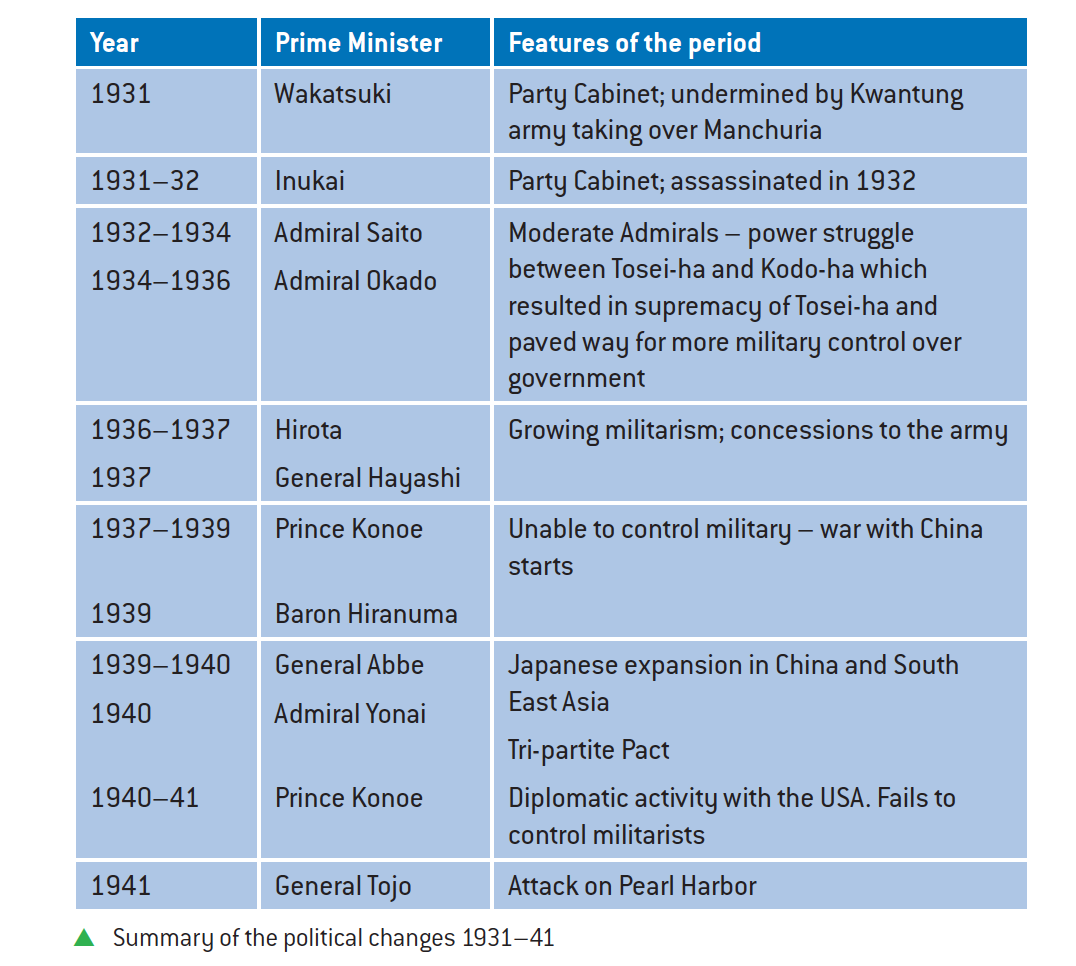
From 'Move to Global War' Jo Thomas and Keely Rogers, OUP
As indicated by the quote at the start of this page, domestic and international events are inextricably linked during this period. The next task is to help you see the links more clearly.
Task Two
ATL: Self-management skills
Create a time line to cover the years 1920 to 1940.
Above this line mark on key political events within Japan.
Add in any international events that you are aware of below the line (you can add to this timeline after you have done the next section)
 Twitter
 Facebook
 LinkedIn