
 IB Docs (2) Team

6. Balkan conflicts in the 1990s: Part 2
 In 1992, Bosnia-Herzegovina also declared independence from Serbia thus beginning the bloodiest of the Balkan conflicts. This page examines the reasons, course and consequence of this war. It also examines the Kosovo War (also covered under Paper 1: 2. Kosovo (1989–2002) (ATL) and tries to draw conclusions as to the overall causes and consequences of the Balkan conflicts.
Guiding questions:
What led to the Bosnian War in 1992 – 1995?
What brought about the end to the conflict in Bosnia and Herzegovina?
What led to the outbreak of the war in Kosovo in 1998-1999?
What was the role of foreign intervention in determining the outcome of the war in Kosovo?
Overview: What were the key causes of the Balkan conflicts in the 1990s?
Overview; What were the consequences of the Balkan conflicts of the 1990s?
1. What led to the Bosnian War in 1992 – 1995?
‘Bosnia won’t stay in a Yugoslavia run by Serbia’
‘Alija Izetbegovic – 1990.
'While the attention of the media was focused on Sarajevo, [Karadzic and Mladic] pursued a relentless policy of 'ethnic cleansing' all over Bosnia that, by the end of 1992, had cost 100,000 Bosnian lives and had driven two million people - almost half the population of Bosnia - from their homes'.
Stoessinger, Why Nations go to War, pg 193
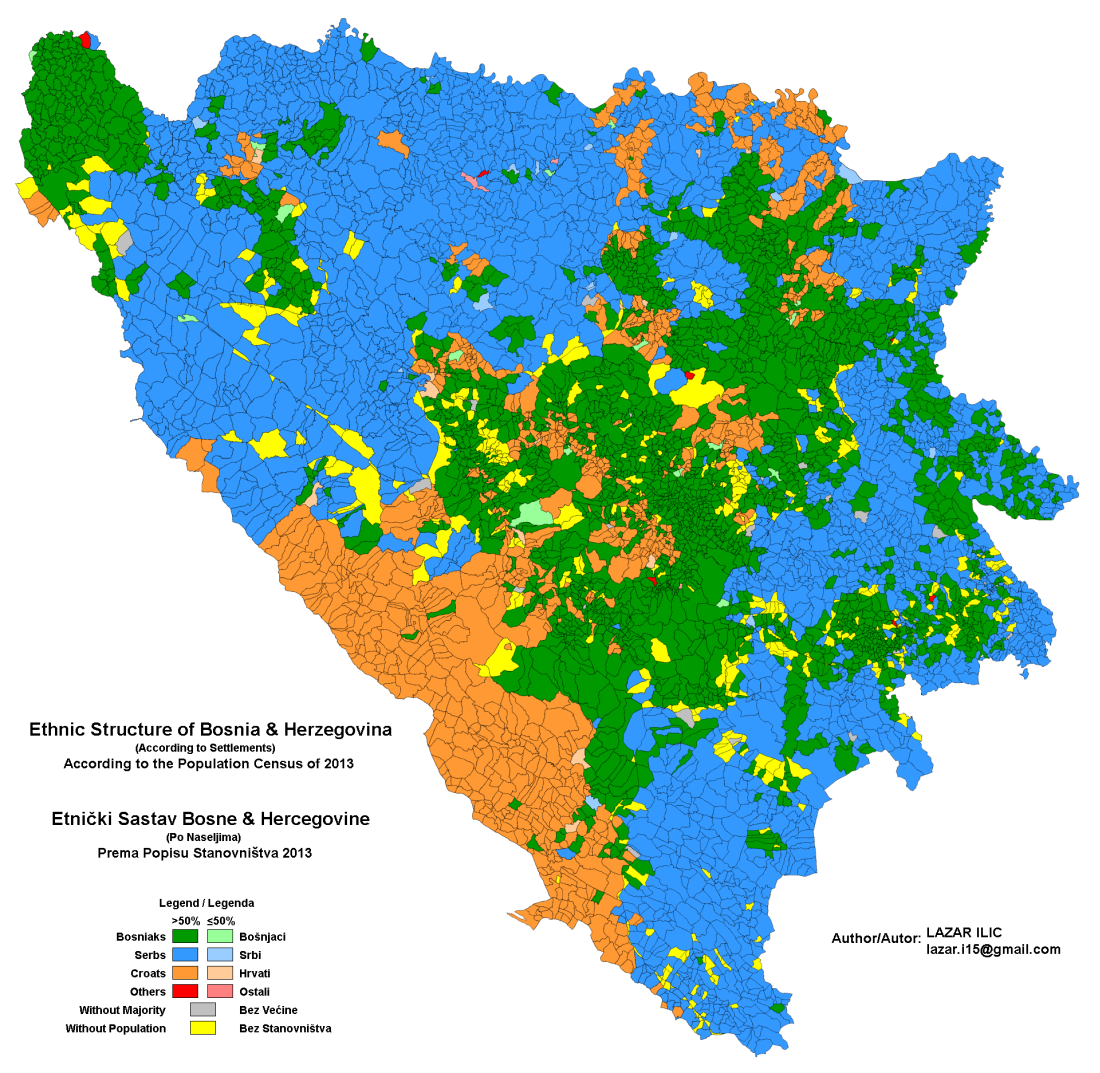 Starter:
What does this map indicate about the problems of Bosnia and Herzegovina following the path of Croatia and Slovenia in declaring independence from Serbia?
Bosnia-Herzegovina was a multi-ethnic and multi-religious state; Sarajevo had the highest proportion of mixed marriages in the whole of Yugoslavia. However, it was made vulnerable by the nationalism of the new Croatian and Serbian leaderships. Indeed, both Milošević and Tuđman had ambitions to divide the state between them. In March 1992, Bosnia-Herzogovina held a referendum on independence which was boycotted by the Serbian minority (one third of the population) who wanted to remain in Yugoslavia. President, and Muslim leader, Alija Izetbegović subsequently declared Bosnia- Herzegovina independent in March 1992 hoping for international recognition and support, and he called for unity between the Serb, Croat and Muslim communities in Croatia. However, as Tony Judt writes, 'once Bosnia declared itself independent, its fate was sealed.' (Postwar, pg 675)
Following the referendum, Bosnian Serb leaders declared the Republika Srpska and, although Milosevic would not send in the Yugoslav military, he transferred Bosnian Serb units from the federal units to Bosnia and sent in paramilitaries that specialized in terror. This gave Karadzic a standing army of 80,000.
After taking the strategically important city of Bijeljina, the Bosnian Serbs targeted the town of Zvornik as it was a crossing point for road and rail links between Serbia and Bosnia. The Muslim ‘Green Berets’ defenders were overwhelmed within a day. A UN official witnessed trucks of dead bodies being transported away. Thousands were sent to camps and 2,000 people were ‘unaccounted’ for. There had been 49,000 Muslims living there and their removal was ‘ethnic cleansing’.
Bosnian Serb artillery and troops now massed around the capital Sarajevo. The Bosnian foreign minister stated that he had no choice but to appeal for a military foreign intervention. In response the international community sent Lord Carrington as a peace envoy on 23rd April 1992. His proposal was that Bosnia would be partitioned into ethnic provinces. Izetbegovic said that he would not except the partition of his state, and thus had to fight. On 2nd May 1992 the Bosnian Serbs launched an attack on Sarajevo.
Task One
ATL: Thinking and communication skills
Watch death of Yugoslavia – part 4, 'The Gates of Hell' from 25.30 minutes to the end and answer the questions that follow. This video can be found on YouTube e.g. here
Questions:
1. What happened in Sarajevo that led both sides to fight to a ‘standstill’
2. What happened to Izetbegović when he returned from a meeting with the international community in Lisbon?
3. How did Izetbegovic manage to speak to the people of television whilst being held hostage?
4. As a new member of the United Nations, did the UN offer to intervene to stop the conflict in Bosnia?
5. What did US Secretary of State James Baker state the US would not do?
6. Which general was sent by Milošević to organize the Serb forces there, and what was he ordered to do?
Karadžić had aimed for independence for all Serb territories in Bosnia and to pursue this he had ethnically cleansed areas by killing the population or forced removals. Nevertheless, Karadžić was concerned that foreign intervention could tip the scales in the war. ‘I knew that if the West put in 10,000 troops to cut supply corridors, we Serbs would be finished’
Europe’s peace negotiator, Lord Owen arrived in Sarajevo on 18th December 1992 and made it clear that the Europeans were not going to intervene to resolve the conflict. A peace plan proposal by Owen which recognised the self-proclaimed Bosnian Serb ‘Republic of Srpska’ was rejected by the Bosnian Serbs, despite Milosevic’s backing, as it would have meant the loss of significant amounts of territory gained in the war thus far.
Izetbegović had allied with the Bosnian Croats against the Serbs; however by the end of 1992 this cooperation broke down.
Task Two
ATL: Thinking skills
Watch death of Yugoslavia – part 5, A Safe Area, from 24.05 minutes – end and answer the questions that follow (click on the eye). This can be found on YouTube e.g. here
Questions:
1. Why did Izetbegovic have good reason to be concerned about a ‘second front’ developing with the Bosnian Croats?
2. What happened in Mostar in the spring of 1993?
3. What happened in the ‘internment camps’?
4. US President Clinton warned Tudman that what would happen if the conflict continued?
5. What ended the conflict between the Bosnian Croatians and the Bosnian Muslims?
6. The Bosnian Serb shelling of Sarajevo in February 1994 led Clinton to call for airstrikes by which international alliance bloc?
7. Which NATO member initially opposed the air strikes?
8. The NATO ultimatum gave how many days for the Bosnian Serbs to withdraw their heavy weapons from hills around Sarajevo
9. What was the response of Russian President Yeltsin?
10. Why did Karadzic want Russian involvement?
11. What happened on the 10th and final day of the ultimatum?
12. Why did the Bosnian Serbs then comply and withdraw from the hills around Sarajevo?
13. Madelaine Albright, US ambassador to UN, stated on 29 March 1994 – ‘I am Sarajevoan’ – why?
14. Why was Srebrinica targeted by Karadzic?
2. What brought about the end to the conflict in Bosnia and Herzegovina?

https://en.wikipedia.org/wiki/Dayton_Agreement#/media/File:Bih_dayton_en.png
The Dayton Accords
The Dayton accords, the General Framework for Peace in Bosnia and Herzegovina, was signed in Paris on 14 December 1995. The US had facilitated a peace agreement between Croatian Bosnian forces and the Bosnian Muslim forces in the Washington agreement. Combined attacks by Croatian and Bosnian Muslim forces in Operation Mistral in September 1995 along with NATO air strikes pushed the Bosnian Serbs to negotiate.
The core elements of this agreement were proposed in 1992; when fighting continued the US and Russia and other major powers applied pressure to the three leaders to enter into talks at Dayton, Ohio. The conference was led by chief negotiator US Richard Holbrooke and US Secretary of State Warren Christopher, and had two co-Chairs the Russian deputy Foreign Minister Igor Ivanov and EU special representative Carl Bildt. The conference had a time limit of 3 weeks, 21 days, to reach a conclusion and Milošević, Tuđman and Izetbegović were pressed to reach an agreement. The location was chosen to:
o Remove the three leaders from their own environment
o Remove the possibility of each leader negotiating through the media and prevent leaks to the press
The agreement established a single state comprised of two elements – the Republika Srpska and the Croat-Bosniak Federation of Bosnia and Herzegovina.
Task One
ATL: Thinking and communication skills
Continue watching the overview video 'Death of Yugoslavia' from 9 minutes 15 seconds to 14 minutes 45 seconds to summarise the events in Bosnia.
Task Two
Thinking and communication skills
Get into groups and assign a different state/republic to each member of your group. You will be writing an editorial for your state/republic's main newspaper on the results and implications of the Dayton Accords. You need to outline the details of the agreement and the potential positives and negatives of its implementation for your state/republic and its interests in the region.
You should have a banner headline which offers your overall appraisal of the Accords; include interviews with key leaders, negotiators and your local community.
- Serbia
- Croatia
- Republika Srpska
- Federation of Bosia and Herzogovinia
- Kosovo (from a Kosovan Serb)
- Kosovo (from an Albanian Serb)
- Slovenia
3. What led to the outbreak of the war in Kosovo in 1998-1999?
Task One
ATL: Thinking and self-managment skills
In pairs or small groups go to 2. Kosovo (1989–2002) (ATL) and work through the ATL activities on the causes of the conflict in Kosovo.
Task Two
ATL: Thinking and self-mangement skills
1. Discuss the role of nationalism, ethnic and religious tensions, economics, and the response of the international community in causing the conflict in Kosovo.
2. Now discuss the role of Milosevic and Rugova in the escalation of violence in Kosovo and add notes to a copy of the Venn diagram below:
.png) Role of key leaders in the Kosovo conflict
Role of key leaders in the Kosovo conflict
4. What was the role of foreign intervention in determining the outcome of the war in Kosovo?
Task One
ATL: Thinking skills
In pairs or small groups go to 2. Kosovo (1989–2002) (ATL) and work through the ATL activities for Guiding questions 8 to 11.
Discuss the role of the UN, NATO bombing and KFOR in determining the outcome of the conflict in Kosovo.
Task Two
In pairs or small groups go to 2. Kosovo (1989–2002) (ATL) and work through the ATL activities on the consequences of the war (Guiding questions 12 to 15)
Copy out the chart below and add information from your work on the ATLs to complete it.
Consequences of the Kosovo War
Social impact | |
Economic impact | |
Political impact | |
International Criminal Tribunal for the Former Yugoslavia [ICTY] |
5. Overview: What were the key causes of the Balkan conflicts in the 1990s?
'Yugoslavia did not fall: it was pushed. It did not die: it was killed'
Tony Judt, Postwar, pg 685
Task One
ATL: Thinking and self-management skills
In groups review the causes of each of the Balkan wars and identify when Slobodan Milošević's decisions, policies and actions led to increased tension, escalating violence and conflict.
Task 1:
Create an info-graphic which shows the role of Milošević and the other causal connections between the conflicts.
Task 2:
In your groups now consider the evidence that each of the leaders below had a role in causing the conflict in the Balkans in the 1990s. Copy out or print off the PDF to show your evidence.
Task 3
To what extent do you agree with Tony Judt's verdict on Milošević?
But in the end the primary responsibility for the Yugoslav catastrophe must rest with the Serbs and their elected leader Slobodan Milošević. it was Milošević whose bid for power drove the other republics to leave. It was Milošević who then encouraged his fellow Serbs in Croatia and Bosnia to carve out territorial enclaves and who backed them with his army. And it was Milošević who authorised and directed the sustained assault on Yugoslavia's Albanian population that led to war in Kosovo'.
Judt, Postwar, pg 684
 the role of leaders in causing the Balkan conflicts

Task Two
ATL: Thinking and self-management skills and communication skills
In pairs discuss the role of each of the factors in the diagram below in causing conflict in the Balkans. Either copy out or print out the diagram and add evidence to each of the factors.
 Causes of the Balkan Conflicts mind map
Task Three
ATL: Thinking skills
In small groups, read through the source below and discuss the extent to which you agree with Craig Nation’s assessment of the causes of the Balkan conflicts.
‘The Kosovo conflict was the latest in a series of four wars occasioned by the purposeful destruction of the Yugoslav federation. Though waged sequentially and in different geographical areas (Slovenia, Croatia, Bosnia-Herzegovina, Serbia) they are best regarded as a single protracted conflict with a consistent logic – the reallocation of territory and populations among fragments of the former Yugoslavia’
Craig Nation, War in the Balkans 1991 – 2002. p.325
6. Overview: What were the consequences of the Balkan conflicts of the 1990s?
Human Cost
It is estimated that 140,00 people were killed in the Balkan conflicts of the 1990s. The heaviest losses were incurred by Bosnia and Herzegovina with 100,000 casualties; in Sarajevo alone 14,000 were killed. In the Croatian war, over 40% of those killed were civilians with this figure rising to over 80% in the Bosnian War. The conflicts led to an acute refugee crisis as 2.4 million people fled the fighting and another 2 million were internally displaced. Croatia hosted the highest number of refugees - almost 750,000 people which placed stress on its own population of less than 5 million people. Lives continued to be lost in the aftermath, for example approximately 5 million landmines remained across Bosnia and 1,520 people were killed by them after the war.
Economic Cost
The economic cost of the conflicts was catastrophic. It was not only the human cost and the need to clear minefields and dangerous structures. Infrastructure, industry and farming had been devastated. The overall war damages were estimated to be for Croatia $37 billion, for Bosnia and Herzegovina $60 billion. The international sanctions that had been imposed on the FRY had led to hyperinflation, GDP had fallen by 55% and one million workers had been made unemployed by 1995. The NATO bombing campaigns had also resulted in widespread damage.
War crimes
The International Tribunal for the Prosecution of persons responsible for serious violations of International Humanitarian Law committed in the territory of the former Yugoslavia since 1991 [ICTY] was established on 25 May 1993 by the UN security resolution 827. It had jurisdiction for the following crimes: violations of the Geneva Conventions and the customs of war, genocide and crimes against humanity. The maximum sentence that the court could impose was life in prison. By December 2004, when the final indictments were made, 161 people had been indicted.
Task One
ATL – Thinking and research skills
In pairs read the following extract and discuss the key points made about the impact of the Balkan conflicts:
‘The war of Yugoslav succession had a destructive impact throughout the region, but burdens were not distributed evenly… The Slovenes broke away at low cost, and have been successful in consolidating a new regime…Croatia’s “thousand-year dream” of statehood was also secured, though the cost was considerably higher…Though the Serbs achieved independence, it’s aspiration to create a greater Serbia where “all Serbs would live in one state” was beaten back across the board… Bosnia-Herzegovina emerged from the Dayton process as a ward of the international community plagued by declining living standards and poisoned intercommunal relations.’
Craig Nation, War in the Balkans, 1991 – 2002.
Task Two
ATL: Thinking skills
With your partner you will complete a short research task. One student will research the social impact of the conflicts and the other researches the economic effects. Feedback to your partner on your findings and add your shared information to a copy of the chart below.

Task Three
ATL: Thinking skills
Go to the International Criminal Tribunal for the former Yugoslavia website and answer the following questions:
- What was the ICTY and why was it established?
- Which leaders have gone on trial and what were they indicted for?
- What controversy was there surrounding the trials of key figures such as Milošević?
- What judgments were passed down and what sentences did those convicted receive?
- Which leading figures in the Balkan conflicts are still awaiting verdicts?
- In pairs discuss the extent to which the work of the ICTY will ‘deter crimes against humanity’?
 Twitter
 Facebook
 LinkedIn
