
 IB Docs (2) Team

4. Second World War: Effects (ATL)
 This page looks at the effects of the Second World War. There are a variety of ATL which get students to look at the economic, political, ideological effects of the war as well as the impact of peace making.
Guiding questions:
What was the situation in Europe and Asia at the end of the Second World War?
What were the political and ideological effects of the Second World War?
What were the territorial consequences of the Second World War?
Why was the United Nations supra-national organisation established?
To what extent was the Treaty of San Francisco successful?
What were the war crimes tribunals after the Second World War?
Why did an arms race develop at the end of the Second World War?
1. What was the situation in Europe and Asia at the end of the Second World War?
Human cost
The Second World War had a catastrophic human cost with some estimates of more than 50 million killed, millions more injured and more than 20 million people had been displaced or deported. Unlike previous modern wars between states, including the First World War, the majority of those killed were civilians. Indeed, perhaps as many as two-thirds of the war dead were non-combatants. As a global war its effects were also cross-regional. We will focus on an analysis of the effects of the Second World War in Europe and Asia.
The suffering continued after the Second World War. Between 1945 and 1947, approximately 16 million Germans were expelled from the countries of Central and Eastern Europe, and many died as a result of this forced exodus to the west. In China the civil war, which had been suspended between the Chinese Nationalists and the Communists to fight the Japanese, resumed and the slaughter continued.
Economic devastation
The economic cost of fighting a total war devastated the economies of the key belligerents, all bar the US. It was not only the cost of weapons, supplies and the economic impact of the loss of ‘manpower’ and labour, it was also the cost of the devastating destruction of the war on the home-front.
- Aerial bombing was particularly destructive. Very few cities of any size were left unscathed, industry and the infrastructure were targeted and destroyed.
- Aerial bombing had also left millions homeless
- War on the land had also destroyed industry and agriculture
- Advancing and retreating armies had razed entire towns and villages
- Farmland was destroyed, livestock killed, land was made unusable by mines and war debris. Food production fell in Europe to 50% of pre-war levels
- 150 million Europeans were dependent on food relief after 1945
Task One
ATL: Research skills
You will complete a short research task. In groups of six research the economic impact of the Second World War on the following countries:
- Japan
- China
- Britain
- Germany
- USSR
- USA
Each student should focus on one of the countries. Feedback your findings to your group. What are the similarities between the impact of the war on the ‘victors’ and the ‘defeated’ states? Why was the US economy not negatively impacted by the Second World War?
Political tensions
Task One
ATL: Thinking skills
In pairs look at the two maps below. What do you notice about the final positions of the Allied armies in Europe in 1945? What do you notice about the final positions of the Allied armies in Asia in 1945? You should note that the USSR only entered the war in Asia after it declared war on Japan on 8th August.


Task Two
ATL: Thinking skills
Watch the first episode from the CNN Cold War series from 24 minutes in:
Tehran:
- What happened at the Tehran Conference that could be significant for the post Second World War world?
- What was the significance of Stalin's actions regarding the Warsaw uprising?
- What was the significance of the deal made between Stalin and Churchill?
Yalta:
- What was the 'mistake' made by Roosevelt at Yalta?
- Why were the Soviets in a strong position to take Poland and much of Eastern Europe?
- What decisions over Poland and Eastern Europe were decided at Yalta?
- What was decided about Germany and the war?
Potsdam:
- What was Truman's attitude towards Stalin at Potsdam?
- How did this differ to what had happened at Yalta?
- Why did Stalin not have to join the war in the Pacific?
- Why was Stalin not surprised about the Atomic Bomb?
Note that there is another excellent video on Roosevelt and his relationship with Stalin on this page 5. Economic and diplomatic effects of the Second World War
Task Three
ATL: Thinking skills
Review the key agreements made and key areas of disagreement that emerged during the conferences at Tehran in 1943, and at Yalta and Potsdam in 1945.
In small groups role play a final session of the Potsdam meeting. Your role play should feature: Stalin and a Soviet representative; Truman and a US representative; Atlee and a British representative.
Your role play should include concluding discussions on decisions, agreements and areas of dispute regarding each of the following:
- Germany
- Poland
- Eastern Europe
- Japan
- United Nations
2. What were the longer-term political and ideological effects of the Second World War?
'The Cold War began where it had left off in 1941, with profound distrust of Soviet motives, and an ideological divide every bit as deep as that between liberalism and Nazism..American strategists moved effortlessly from on Manichean world to the next'. Richard Overy, Why the Allies Won, 2006, pg 404
The most significant post-war political development was the defeat of Italian fascism, German Nazism and Japanese nationalist militarism. The political and ideological victors were the capitalist liberal democracies and Soviet communism. The ramifications of this emerged in terms of international relations. The war had dramatically changed the balance of power. After the Second World War, as US politician Dean Acheson wrote ‘The whole world structure and order that we had inherited from the 19th century was gone.’
The emergence of the 'superpowers' after 1945 would shape the ideological, political, economic and military nature of the post-war world.
The superpowers emerged due to following:
- The US had developed the largest air force in the world during the Second World War .
- The USSR had developed the largest conventional land force in the world.
- The US economy was strengthened by the war. After the war it could out-produce all the other powers put together.
- The Soviet economy needed reconstruction and recovery. It would benefit from the establishment of other communist command economies in the region. The countries in Eastern Europe that had been formed after the end of the First World War were economically weak and unstable, and needed the support of a stronger neighbour, and the USSR could replace Germany in this role.
- Ideological victory for the US and USSR in the Second World War strengthened the potential to shape the political nature of states in the post-war period. Liberal capitalist democracy or communism could fill the political vacuum left after the removal of defeated regimes.
- The Second World War fostered the growth of decolonization movements, newly independent states would need to establish a new political order.
The impact of the breakdown of the Grand Alliance and the emergence of superpower rivalry meant:
- The political, economic and military division of Europe into two opposing camps.
- The involvement of the superpowers in ‘proxy’ wars in Asia.
Task One
ATL: Thinking skills
1. Read the extracts on the attached sheet on why USSR and USA emerged as superpowers (Los extractos son una adaptación del libro de Richard Overy, Why the Allies Won.)
a. Decide what point each extract is making and whether it is giving a reason linked to military, economic, or political factors.
b. Create a mind map to show the military, economic and political factors which led the emergence of the superpowers; use the sources to give you detailed evidence. Can you think of any other factors?
c. In pairs discuss whether the fact that two powers had emerged as superpowers means that a clash was inevitable regardless of their differences in ideology. In other words, to what extent was the grown in tension after 1945 more about traditional Great Power rivalry?

As you have seen, Western Europe was weakened politically and economically after the Second World War. It would never again have such influence in international politics and US military and economic influence became key. Indeed the Marshall Plan enabled Western Europe to recover and the next two decades saw a period of sustained economic growth.
There were other key political, social and economic developments:
- with the elimination of Fascism, Western Europe also saw the establishment of multiparty democracies
- social legislation was introduced to provide a wide range of social services (e.g. the Welfare State in Britain)
- the devastation of war, the communist threat and the desire to prevent future conflict also now led to much greater co-operation between the European states which ultimately resulted in the European Economic Community (EEC) in the 1950s
Task Two
ATL: Thinking and research skills
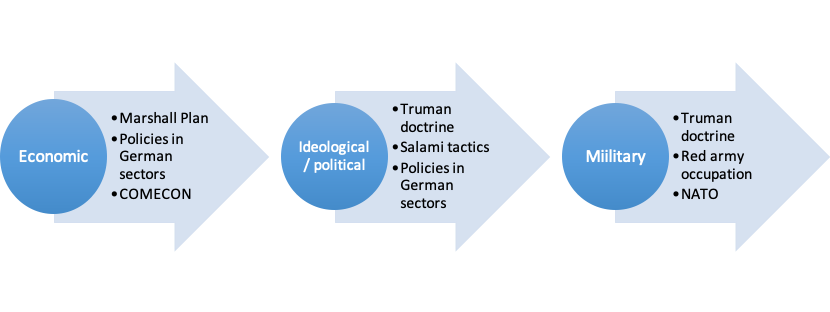
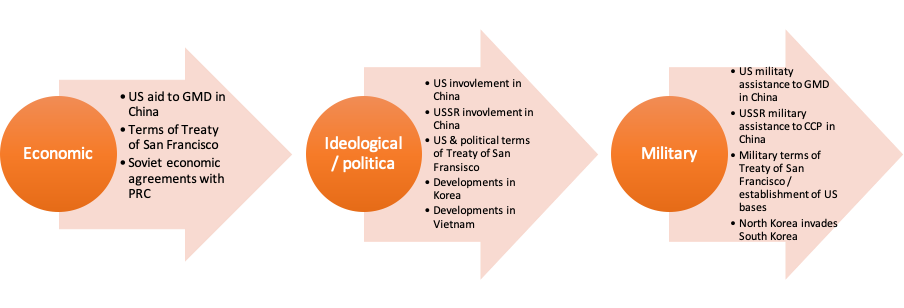
In pairs research the impact of the emerging superpower confrontation on Europe and Asia up to 1950. One student should focus on Europe, one student should focus on Asia.
Feedback your research to your partner. What were the key features of the impact of the post war superpower confrontation in Europe and Asia? What are the similarities and differences?
To get started here are some key events and themes:
Europe
Asia
3. What were the territorial consequences of the Second World War?
'At the conclusion of the First World War it was borders that were invented and adjusted while people were on the whole left in place. After 1945 what happened was rather the opposite with one major exception boundaries stayed broadly intact and people were moved instead'.
Tony Judt, Postwar, Vintage, 2010, pg 27
Task One
ATL: Thinking skills
What, according to the extract below, were the territorial consequences of the Second World War?
There were not the dramatic boundary changes after the Second World War that resulted from the treaty settlements of the First World War. The one major adjustment in Europe was with regards to Polish and German territory. Poland’s borders were redrawn westwards – it gained 104,000 square kilometers from German territories on its western border and lost 179,000 square kilometers of land in the east. These new boundaries were decided at the second wartime conference of the Grand Alliance, in Yalta in February 1945. However, despite a total of three wartime conferences the Allies could not agree on the terms for major treaties in Europe. Rather, the emerging superpower confrontation led to the development of ‘spheres of influence’ in Europe and the division of Germany into two separate states. The countries that the Red Army had liberated: Poland, Hungary, Bulgaria, and Czechoslovakia became single party regimes under Soviet control by 1948.
In Asia, Japan was stripped of its former colonies. Again, the agreements regarding the temporary occupation of countries such as Korea ultimately led to the development of opposing regimes and conflicts that drew in superpower interventions.
Task Two
ATL: Thinking and self-management skills
In pairs discuss the key political, economic and territorial effects of the Second World War.
To what extent do you and your partner agree that the superpower confrontation was ‘inevitable’ after the Second World War?
4. Why was the United Nations supra-national organisation established?
Task One
ATL: Thinking and social skills
Get into groups of four. You will investigate the United Nations organization that was established at the end of the Second World War.
Go to the UN website
You will need to answer the following questions:
- What is set down in the United Nations Charter?
- What were the founding ideas and principles of the United Nations?
- What are the functions of its main organs and specialized agencies?
- Who are the member states?
You should then go to: History of the United Nations
Create a timeline of the History of the United Nations between:
1945 -----------------------------------------------------------------1971
Your group should then identify and discuss:
- the key interventions made by the UN between 1945 and 1971
- what key challenges and issues the UN faced
- when was the UN successful in peacemaking and / or peacekeeping
- when was the UN unsuccessful in peacemaking and / or peacekeeping
Present your findings to the class.
Task Two
ATL: Thinking and communication skills
Organize a class debate on the following resolution:
The United Nations was ineffective between 1945 and 1971 due to superpower rivalry and confrontation.
6. To what extent was the Treaty of San Francisco successful?
Although the US did not invade Japan at the end of the Second World War, the country was totally defeated and unconditionally surrendered 15th August and signed terms on 2nd September. Following its surrender, the US occupied Japan. Japan had been devastated by the US naval blockade and aerial bombardment. The US military occupation enabled it to oversee the immediate post-war period in Japan as the Treaty of San Francisco was not signed until September, 1951. The US had total control over Japan during this period and, due to the breakdown of the Grand Alliance with the USSR and its military occupation, it could impose its objectives without interference.
Task One
ATL: Thinking and research skills
In pairs research the following on the Treaty of San Francisco (click on the eye for extra information)
- US aims
- The terms of the Treaty
- Soviet attitude towards the Treaty
- Results of the treaty for US-Japan relations
- The verdicts of historians on the Treaty
US aims:
- demilitarize Japan
- end Japanese imperialism
- stabilise and strengthen democracy
- instil US values socially and politically
- rebuild and strengthen a capitalist economy
During the meetings discussing and drafting the Treaty of San Francisco, the USSR raised objections to the terms as favouring Japan’s relationship with America. When the terms were finalized the Soviets refused to sign it. Despite China having fought Japan between 1937 and 1945, the People’s Republic of China [established after Mao Zedong’s communist party won the Chinese civil war in October 1949] and the Republic of China of Taiwan [established by the Jiang Jieshi’s nationalist forces who had fled to the island at the end of the Chinese civil war] were not invited to the peace conference. Neither were North and South Korea. India and Burma refused to participate, and the Philippines did not sign the treaty until after it was implemented. Although Indonesia signed the treaty, it never ratified it.
The terms of the Treaty of San Francisco:
- Japan renounced all claims to Taiwan, Sakhalin, and the Kuriles.
- The Pacific Islands of Micronesia were to be administered under a United Nations trusteeship.
- The Ryuku and Bonin Islands were given to the US .
- Japan had to accept the judgements of the International Military Tribunal for the Far East and agreed to carry out the sentences imposed.
- Guidelines were set for the repatriation of and compensation to prisoners of war.
- Japan renounced future military aggression under the guidelines set by the UN Charter.
- Prior treaties signed by the Japanese government were nullified.
- Japan could only retain a military that was purely defensive in nature.
- No reparations were set down, however, Japan was to help rehabilitate countries that had suffered damage because of the Japanese occupation.
In addition to the Treaty of San Francisco, the American–Japanese Security Treaty was signed in 1951, which in effect made Japan a military protectorate of the US. The treaty provided for the retention of American bases in Japan and permitted the US to use its forces stationed there in any way that would contribute to the ‘maintenance of international peace and security in the Far East’. The agreement also prohibited Japan from granting military bases to any other power without American consent.
As with West Germany, which was established after the Berlin Blockade in 1949, Japan became a close and dependable ally to the Western powers. Japan also became a stable democracy politically and rebuilt and developed a strong capitalist economy. In addition, Japan became an important military and strategic base for the US in its fight against communism in Asia.
Japan’s economy developed rapidly and, following the so-called economic miracle of the 1950s, Japan emerged as an economic power house in Asia. It also had a succession of conservative governments in the post-war period that had gained a popular mandate to focus on economic growth as its priority. Thus, the US achieved its peacemaking aim of making Japan a stable capitalist democracy and a bulwark against the spread of communism in the Far East.
However, some historians have challenged how far this was due to the peacemaking policies and Treaty implemented by the US or the attitude and approach of the Japanese themselves. The apparent success of the Treaty of San Francisco may have been due to the Japanese people themselves rejecting militarism and imperialism after the Second World War. The historian Kenneth Pyle refers to General MacArthur’s memoirs in which he states that Prime Minister Shidehara had suggested in 1946 that the demilitarization clause was added to the new Japanese constitution. Although, William G Beasley disagrees with Pyle and argues that the clause was MacArthur’s idea, most historians agree that there was a deep-rooted rejection of militarism in post-war Japan.
In addition, as the Cold War intensified, the US changed its objectives for Japan and encouraged it to establish a large military force and to join a regional defence alliance in order to play a more significant role in containing communism in the region. The Japanese government resisted these demands. The Japanese understood that the US presence in Japan would deter a Soviet attack and this meant it could focus government investment on economic development as the US picked up its ‘defence bill’.
Task Two
ATL: Thinking skills and self-management skills
Complete the following table using the information you have researched on the effects of the Second World War in Europe and Asia, and the relative successes of the Treaty of San Francisco
 Grid on success of peacemaking after Second World War
6. What were the war crimes tribunals after the Second World War?
At the end of the Second World War, tribunals were set up to put war criminals on trial in both Europe and Asia. The trial of German war criminals took place at Nuremberg; the Nuremburg Tribunal began in November 1945 and lasted until October 1946. This trial was the first of its kind in history. Twenty-one leading Nazis were charged with war crimes and crimes against humanity. Eleven were given the death penalty. In Japan, General MacArthur conducted trials against war criminals, and 28 of Japan’s leaders were tried before an international tribunal in Tokyo. Over a six-year period, 5,700 Japanese war criminals were tried before Allied tribunals, and about 1,000 were executed.
Task One
ATL: Thinking and Research skills
In pairs explore the Nuremburg Tribunal and the Tokyo War Crimes Tribunal.
These sites are a good starting point:
PBS: The American War experience
Office of the Historian: Nuremburg and Tokyo
Discuss the nature of the charges made against those put on trial. Identify the key characteristics of the defence made by the individuals on trial. Compare and contrast the charges, decisions and verdicts handed down at the Nuremburg and Tokyo tribunals.
Task Two
ATL: Thinking skills
Read the following sources - taken from the articles above.
What, according to these sources were the short and long-term political consequences of the Nuremburg and Tokyo Trials?
Still, the judgments at Nuremberg established the legal precedent for denazification and created a record of evidence so compelling that, when shown to the German public, it dispelled any suggestion that the Nazi regime had been innocent of the accusations levelled against it.
https://www.nationalww2museum.org/war/articles/the-nuremberg-trial-and-its-legacy
The Nuremberg and Tokyo tribunals contributed significantly to the development of international criminal law, then in its infancy. For several decades, these tribunals stood as the only examples of international war crimes tribunals, but they ultimately served as models for a new series of international criminal tribunals that were established beginning in the 1990s. In addition, the Nuremberg Charter’s reference to “crimes against peace,” “war crimes,” and “crimes against humanity” represented the first time these terms were used and defined in an adopted international instrument. These terms and definitions were adopted nearly verbatim in the Charter of the IMTFE, but have been replicated and expanded in a succession of international legal instruments since that time.
7. Why did an arms race develop at the end of the Second World War?
As you have seen, a key military reason for the emergence of the superpowers after the Second World War was the Soviet creation of the largest land force in the world to defeat Nazi Germany and the US development of the largest air force not only to defeat Nazi Germany but also to defeat Japan in the Pacific. Therefore, in 1945 the USSR and the US were dominant military powers and as the Grand Alliance broke down so there was a renewal of military spending and competition in a conventional arms race between the two superpowers.
However, a new and deadly dynamic in the post-war period was rivalry in a new nuclear arms race. President Truman had decided to use the new technology of the A-bomb to end the war in the Pacific. These new weapons of mass destruction were dropped on Hiroshima and Nagasaki. Some historians argue that the use of atomic weapons was in fact not militarily necessary to defeat Japan and was in fact the first act of the Cold War. This idea has been contested by historians; nevertheless what is clear is that Hiroshima would be the beginning of the nuclear arms race between the USSR and the USA.
Refer to Topic 12 Cold War: ATL: Rivalry, Mistrust and Accord for activities on the nuclear arms race.
Task One
ATL: Thinking skills
In pairs read the definition of militarism below.
Militarism
- Militarism is an ideology which claims that the military is the foundation of a society's security, and thereby its most important aspect.
- The belief that a country should maintain a strong military capability and be prepared to use it aggressively to defend or promote national interests.
Discuss the reasons for the development of an arms race after the Second World War. How might renewed militarism be considered a failure of the peacemakers at the end of the Second World War?
 Twitter
 Facebook
 LinkedIn