
 IB Docs (2) Team

3. Events - German expansion (1938–1939)
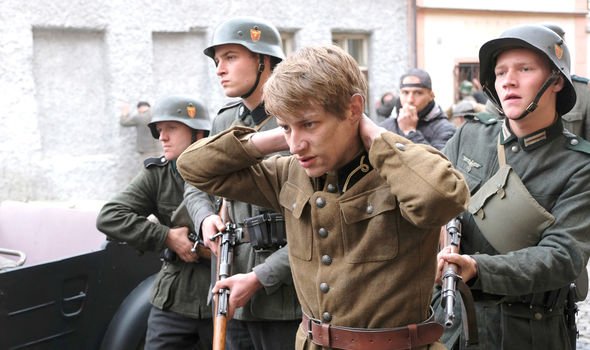
The ATL on this page consider the German expansion after the Munich Agreement (September 1938) and the events that led to the outbreak of war in Europe the following year, in September 1939.
Guiding questions
How did Germany break the Munich Agreement?
Why did Germany and the Soviet Union sign a non-aggression pact in August 1939?
Why did the invasion of Poland lead to the outbreak of war in Europe in September 1939?
As you have seen, war over the Sudentenland crisis was averted in September 1938 by British Prime Minister Neville Chamberlain's determination to keep the peace. However, Hitler, was determined not to be deprived of his war against Czechoslovakia. On 21 October, he gave orders for the ‘liquidation of the remainder of the Czech state’.
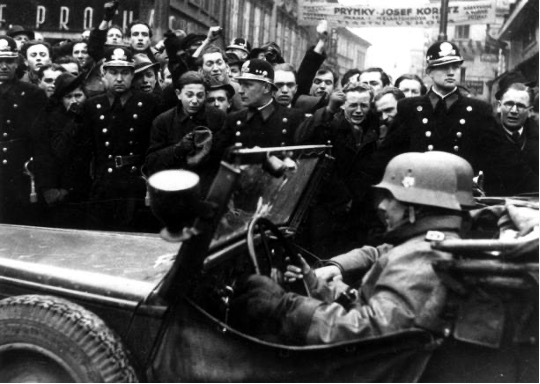
On 15th March, 1939, German troops occupied the rest of Czechoslovakia.
On 16th March, bohemia and Moravia were declared a protectorate of Germany, Slovakia was to be an independent state under the protection of Germany and Ruthenia was occupied by Hungarian troops.
- Italian invasion of Albania had been seen by Britain and France as a coordinated action between the fascist states
- Britain and France had immediately guaranteed Greece and Romania
- Germany had supported Italy's invasion of Albania and Mussolini knew he needed Hitler's support against the hostile reaction from Britain and France.
- Mussolini had proposed the Pact of Steel
- BUT Mussolini understood that Italy was not in a position to engage in a major war for another 3 or 4 years (after his involvement in the Abyssinia and Spain)
- To emphasise this to Hitler, Mussolini listed the extensive war materials Italy would need to be able to fight.
- However, Hitler was intent on war.
In pairs read through Article III of the Pact of Steel and discuss what it commits member states to do.
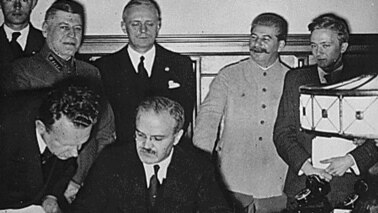
In the summer of 1939, both the Western democracies and Hitler approached the Soviet Union for an alliance. Despite Hitler’s loathing of Communist Russia and his plans for lebensraum in the East, an alliance with the Soviet Union at this stage was highly desirable for Hitler.
In pairs discuss the reasons that (a) Britain and France and (b) Hitler would have had for wanting an agreement with the Soviet Union.
If you were Stalin, which side would you make an agreement with and why?
Initially the Soviet Union favoured an alliance with Britain and France. In 1934, the USSR had joined the League of Nations and, alarmed by the growing power of Hitler, had hoped that collective security would work to prevent Hitler’s aggression.
However the Western democracies were still suspicious of a Communist government and, as you have seen, they had worked rather to appease Hitler. The French alone had signed a defensive pact with the Soviet Union in response to German rearmament in 1935 but this collapsed after the Munich Agreement.
Despite Munich and what seemed to Stalin a capitulation to the Nazis, he renewed a proposal of a military alliance with the West following Hitler’s occupation of Prague. However, negotiations with the democracies dragged on and both sides ultimately distrusted each other. Meanwhile. Stalin had also made it clear to the Germans that he would welcome an agreement and as a result, on 24 August, 1939, Germany pulled off one of the most controversial and cynical alliances in modern history: the Nazi Soviet Pact (also known as the Molotov-Ribbentrip Pact after the two foreign ministers that signed it):
- It was also known as the 'non-aggression' pact as Germany and the Soviet Union agreed not to attack each other.
- The Soviet Union was to have influence over the Baltic states and Bessarabia in Romania
- Secretly Stalin and and Hitler also agreed to divide Poland between them.
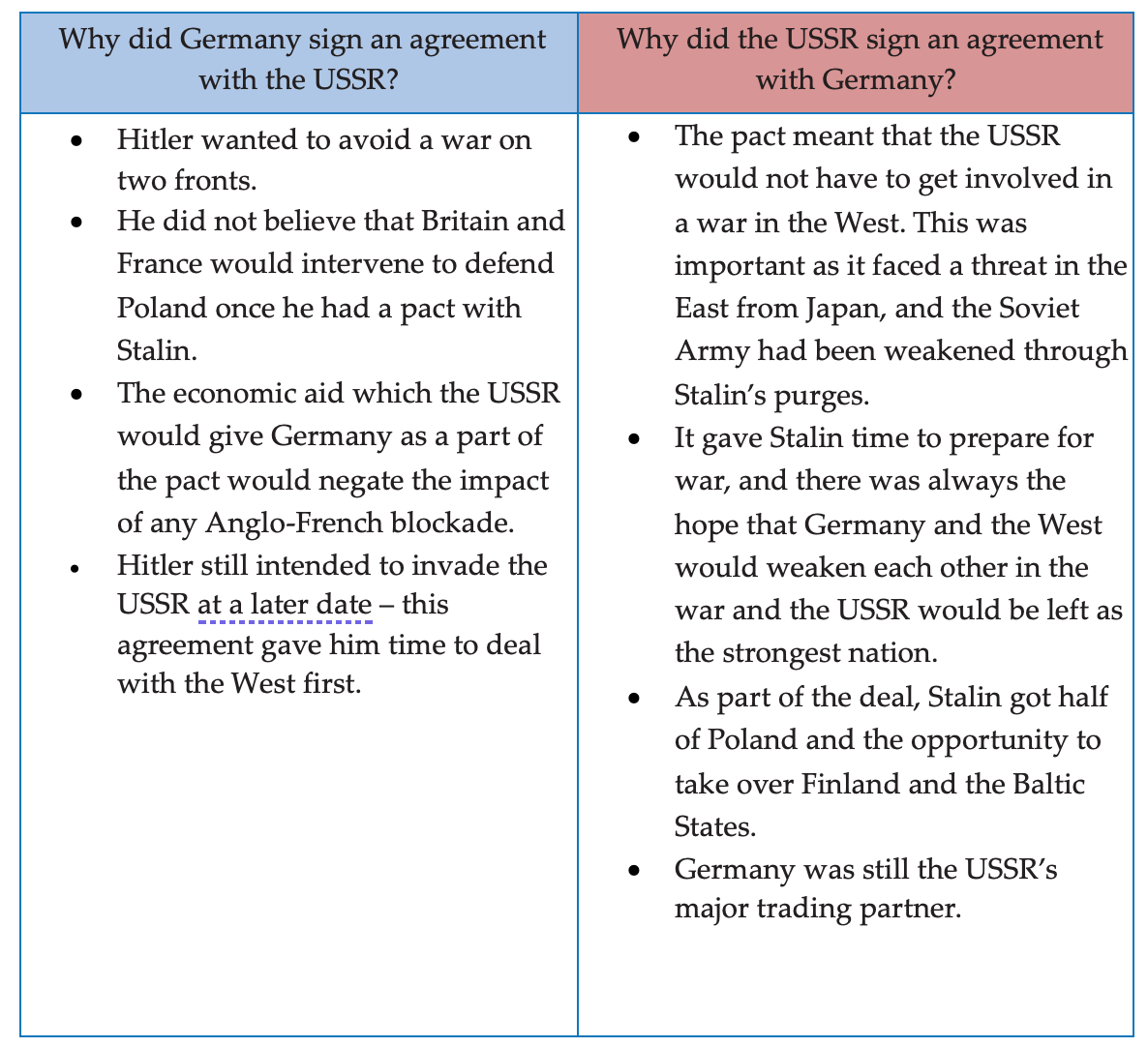
In pairs consider the table below which sets out the reasons why both sides signed this agreement.
- Who do you think benefited the most from this agreement?
- What was likely to be in the impact of this Treaty for Britain and France and for the international situation?
The Nazi-Soviet Pact had important consequences for the international situation:
- It clearly showed that collective security had failed
- It also showed that Britain's policy of appeasement had failed
- Hitler was now free to move against Poland and then to attack the West without any fear of a two-front war
On 1 September 1939, the Germany army invaded Poland from the west, where they met little resistance. Britain and France now demanded that Hitler withdraw, or they would declare war. Having seen that Britain and France in the years 1933 to 1938 had been reluctant to take any direct action against him, Hitler assumed that they would not do anything about his invasion of Poland. He was thus both surprised and furious when Britain and France responded to his attack on Poland by declaring war.
What can you learn from these sources about the reasons Hitler misjudged Britain and France?
Source A
Hitler, speaking in August 1939
Our enemies have men who are below average. No personalities. No masters. No men of action. Our enemies are little worms. I saw them at Munich. They will be too cowardly to attack. They won't go beyond a blockade. My only worry is that Chamberlain or some other such pig of a fellow will come at the last moment with proposals.
Source B
Ribbentrop, the German foreign Minister, speaking in May 1939
It is certain that within a few months not one Frenchman nor a single Englishman will go to war for Poland.
Source C
Hitler, speaking after the declaration of war, October 1939
Why do they fight, they have nothing to gain? they have no definite objectives. We want nothing from great Britain or France. I have not a single aspiration in the West. I want England to retain her Empire and her command of the seas unimpaired
In pairs answer the following question:
What does this source suggest about the Nazi-Soviet Pact?

A cartoon by David Low, 'Rendezvous' published in the Evening standard newspaper on 20 Spetember, 1939
The text reads: [Hitler to Stalin] 'the scum of the earth I believe?
[Stalin to Hitler] 'The bloody assassin of the workers, I presume?
Click on the eye for some hints
- Are Hitler and Stalin being 'polite' to each other?
- What do the greetings that Hitler and Stalin are giving one another indicate about the true nature of their relationship?
- What is the significance of the dead body on the ground, which has come about as a result of the meeting or 'rendez-vous' between the two dictators?
- Are both leaders armed?
- Copy out and complete the following grid.
- Discuss in pairs how far each of the events on the grid strengthened Hitler's position with regard to a future war.
- Refer back to Hitler’s foreign policy aims; how far had Hitler achieved these aims by 1939?
- Do you believe that these events indicate that Hitler had clear a clear plan with regard to foreign policy which he followed through?
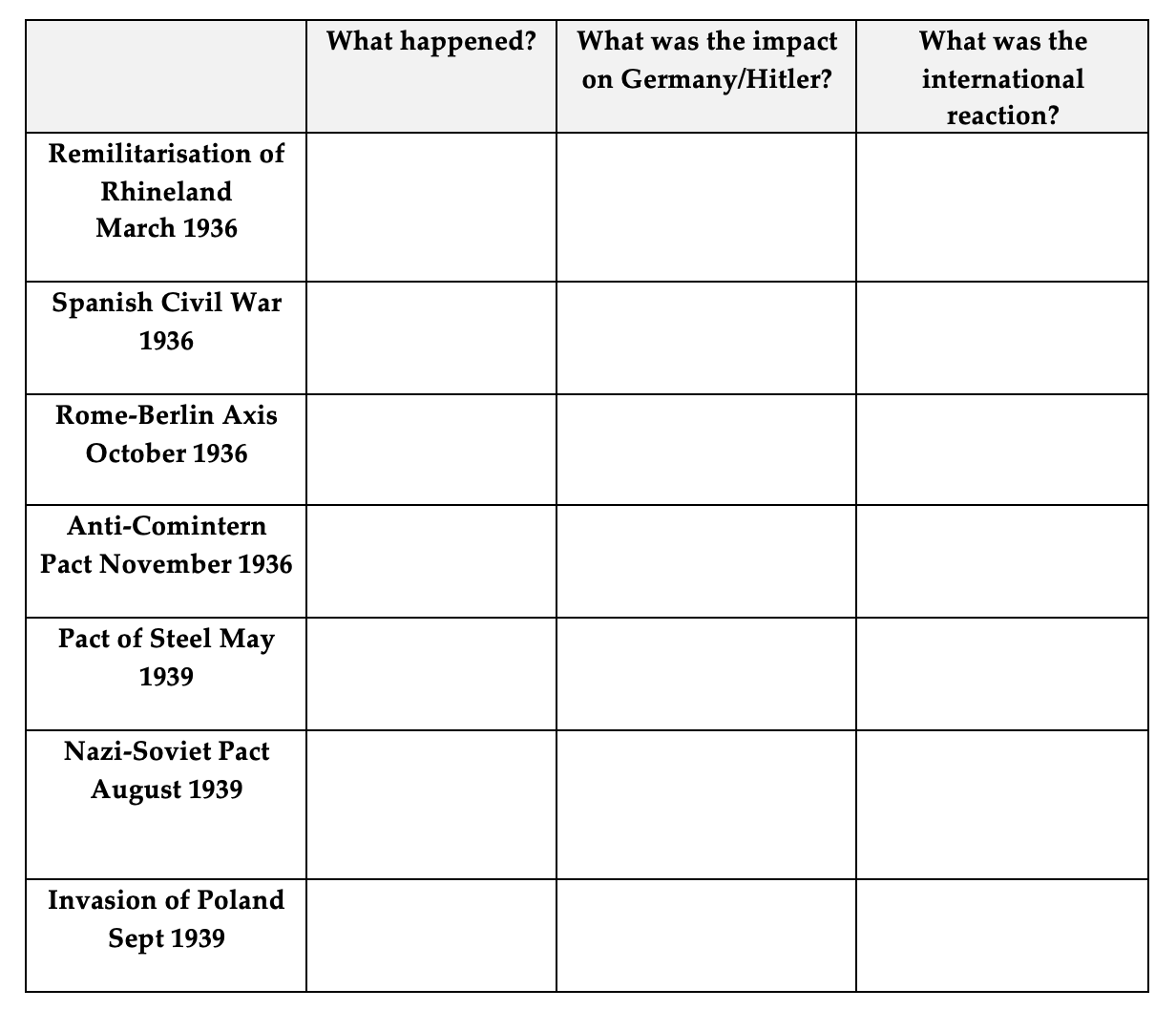
Extension activity: As a class, debate this issue; one side should argue that Hitler had a clear plan and the other side should argue that he was an opportunist taking advantages of events as they arose.
Although Mussolini had made it clear that Italy was not ready for war in 1939, and despite , Hitler launched his invasion of Poland on 1st September 1939.
Hitler seemed to believe that the the western reaction would stop short of a declaration of war.
Hitler prepared his forces for an invasion of Poland, despite Britain and France’s guarantee of Polish sovereignty in March 1939
- Hitler was surprised when Britain and Poland had signed a full military alliance on 25 August.
- Mussolini also informed him that he was not ready for war.
- Hitler then delayed attack planned for 26 August until 1 September.
- Germany hoped divisions would develop and he sent a proposal to Britain - guaranteeing the British Empire in return for giving Germany a free hand in Danzig and the Polish Corridor.
- Britain did not accept this.
- Poland refused further negotiation.
- On 31 August, Mussolini proposed a conference to resolve the crisis.
On 31st August, Germany claimed oneof its wireless stations near the Polish border had been attacked by Poles.
In reality, SS soldiers dressed in Polish uniforms had staged the attack and bodies of convicted criminals were left in situ dressed in Polish uniforms.
This 'Polish attack' was the excuse for war. At 4.45am on 1 September 1939, German troops invaded Poland and German planes bombed Warsaw.
The outbreak of war
- On 3 September, British government presented an ultimatum to Germany - to withdraw its forces by 11.00am.
- When no response came, Britain and France declared war.
Hitler's 'local' war on Poland had unleashed the Second World War in Europe.
Your class will devise a role play of the events that led to the outbreak and the development of the European conflict between 1939 and 1941.
Your role play will be set in a Newsroom in a neutral country. You should assign roles for the ‘news anchor’, foreign correspondents in different European countries, a correspondent in China and Japan and two correspondents in the US.
Begin by researching the timeline of events between:
September 1938 December, 11th 1941
Nazi Soviet Pact__________________________________________Hitler declares war on US
Each correspondent then gives a ‘live report’ on events as they happen, and the newsroom team provides an ‘analysis’ of the impact of these developments on the European conflict.
 Twitter
 Facebook
 LinkedIn