
 IB Docs (2) Team

6. The fall of the Tokugawa Shogunate, 1853 to 1868
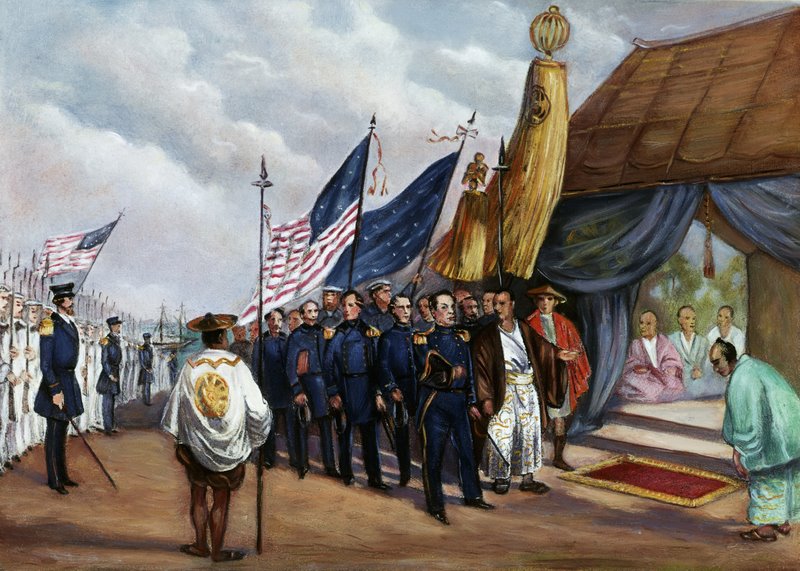
While the bakufu were struggling with the social and economic problems discussed on the previous page, a foreign crisis developed which brought matters to a head. The arrival of Commodore Perry from the US and his demands that Japan open up for trade created a domestic crisis which resulted in the end of the Tokugawa Shogunate and the start of the Meiji Restoration.
Guiding questions:
What was the relationship between Japan and other nations before 1853?
What was the impact of Commodore Perry's expedition on Japan's seclusion policy?
Why did Perry's arrival cause a crisis in Japanese domestic politics?
What was the significance of the Meiji restoration?
1. What was the relationship between Japan and other nations before 1853?
 Curious Japanese watching Dutchmen lodging in the Nagasakiya Inn in Edo. During the Edo period, the chief of the Dutch trading post Dejim had to travel to Edo to express the gratitude of the Dutch East India Company at the court of the shogun. During their stay in Edo they lodged in an inn called Nagasakiya in the quarter Hongokuchō.
One of the key control measures that had been set up by the founders of the Tokugawa system was strict management of foreign relations; this involved limited contact with the outside world. In 1637, the Shogun ordered that no Japanese person should ever leave the country and foreigners were banned from entering Japan. However, this did not initially involve total isolation. There was trading and contact with the Dutch in the port of Nagasaki and trade with China, the Ryukyus and Korea. All of this allowed the Shogunate to gain news of the outside world. In the 18th Century Western books circulated in Japan and 'Dutch scholars' were familiar with western science and technology. Thus by 1850, there were iron works in the Choshu and Satsuma domains, factories making guns in Mito and Satsuma, textile mills and other innovations which had come from Japanese contacts with the Dutch.
Task One
ATL: Thinking skills
Read the following source from Japanese historian, Toru Haga.
Why, according to this source, can the Tokugawa's seclusion policies be seen as 'brilliant'?
Seclusion eliminated the factor of instability in foreign relations and let the shogunate focus its energies on perfecting the administrative setup. At the same time the country wasn't really walled off..The shogunate could bring in the things it needed and keep out what it didn't. It could take in all the information it found useful without letting out any information it didn't want to. In this way it ensured the nation's security, both externally and internally. It was brilliant...'
Haga, Toru, 'Reexamining the Era of National Seclusion', quoted in Pyle, The Making of Modern Japan, pg 58
However, with the increasing encroachment of western powers into the Far East in the 19th Century, the seclusion policy became more restrictive and more xenophobic with the bakufu announcing that Westerners would be expelled by force. In its Expulsion Edict of 1825, the bakufu declared that Western barbarians 'have become steadily more unruly, and moreover, seem to be propagating their wicked religion among our people...Henceforth whenever a foreign ship is sighted approaching any point on our coast, all persons on hand should fired on and drive it off.'
2. What was the impact of Commodore Perry's expedition on Japan's seclusion policy?

Starter:
What impact had the West had in China by 1850? What was likely to be the reaction of the Japanese to such events?
What international factors threatened the isolation and stability of Japan by the middle of the 19th Century?
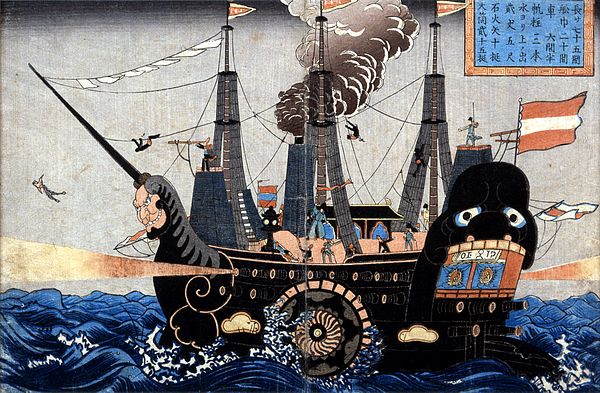
Although it was Britain that had forced China to open up to trade, it was in fact not Britain that became a threat to the bafuku's policies by the middle of the 19th Century, but rather the US.
The Americans were interested in Japan for two reasons:
- As they expanded their territories westwards, and Oregon and California became part of the USA in 1848, the Pacific Ocean became a sphere of interest
- US ships needed a place where they could take on fresh provisions for ships trading between China and San Francisco across the vast expanse of the Pacific Ocean.
The video below gives another reason as well.
Task One
ATL: Thinking skills
Watch the following video (History of Japan's ancient and modern empires) from 2 hours 31 until 2 hours 43; this section covers the arrival of Commodore Perry and the impact of his arrival on Japan. Answer the questions below.
1. What factors made the US interested in Japan, according to the video?
2. Why was Perry's fleet bound to be intimidating to the Japanese?
3. What was the reaction of the Shogunate? (Why was this a problem do you think?)
4. What was Perry's response? Why?
5. How did the Japanese population react to Perry's visit?
6. What internal problem made the crisis worse?
7. What are the 'two positions' that are set out by the daimyo? What was the rationale of each position?
8. What was the agreement that was made? Why did 'both sides get what they wanted'?
Task Two
ATL: Thinking skills
Read the letter that Commodore Perry brought to the Shogun from President Filmore. The letter can also be found here.

- How would you describe the tone of the letter?
- What tactics are used in the letter to persuade the Japanese to accept their terms?
- How do you think the Shogun would have responded? In pairs, write a response to President Fillmore from the Shogun.
(You can read the actual response here)
When Perry returned in 1854 with twice as many ships, the bakufu agreed to negotiate. As a result the Treaty of Kanagawa was signed. In this Treaty, the Japanese agree to:
- open up the isolated ports of Hakodate and Shimoda to ships from the USA
- allow Americans to station a consul in Shimoda
- treat shipwrecked sailors well
- give the USA 'most favoured nation' status'
This treaty was quickly followed by other treaties with Britain, Russia and Holland. The Shogun believed that he had prevented the full-scale opening up of Japan for trade. However, in the succeeding years, pressure was put on Japan to open up fully and grant more concessions. The American consul, Townsend Harris played a leading role in this and the result was the Harris Treaty of 1858; this became the model for similar treaties signed in the following weeks with Britain, France, Holland and Russia:
- Edo, Kobe, Nagasaki, Niigata, and Yokohama were opened to foreign trade
- Japanese tariffs were placed under international control and import duties were fixed at low levels
- a system of extra territoriality was established, which provided that foreign residents would be subject to their own consular courts rather than to Japanese law
Task Three
ATL: Thinking skills
1. What was the significant difference between the Treaty of Kanagawa (1854) and the Harris Treaty of 1858?
2. In pairs, compare the treaties signed by China after the Opium Wars and the treaties signed by Japan following the Harris Treaty. What were the similarities? What were the differences?
3. Why did Perry's arrival cause a crisis in Japanese domestic politics?
Task One
ATL: Thinking skills
- What, according to these sources, were the effects of the 'unequal' treaties for Japan?
- Discuss in pairs how far the actions of the Shogun in response to Perry had weakened his political position
These unequal treaties imposed for the first time in Japan's history extensive restrictions on its national sovereignty, and, while they did not require the cession of any territory...placed Japan in a semi-colonial status. In the long run the treaties became a symbol of the national impotence that was exposed by renewed contact with the West, and recovery of national independence and international respect became an overriding goal..In the short run the treaties ignited political conflict that destroyed bakufu authority...'
Pyle, The Making of Modern Japan, pg 66
The events of the summer of 1858 marked the beginning of modern nationalism in Japan....enforced acceptance of the treaties brought a new awareness of a foreign threat directed at something larger than the villages or domains that most Japanese described as 'home'. the Treaties, after all, applied ot everyone...A recognition of political unity slowly spread, first from major centres to the provinces, then from samurai to other sections of the population. It was given focus by the call to 'honour the emperor'.
W. G. Beasley, The Japanese Experience, 1999, pg 196
As you will have seen from the video, there were two responses to Perry's demands: the kaikoku (open country) school and the sonnō jōi (revere the emperor and expel the barbarian) school. The former was linked with the 'Dutch learning' (see previous page) and saw opening up Japan as an opportunity to gain Western weapons and technology and thus to ultimately create a strong and independent japan. The sonnō jōi, however, believed that opening up Japan would bring political and cultural disaster; it was inspired by the Mito School (see previous page) which had a zealous commitment to the imperial institution as the mystic embodiment of the Japanese nation and was also intensely xenophobic.
Perry's arrival opened up this debate. It also brought the discontent of the samurai (discussed on the previous page) to the fore; the argument for promoting men of talent now became more relevant than ever and in many domains, young samurai now became involved in politics. Many of these lower rank activists became known as 'shishi' (men of spirit).
After the signing of the Harris Treaty, rage that had originally been directed against foreigners was now vented against the Shogun and the bakufu and a determination to get rid of the incompetent and 'evil' officials. There now followed 14 years of conflict in Japan dominated by the actions of the Chōshū and Satsuma clans.
Both the Chōshū and Satsuma clans came from outer domains and had been excluded from central government and generally distrusted by the shogunate. They thus had a history of hostility towards the shogunate. In addition, however they were strong, financially solvent domains where the morale of the samurai remained strong. Their financial strength enabled them to buy rifles, cannons and ships in the 1860s.
Task Two
ATL: Thinking and research skills

Research the actions of shishi activist Yoshida Shoin and his influence on Chōshū samurai. You will find this site useful.
At first the two clans were rivals with different views of how to solve the crisis, though both were anti-foreigners. However, both experienced foreign military might in separate local conflicts with Britain and with a combined international force in 1863–64. This brought the painful realization that simply “expelling” the foreigners was impossible. To prevent Japan becoming a colony, it was necessary to rapidly construct a modern state and to prevent the reassertion of Tokugawa supremacy. In 1866, the former rival domains secretly formed the Satsuma-Chōshū Alliance.
The Shogun sent an army against them but was defeated thus weakening his position further. A year later, in 1868, the two domains openly joined forces; they seized the imperial palace on January 3, 1868 and had the boy Emperor, Mutsuhito (later known as the Meiji Emperor) proclaim the end of the Tokugawa regime and the restoration of imperial rule. The ensuing battle with the bakufu army (the Boshin War), saw the Shogun's forces surrender thus ending Tokugawa rule.
Task One
ATL: Thinking skills
Watch the following video covers these events in more detail:
In January 1868 the daimyo were summoned to Kyoto where they were told that political power had been restored to the Emperor. The next year, the capital was moved to Edo, which was then renamed Tokyo. From this time on, the building of a modern state, Meiji Japan, began.
Task Three
ATL: Thinking skills
In April 1868, the Emperor issued the 'Five Articles Oath', sometimes referred to as the Charter Oath.
What does each of these oaths suggest about the future direction of the new government? How would each one impact on the Tokugawa system?
1. Deliberative assemblies shall be widely established and all matters decided by public discussion
2. All classes, high and low, shall unite in vigorously carrying out the administration of affairs of state
3. The common people, no less than the civil and military officials, shall each be allowed to pursue his own calling so that there may not be discontent
4. Evil customs of the past shall be broken off and everything based upon the just laws of nature
5. Knowledge shall be sought throughout the world so as to strengthen the foundations of imperial rule
4. What was the significance of the Meiji restoration?

Meiji emperor moving from Kyoto to Tokyo
There has been much discussion among historians on the causes, nature and significance of the Meiji Restoration.
Task One
ATL: Thinking and communication skills
Before looking at the views of historians, discuss in pairs whether you consider the Tokugawa Shogunate to have been carried out by:
Conservatives
Reactionaries
Radicals
Nationalists
Representatives of the popular will
Consider who carried out the change in government, their purpose and their actions
Task Two
ATL: Thinking skills
Now read the views of historians regarding the different interpretations of the Meiji Restoration below. Which of these interpretations do you agree with?
If however these men, as Albert Craig argues, were only looking backwards, why then did they not rebuild another bakufu? Why did they in fact destroy the feudal system? To answer these question, other historians emphasise the nationalism of the new ruling elite and their determination to make whatever changes were necessary to restore national sovereignty and national defense. William Beasley thus called it a 'nationalist revolution'.
A radical revolution?
Many other historians, however, argue that in addition to a patriotic desire to respond to the foreign crisis, the Restoration was motivated by radical dissatisfaction with the domestic social order. They argue that radical thinkers in Tokugawa Japan had already been arguing for revolutionary changes similar to the ones that were carried out later under Meiji. In addition, there was popular discontent with the existing situation which took many forms: new religions, urban riots, peasant uprisings. Historian George Wilson writes, 'The samurai elite and the popular movements were simultaneously groping for a new and stable order in Japan'. It was this strong and purposeful leadership that the new government set about establishing in 1868 by '..suppressing many of the signs of disarray and malaise, consolidating power, and creating a national ethic that would answer the popular need for surety ad direction.' (Pyle). In this interpretation, the role of the foreign crisis was to bring into sharp focus the impotence of the old system and to prompt revolutionary action to create a new order.
Task Three
ATL: Thinking and communication skills
Work in pairs to decide how you would explain the overthrow of the Shogunate in 1868. Use the diagram below - or create your own infographic to show how long-term and short-term factors played a role in the collapse of the system.
Overall, which factor/s do you consider to be most important; use historians' views to support your points.
You can use this to help you with planning an essay on this topic on this page: 7. Challenges to East Asian societies: Essay planning

 Twitter
 Facebook
 LinkedIn