
 IB Docs (2) Team

1. Causes of the Spanish Civil War
Test your knowledge on the causes of the Spanish Civil War by doing the interactive quiz below.
During the political upheavel in Spain in the 19th century which of the follow type of government did not have power?
Which foreign power had intervened in Spain to restore a regime in the 19th century?
On which side did Spain fight in the First World War?
How many governments were there in Spain between 1918 and 1923?
Which general came to power with the support of the King in 1923?
After the defeat of the Spanish army at Anual in Morocco a parliamentary inquiry was launched which potentially would have exposed significant failings by the government and the military. To avoid this, and to prevent a major political crisis, General Primo de Rivera established a temporary military dictatorship. De Rivera retained the monarchy, and received the backing of King Alfonso. The dictatorship was formally ended in 1925, but de Rivera remained as prime minister of a military government.
Which of the following was not a success for de Rivera's regime?
What global crisis led to de Rivera facing an economic crisis in Spain?
As well as foreign debt and the impact of the Great Depressionhere there were other key failures of de Rivera's regime:
- Social justice reform of fiscal system was defeated by banking sector. De Rivera had wanted to tax capital as well as wages
- Economic growth based on world trade boom between 1923 and 1929, economy enters period of crisis after Wall Street Crash in 1929 and ensuing global depression
- Great Depression impacted Latin America badly and this damaged trade with Spain’s key partners
- Government borrowed heavily to finance infrastructure projects
- De Rivera overvalued the Peseta before being forced to accept a significant devaluation
- The socialists withdrew support from the government as workers living standards fell
- Censorship and promotion of the influence of the church in higher education alienated the liberals and intellectuals
- Opposed regional autonomy and reduced Catalonia’s independence by banning the use of Catalan in religious services.
- Only introduced very limited land reform – opposed extensive interference in land ownership in the countryside
- Nationalists were disappointed by his failure to extend Spain’s north African territories and by his failure to gain Spain a permanent seat on the Council of the League of Nations
- The army was hostile to the disbandment of the Artillery corps
When did Primo de Rivera resign?
Primo de Rivera resigned in January, 1930 after failing to gain backing from his generals. King Alfonso XIII then appointed another general to replace de Rivera. This was a mistake, as his choice was the elderly General Berenguer who inflamed political opposition by initially promising a general election and then postponing it for a year. The monarchy, which had been damaged by the demise of de Rivera’s regime, which it had backed, was now further undermined by the indecisiveness of Berenguer. Republican opposition strengthened; had the king had restored the constitution in 1930 the monarchy may have survived.
When was Spain's Second Republic established?
In August 1930 representatives of the Republican organizations signed the Pact of San Sebastián, and after municipal elections had shown support for the San Sebastián pact’s coalition of parties (Republicans, Liberals, Socialists, and Catalans), the king went into voluntary exile. The army did not intervene and a relatively peaceful revolution transpired. The Second Spanish Republic was established in April 1931.
Who won the elections that followed the King's exile in April 1931?
The new government drew up a new constitution which described Spain as a ‘democratic republic of workers of all classes’. The constitution established:
- the Cortes would be elected every four years
- there would be universal suffrage for both men and women
- there would be a president as head of state,
- there would be freedom of worship for all religions.
Which of the following was not an economic reform of Manual Azana's left-coalition goverment between April 1931 - November 1933?
These economic reforms came with key challenges:
- Great Depression meant government had insufficient funds to finance reforms.
- Land reforms only benefitted 7,000 families as government could not afford compensation to landowners.
- Violence increased in the countryside. The anarchists viewed the land reforms as far too limited and a failure. In Casas Viejas the assault guard killed 25 anarchists.
- The removal of church run schools meant the government had to try to fund the building of new schools and the training and payment of teachers.
- The military reform did not save the government money as retired officers retained full pay
Which of the following was not a socio-political reform of Azana's government up to 1933
These reforms led to the following issues:
- Catalan autonomy undermined the unity of the state and was opposed by conservatives
- Right wing elements of the army opposed regional autonomy
- The royalist Carlist movement gained new support for its aim to restore the monarchy under the claim of Don Carlos.
- The socialists were disillusioned by what they saw as very limited reforms under Azana.
- Government inflamed opposition within the military as its threatened compulsory retirement if there was a lack of volunteers
- The military reforms had far reaching consequences as the officers that refused early retirement tended to be more political and highly nationalist and opposed to the Left Republics reforms
- Strong opposition from the church as its interests were threatened
- Government failed to manage the expectations of the working classes for example, better health care
Which political party was established to protect the interests of 'landowners and the Church'?
The CEDA, led by Gil Robles, was an authoritarian right wing party set up in February 1933. It had a manifesto that promoted and protected the church, opposed the republic, and supported the property owners and conservative peasantry.
Which general attempted to seize power in a failed coup in 1932?
After the coalition on the centre-left fractured and Azana resigned, who won the general election in November 1933?
When was the Asturias miners uprising?
Asturian miners' strike of 1934 was a major strike by regional miners against the 1933 Spanish general election, which redistributed political power from the leftists to conservatives in the Second Spanish Republic. The conservative Spanish Confederation of the Autonomous Right (CEDA), secured a parliamentary majority
- Strike lasted two weeks from 4 October to 19 October 1934 in Asturias.
- Initial strike developed into violent revolutionary uprising - protestors took over the province of Asturias by force and killed a large number of region's police and religious leaders.
- The rebellion was brutally crushed by the Spanish Navy and the Spanish Republican Army, with Franco and the Africanistas deployed with ruthless efficiency.
When was the fascist Falange party established in Spain?
Which of the following was not a policy of the right-coalistion governmnent up to 1936?
Who was the leader of the CEDA?
What was the name of the coalition that won the elections of February 1936?
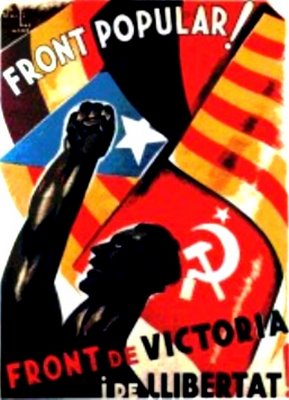
In the elections that followed the collapse of the Right Republic imbued with financial scandals, a Popular Front government was brought to power. The Popular Front was a coalition of anti-Fascist groups which included socialists and communists as well as center left parties and liberals. Azana returned to lead the government, initially as the prime minister and then as president, and he wanted to restore the reforms of the 1931–1933 regime.
Which leftist party refused to join Azana's coalition?
The Popular Front government faced political problems from the start as Caballero’s radical socialists refused to join it and the right wing groups would not accept the restoration of reforms.
What was Azana's response to the Anarchists encouraging peasants to seize land, increasing violence in the countryside?
Which trade union called a general strike in May 1936?
Whose murder triggered the general attempted coup?
Military officers began planning a coup to seize power when the victory of the Popular Front in the elections was announced. Gil Robles also offered support and funding for a coup. An extreme nationalist group of junior officers joined with senior Africanista officers, including General Mola. The conspirators used the murder of a popular right-wing leader, José Calvo Sotelo, on 13 July 1936 as the catalyst
How had Azana attempted to diffuse the general plot?
Azaña had known that there were plans for a coup but he was unable to prevent it. The officers had the support of the fascist Falange, the CEDA, and the monarchist ‘Carlist’ and ‘Alfonsist’ groups. On 17 July, the revolt began in Morocco and quickly spread to the mainland. The conspirators were successful in taking Cantabria and parts of Andalusia. However, the coup failed to take control of the main industrial areas nor the capital, Madrid. In addition, half of the Spanish army remained loyal to the Republic.
It was the failure of the coup, and the resistance of the Republic that turned the revolt of the officers into a civil war.
 Twitter
 Facebook
 LinkedIn