
 IB Docs (2) Team

1. Origins and rise of Vietnam's independence movement
.svg.png) Vietnam's independence movement had its roots in resistance to Chinese rule but it was the fight against French colonial rule that created a unified nationalist movement under Ho Chi Minh. However, the route to independence for Vietnam involved not only eliminating French influence in the country but also American influence when the US, which saw Vietnamese independence under Communist Ho Chi Minh as part of the wider Cold War conflict, intervened to prevent Ho Chi Minh controlling the whole of the country.
Vietnam's independence movement had its roots in resistance to Chinese rule but it was the fight against French colonial rule that created a unified nationalist movement under Ho Chi Minh. However, the route to independence for Vietnam involved not only eliminating French influence in the country but also American influence when the US, which saw Vietnamese independence under Communist Ho Chi Minh as part of the wider Cold War conflict, intervened to prevent Ho Chi Minh controlling the whole of the country.
Guiding questions:
Theme One: Origins and rise of independence movements
Background: Growing nationalism under Chinese rule
How and why did nationalism grow under French rule?
What was the impact of communist ideology and the Second World War?
What was the impact of wars against the Japanese and the French on the independence movement?
Why did the Cold War lead to US intervention and what impact did this have?
Theme One: Origins and rise of independence movements
Background: Growing nationalism under Chinese rule
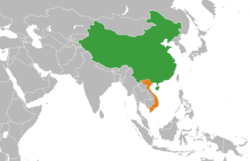
Vietnam's history has always been influenced by its proximity to China.
The original Vietnamese state, Nam Viet (Nam meaning South) was first established in the Red River Delta around 207 BC. However, in 111 BC Nam Viet was conquered by the Chinese Emperor and became a province of China.
As a province of China, paying taxes to the emperor, Vietnam was dominated by China for a thousand years; indeed Vietnam's ancient name in Chinese, Annam, literally means 'pacified south'. The Chinese introduced Confucianism to Vietnam and Vietnamese competed in the Chinese state examinations and obtained posts in the imperial government of the Chinese Emperor. Buddhism also came to Vietnam through China.
Confucianism brought with it the mandarins, the emperor's officials who carried out the administration of the country. They were not popular and the Vietnamese frequently rebelled against Chinese rule. Although they were crushed, these rebellions nevertheless fostered a sense of nationalism.
Task One
ATL: Thinking skills
1. Using the National Geographical site, make notes on the key ideas underpinning Confucianism
2. How, according to the following source, did Confucianism help the Chinese Emperors to dominate Vietnam?
3. What, according to this source, was the impact of Chinese rule on Vietnamese society?
Confucianism was introduced into Vietnam during its period of domination and was used by the Chinese as an effective way of controlling their citizens. it was also very useful to the Vietnamese emperors later on, as it helped them retain power by reminding the citizens of their place in society. Under Confucianism, society was strictly organised. Everyone knew their place in this society, and had obligations to those below them and duties to those above them; women had only duties. The emperor was obliged to look after his people and the people had to pay their dues to the emperor . The emperor was said to have the Mandate of Heaven to govern the country, which meant he was approved by the gods as ruler. This made it very hard for ordinary people to oppose him...Vietnam society developed into two distinct groups: a Confucian elite, which was the ruling class and Chinese influenced, and the peasant masses.'
Conflict in Indochina, Ian Sutherland, Nelson, 1993, pg 21
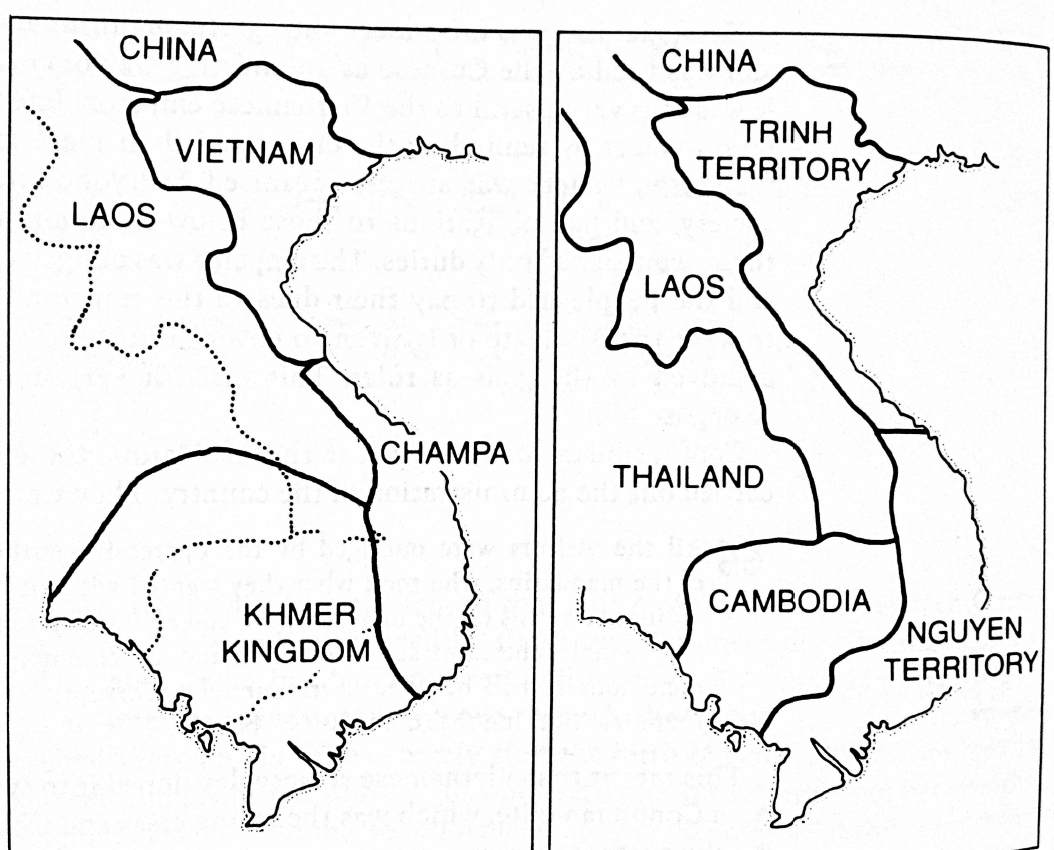 After the Chinese were finally expelled in 939 AD, the Vietnamese faced threats from the Chams and the Khmers. However, the Vietnamese were able to push South over the next 600 years with settlers following their successful soldiers and taking over the villages. By 1708, the Vietnamese were in control of all the southern provinces; however they now turned on themselves in civil war. The Nguyen and Trinh families fought each other for fifty years from 1620, before dividing the country between them. Fighting began again in 1771 with the Tay Son Revolt, and lasted until the Nguyen dynasty was finally unified with Nguyen Anh setting himself up as the Emperor Gia Long.
Emperor Gia Long (1802 - 1820) is considered the first unifier of Vietnam. A road was built along the coast linking Hanoi, Hue and Saigon, a distance of 1600 kilometres. Hue became the capital. The Nguyen dynasty lasted until 1955 ending with the last Vietnamese emperor, Bao Dai.
How and why did nationalism grow under French rule?
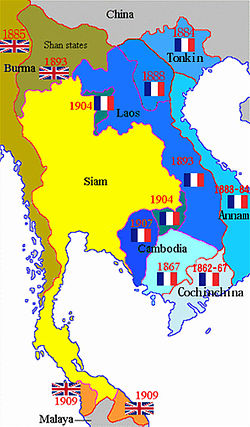 Map showing the gradual takeover of Indochina by the French
http://gorhistory.com/hist111/vietnam.html
During the 19th Century, the French replaced the Chinese as the greatest threat to Vietnamese independence. Traders had tried to establish relations with Vietnam but without much success and had largely given up by 1700. French missionaries had much more success. The first missionaries arrived in the 1630s and by 1800 had been successful in converting hundreds of thousands of Vietnamese. The missionaries were backed by the (French) East India Company who hoped to gain economic benefits via the influence of the missionaries. When, in 1830, the Vietnamese emperors started to persecute the French missionaries, the excuse was provided for French political and military intervention. Poor government by the Emperors made it easier for the French to extend their influence. By 1887, the countries now known as Vietnam, Laos and Cambodia were under the control of the French.
The French wiped out any trace of Vietnam as a single unified country. Cohinchina, Cambodia, Annam and Tonkin were brought under a new entity called the Indochina Union, administered by a French Governor General headquartered in Hanoi.
Cochina had special status and privileges, ruled as part of France by a French Lieutenant-Governor. it was allowed to send representatives to the French National Assembly in Paris. The Vietnamese of Cochinchina were French citizens. However Tonkin and Annam were not given these privileges or made part of France. In Annam the Vietnamese emperor was allowed to maintain a court at Hue.
Task One
ATL: Research skills
Using the following brief video clip as a starting point, research the impact of French rule in Indochina. Prepare a brief presentation on your findings. (Note also see the first few minutes of the video below, 'Uncle Ho and Uncle Sam' for some interesting insights into French colonial rule).
Consider:
- Land ownership
- Economic impact
- Social impact
- the role of Emperor Bao Dai
For each factor also investigate the impact that French policies had on encouraging a growth of nationalism.
The Vietnamese never passively accepted French rule, and there were many outbreaks of violent resistance all put down harshly by the French. The first serious rebellion was the Scholars' Revolt. This was led by 'traditionalists' who opposed the French because of their attempts to restructure the traditional Confucian systems; they fought for a return to a Vietnamese way of live. However this revolt was crushed - as were other traditonalist revolts.
In the early 1900s, a nationalist leader, Phan Boi Chau emerged. He formed Duy Tan Hoi (Reform Association) which was the first nationalist organisation in Vietnam. Initially, Phan advocated modernisation on the Japanese model. However, following the Chinese Revolution of 1911 he advocated a democratic republic on the model of Sun Yat-sen. His attempts at uprisings failed; nevertheless, his ideas are indicative of a new urban class of well educated young Vietnamese with ideas from the West which were becoming a serious threat to the French.
The First World War gave impetus to the growth of Vietnamese nationalist feeling; indeed Ho Chi Minh went to the Versailles peace conference hoping to get the support of President Wilson who had advocated self-determination for all peoples as part of his Fourteen Points.
The early 1920s saw several attempts to establish moderate political parties in Vietnam. These parties achieved little political progress for the Vietnamese who then turned to more radical forces; the VNQDD (Vietnamese Nationalist Party) and the ICP (Indo-Chinese Communist Party). The former party did not survive for long; however the ICP under Ho Chi Minh went on to become the main opposition force to the French and then the Japanese during the Second World War.
What was the impact of communist ideology and the Second World War?
Task One
ATL: Thinking skills
Read Ho Chi Minh's speech on the founding of the Communist Party of Indo China which can be found here and then answer the following questions:
- At which groups in society is Ho Chi Minh aiming this statement? Why would it appeal to them?
- How does Ho Chi Minh interpret the events and aftermath of the First World War?
- Which aspects of his policies can be seen as nationalist and which can be seen as Communist?
Attempts by the ICP to resist the French in the 1930s were largely frustrated. However, it survived and went went underground. When the Japanese took over Indochina in the Second World War, it was Ho Chi Minh who took the lead in resistance. He set up a 'soviet' in the mountainous area just south of the Chinese border. In May 1941, he called a meeting to form the League for Vietnamese Independence, the Viet Minh.
Task Two
ATL: Thinking skills
Read the following speech by Ho Chi Minh on the founding of the Viet Minh in 1941 (click on the eye)
- At which groups is Ho aiming this speech? How is this different form the speech that you read in Task One? Why do you think this is?
- How is the language different to the speech in Task One?
- Is the emphasis on nationalism or Communism? Why do you think that this is?
The Viet Minh fought against the Japanese, led by Vo Nguyen Giap who trained military groups and spread propaganda. They were also helped by the Americans who airdropped weapons to them. By June 1945, they had taken over six northern provinces from the Japanese.
Task Three
ATL: Thinking skills
Watch the following Timewatch video: Uncle Ho and Uncle Sam which gives a fascinating insight into the French attitude towards Vietnam and the relationship between Ho Chi Minh and the Americans during the Second World War.
Answer the following questions:
- What was the French attitude towards Vietnam?
- Why did the Americans decide to ‘make use’ fo Ho Chi Minh during the war?
- How did Ho help the Americans?
- What aid did the Americans give to Ho and Giap?
- What seems to have been the attitude of the Americans towards Ho?
- What was the attitude of Ho and Giap towards the Americans?
- What did Ho want from the Americans after the Second World War?
- Why did Truman agree to support French in their claim to Vietnam?
- What triggered the war between the French and the Viet Minh?
Following Japan's defeat, Ho acted quickly to seize the initiative to take power before the French could return. Emperor Bao Dai sent a message to the French advising them not to return. He then asked the Viet Minh to form a government, before he abdicated as emperor. In Confucian terms, the Mandate of Heaven was being passed from Bao Dai to Ho Chi Minh. On 2 September in Hanoi, Ho proclaimed the formation of the Democratic Republic of Vietnam, with himself as President, and issued a Declaration of Independence.
The possibility of independence now seemed a reality especially due to the fact that, after 1945, both the US and the Soviet Union stated opposition to imperialism and the ideological concepts underpinning it. The notion of empire was further undermined by the founding of the United Nations in 1945 as it emphasised human rights, freedom and self-determination
Task Four
ATL: Thinking skills
Read Ho's Declaration of Independence which can be found here
- Why do you think Ho Chi Minh quotes from the American and French Declarations?
- What arguments does he give as to why the Vietnamese should have independence?
- What is notably missing from this speech?
Task Five
ATL: Thinking skills
Review in pairs the factors that led to the growth of nationalism in Vietnam before 1945. Consider the impact of the following:
- Chinese rule
- French political policies
- French economic policies
- French social policies
- War between Russia and Japan 1905
- The First World War
- The Second World War
- Communist ideology
What was the impact of wars against the Japanese and the French on the independence movement?

Declaration of Independence, 1945
As you have seen, Vietnamese nationalism developed as a result of Chinese and then French rule, along with the impact of the two World Wars. And the Declaration of Independence made it clear that Vietnam was now a country ready and able to rule itself.
However, despite Ho's declaration of independence, the Allies (Britain, USA, USSR, China) had agreed that on the defeat of Japan, Indochina should be temporarily occupied by the Chinese Nationalists north of the 16th parallel and by British troops to the South. On their arrival in Vietnam, the British, under the command of General Gracey, refused to deal with the Viet Minh (despite the Viet Minh arranging for a friendly reception for the British) and in fact set about attacking the Viet Minh. By 1946 Gracey's forces had at least temporarily destroyed the Viet Minh in the south of Vietnam and had allowed the French to return.
In the North, the Chinese forces initially recognised Ho but then in February 1946 recognised French sovereignty over Indochina and withdrew their forces. Although Ho was against the French taking over, he preferred this situation to that of Chinese control. 'It is better to sniff French dung for a while than eat China's all our lives', he is reported as saying.
Ho and the French made an agreement whereby France recognised Vietnam as an independent state within the French Union and Ho would allow 25,000 French troops to remain in Vietnam. However this was seen by both sides as unsatisfactory and temporary. The French wanted to regain Indochina to restore their pride after the occupation in the Second World War; they also saw it as their duty to bring the benefits of civilisation to the 'inferior' Vietnamese. Ho went to France to negotiate but got nowhere; however it did give the Vietminh time to recover and grow in strength.
Despite promises during the Second World War to support independent nations and Roosevelt's anti-imperialist stance mentioned above, Truman supported the French return to Vietnam. Ho Chi Minh made requests for help from the US (as you will have seen in the video above). He asked for US recognition for his Democratic Republic of Vietnam and when this failed, eventually persuaded the Soviets and the Chinese to recognise his state. This, along with the intensification of the Cold War and its spread from Europe to Asia, domestic pressure from the Red Scare within the US and the need for French support for NATO, caused Truman's support for the French to grow.
Task One
ATL: Thinking skills
Read the telegram below which was sent from Ho Chi Minh to President Truman
- What is the tone of this telegram?
- Why does Ho Chi Minh mention the Atlantic Charter and San Francisco Charter?

Task Two:
ATL: Thinking and self-management skills
Complete the following mind map to show the Truman's motives for supporting French aims in Vietnam. You will need to research the development of the Cold War in Europe and Asia as well as the Red Scare in the US (see 1. Containment under Truman and Eisenhower (ATL) and 2. American policy in Vietnam (ATL) )

Task Three
ATL: Thinking skills
1. Using the information above and your own research, discuss the causes of the French Indo-China War that started in 1946. Create a mind-map to show the causes.
You can use this to help write the essay. See 7. Cold War Conflicts in Asia: Essay writing frames and exercises
2. Read this article from Council of Foreign Relations which discusses the 'What if..?' question as to what might have happened if the US had accepted Ho's declaration of Independence in 1945.
The methods used by the Viet Minh to achieve victory against the French are discussed on the next page. However, key to this first theme is the fact that the success of the Vietnamese against the French developed nationalist feeling further in Vietnam.
Task Four
ATL: Thinking skills
The following source is taken from an interview with Giap following Dien Bien Phu. (see the link below for the full interview). According to Giap, what is the significance of Dien Bien Phu?
Q: What do you think about the significance of Diên Bin Phû for the world?
Giap: The history of the Vietnamese people goes back thousands of years. During that time we've repelled thousands of invaders. Only, in former times the countries that tried to invade us were on the same economic level as we were. Theirs, like ours, was a feudal society. That was the case, for example, when we fought the Chinese in the 13th century. But Diên Bin Phû was a victory in another era. What I mean is that in the latter half of the 19th century, when western imperialism divided the world into colonies, a new problem emerged. How could a weak, economically backwards people ever hope to regain its freedom? How could it hope to take on a modern western army, backed by the resources of a modern capitalist state? And that's why it took us 100 years to fight off the French and French imperialism. Diên Bin Phû was the first great decisive victory after 100 years of war against French imperialism and U.S. interventionism. That victory that put an end to the war and marked the end of French aggression. From an international point of view, it was the first great victory for a weak, colonized people struggling against the full strength of modern Western forces. This is why it was the first great defeat for the West. It shook the foundations of colonialism and called on people to fight for their freedom -- it was the beginning of international civilization.
http://www.pbs.org/wgbh/peoplescentury/episodes/guerrillawars/giaptranscript.html
Following the defeat of the French, an international conference was held in Geneva to draw up a peace agreement. Significantly the US did not attend this conference.
Task Five
ATL: Thinking skills
Read the terms of the peace agreement below (click on the eye) They can also be found here.
What was decided about
- the French role in Indochina
- the status of the 17th parallel which divided the country into two zones
- the role of foreign intervention, foreign aid and foreign bases in Indochina
- the status of Laos and Cambodia
2. In pairs discuss the implications of these decisions. How likely was it that they would be adhered to?
“1. The Conference takes note of the agreements ending hostilities in Cambodia, Laos, and Viet-Nam and organising international control and the supervision of the execution of the provisions of these agreements.
2. The Conference expresses satisfaction at the ending of hostilities in Cambodia, Laos, and Viet-Nam. The Conference expresses its conviction that the execution of the provisions set out in the present declaration and in the agreements on the cessation of hostilities will permit Cambodia, Laos, and Viet-Nam henceforth to play their part, in full independence and sovereignty, in the peaceful community of nations.
3. The Conference takes note of the declarations made by the Governments of Cambodia and of Laos of their intention to adopt measures permitting all citizens to take their place in the national community, in particular by participating in the next general elections, which, in conformity with the constitution of each of these countries, shall take place in the course of the year 1955, by secret ballot and in conditions of respect for fundamental freedoms.
4. The Conference takes note of the clauses in the agreement on the cessation of hostilities in Viet-Nam prohibiting the introduction into Viet Nam of foreign troops and military personnel as well as of all kinds of arms and munitions. The Conference also takes note of the declarations made by the Governments of Cambodia and Laos of their resolution not to request foreign aid, whether in war material, in personnel, or in instructors except for the purpose of effective defence of their territory and, in the case of Laos, to the extent defined by the agreements on the cessation of hostilities in Laos.
5. The Conference takes note of the clauses in the agreement on the cessation of hostilities in Viet-Nam to the effect that no military base at the disposition of a foreign state may be established in the regrouping zones of the two parties, the latter having the obligation to see that the zones allotted to them shall not constitute part of any military alliance and shall not be utilised for the resumption of hostilities or in the service of an aggressive policy. The Conference also takes note of the declarations of the Governments of Cambodia and Laos to the effect that they will not join in any agreement with other states if this agreement includes the obligation to participate in a military alliance not in conformity with the principles of the charter of the United Nations or, in the case of Laos, with the principles of the agreement on the cessation of hostilities in Laos or, so long as their security is not threatened, the obligation to establish bases on Cambodian or Laotian territory for the military forces of foreign powers.
6. The Conference recognises that the essential purpose of the agreement relating to Viet-Nam is to settle military questions with a view to ending hostilities and that the military demarcation line should not in any way be interpreted as constituting a political or territorial boundary. The Conference expresses its conviction that the execution of the provisions set out in the present declaration and in the agreement on the cessation of hostilities creates the necessary basis for the achievement in the near future of a political settlement in Viet-Nam.
7. The Conference declares that, so far as Viet-Nam is concerned, the settlement of political problems, effected on the basis of respect for the principles of independence, unity, and territorial integrity, shall permit the Vietnamese people to enjoy the fundamental freedoms, guaranteed by democratic institutions established as a result of free general elections by secret ballot. In order to insure that sufficient progress in the restoration of peace has been made, and that all the necessary conditions obtain for free expression of the national will, general elections shall be held in July 1956, under the supervision of an international commission composed of representatives of the member states of the International Supervisory Commission referred to in the agreement on the cessation of hostilities. Consultations will be held on this subject between the competent representative authorities of the two zones from April 20th 1955 onwards.
8. The provisions of the agreements on the cessation of hostilities intended to insure the protection of individuals and of property must be most strictly applied and must, in particular, allow every one in Viet-Nam to decide freely in which zone he wishes to live.
9. The competent representative authorities of the northern and southern zones of Viet-Nam, as well as the authorities of Laos and Cambodia, must not permit any individual or collective reprisals against persons who have collaborated in any way with one of the parties during the war, or against members of such persons’ families.
10. The Conference takes note of the declaration of the French Government to the effect that it is ready to withdraw its troops from the territory of Cambodia, Laos, and Viet-Nam, at the request of the governments concerned and within a period which shall be fixed by agreement between the parties except in the cases where, by agreement between the two parties, a certain number of French troops shall remain at specified points and for a specified time.
11. The Conference takes note of the declaration of the French Government to the effect that for the settlement of all the problems connected with the reestablishment and consolidation of peace in Cambodia, Laos, and Viet-Nam, the French Government will proceed from the principle of respect for the independence and sovereignty, unity, and territorial integrity of Cambodia, Laos, and Viet-Nam.
12. In their relations with Cambodia, Laos, and Viet-Nam, each member of the Geneva Conference undertakes to respect the sovereignty, the independence, the unity, and the territorial integrity of the above-mentioned states, and to refrain from any interference in their internal affairs.
13. The members of the Conference agree to consult one another on any question which may be referred to them by the International Supervisory Commission, in order to study such measures as may prove necessary to insure that the agreements on the cessation of hostilities in Cambodia, Laos and Viet-Nam are respected
Why did the Cold War lead to US intervention and what impact did this have?
In the context of the developing Cold War, the US failed to recognise that an independent Vietnamese state was about recognising the nationalist aspirations of the Vietnamese; they saw Vietnamese independence as a Communist threat which endangered the whole of Asia. As Robert D Schulzinger writes, 'Had American leaders not thought that all international events were connected to the Cold War there would have been no American War in Vietnam'.
The US support of the leader of South Vietnam, Diem following the Geneva Accords further increased support for a united Vietnam and the war which ensued only reinforced Vietnamese nationalist aspirations.
Task One
ATL: Thinking skills
1. Watch the first 16 minutes of Episode 11 of the CNN Cold War series on Vietnam and answer the questions below (click on the eye or download the question sheet)
2. How did events in South Vietnam following the Geneva Accords contribute to Vietnam's independence movement?
1. What was the significance of the French defeat at Dien Bien Phu according to Giap?
2. Why did the Americans not allow the 1956 elections to take place?
3. Why did some Vietnamese flee from North to South?
4. What words are used to describe Diem?
5. What was the National Liberation Front?
6. What was Kennedy’s promise regarding fighting communism?
7. What was his objective in Vietnam according to McNamara?
8. What actions did Communists take in the South of Vietnam?
9. What was the response of Diem’s government?
10. How effective were these measures?
11. What type of opposition developed against Diem?
12. What was the US’ role in the coup against Diem?
13. What was the impact of Diem’s assassination on US policy?
As you will have seen in the video, the regime of President Ngo Dinh Diem horrified many South Vietnamese, and resistance developed among the remnants of the Viet Minh who had fought against the French. Some of the 80 000 who had gone North in 1954 started to drift back and, along with the ex-Viet-Minh who had remained, provided a focus for resistance to Diem. They became known as the Viet Cong (Vietnamese Communists) although in the early stages the opposition to Diem also included non-communists. The National Liberation Front for South Vietnam (NLF) which developed from 1960 consisted of about 20 South Vietnamese groups opposed to the Diem Regime.
Once the American marines arrived in 1965, opposition to the South Vietnam government and their American supporters developed further.
Task Two
ATL: Thinking skills
How important was Communist ideology in creating the Vietnamese indepencence movement? Discuss in pairs the extent to which you agree with the following verdict:
'The ordinary Vietnamese had no real interest in Communism, but simply wanted Doc Lap (independence). Involvement by the French and the Americans emphasised that they could only achieve Doc Lap if they supported the Viet Minh, and later the Viet Cong.'
Ian Sutherland, Conflict in Indochina, Nelson 1990
Task Two
ATL: Thinking and self-management skills
Copy out and complete the following diagram.
Look back at your answers to Task 5 under guiding Question Two above to help you; use your notes from this task and also consider the impact of events after 1945 on Vietnam's independence movement.

 Twitter
 Facebook
 LinkedIn