
 IB Docs (2) Team

9a. Impact of the First World War on Brazil
The First World War left Brazil had a profound impact on Brazil's economy and on its international standing. The war also led to the rise of new political forces which were to have an impact in the l920s and 1930s.
What were the consequences of the First World War for Brazil?
Task One
ATL: Thinking skills
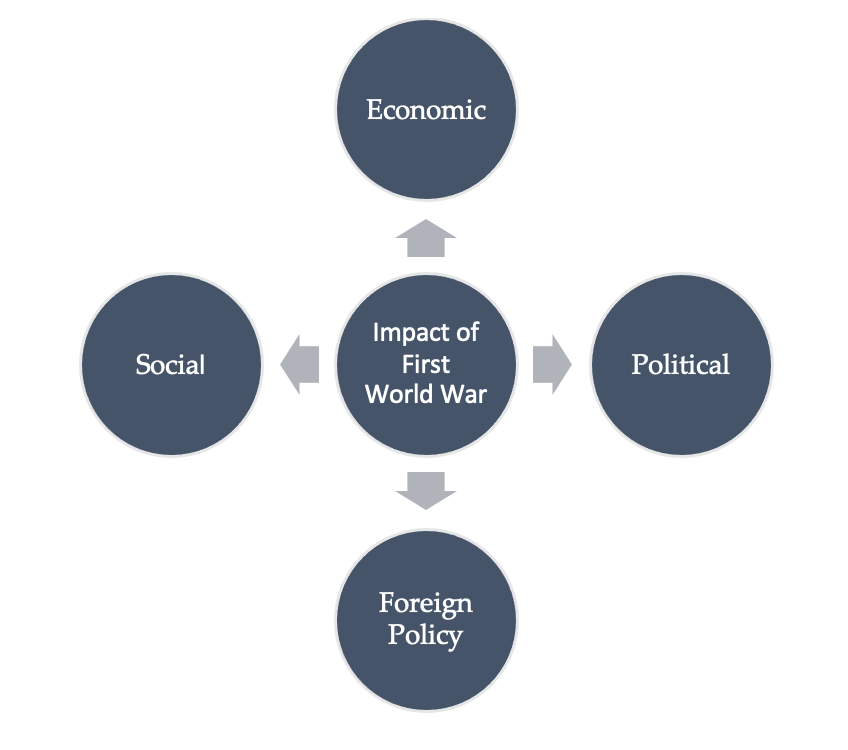
Copy out and add to the diagram below as you read through the consequences of the First World War for Brazil (or create your own infographic.)
'..the war ended up boosting sales of meat and fish, and was a catalyst that forced Brazil to reduce its reliance on others and giving rise to domestic industries. It was just a start, but it was something. Paradoxically, economically speaking WWI was actually positive for Brazil.”
Professor Clodoaldo Bueno
As you will have read on the previous page, initially, the war had a severe impact on the economy of Brazil since it involved the halting of all financing of trade, a stop to almost all shipping and an immediate decline in exports, in part due to the British blockade. Exports of latex and coffee fell sharply; coffee sales fell by almost a third between 1914 and 1915. Reduced exports made it impossible to secure the funds needed to pay the interest on Brazil's external debt, forcing the government in October 1914 to arrange a £14 million loan organised by the Rothschild bank in London. The government met the internal shortfall in revenue by raising indirect taxes. Imports, including consumer goods and foodstuffs, fell sharply which also drastically reduced the customs duties on which government revenues depended.
However, by 1916 Brazil had adjusted to war conditions. With increased international demand for foodstuffs and raw materials exports started to increase. By 1916 coffee exports were equal in size to those of 1913 and, while international prices were only two thirds of what they had been in 1913, the decline in the value of the currency largely compensated for that. Even rubber exports had stabilised, while sugar exports grew due to the demands of the Allies.
The economy underwent several changes;
- Brazilian production of manganese went from 245,000 tons in 1914 to 432,000 meaning that it was providing the USA with 80 per cent of its manganese ore during this period.
- The output of cotton textiles also rose from 70 million to 160 million meters between 1914 and 1918.
- A new industry centered on frozen meat led to the exportation of more than 60,000 tonnes of meat in 1918
- The shortage of imports meant that industrial production increased rapidly to provide the necessary foodstuffs. Local industries now produced to the limit of their capacities and sold at maximum prices; the resulting profits allowed the continued expansion of industry which enabled Brazilian manufacturing to compete with the renewed imports provided mainly by the United States after the war. It also put Brazil in a strong position when the Great depression hit in 1929.
- Brazil thus underwent underwent unprecedented industrial development, also making use of immigrant labour, composed largely of Europeans initially fleeing famine and then the war. The number of factories quadrupled in the war years, doubling the number of workers.
- The war aso meant that the United States replaced Great Britain as Brazil’s main trade partner.
- However it should be noted that coffee still remained the most important export and the number of workers in factories still only amounted to 3 per cent of the population.
Where there was no change was in the conditions of the workers. In the first year of the war real wages for industrial workers dropped by one quarter and in Rio, which was then the capital, the price of food rose by almost one half, driven up by reduced imports. The national government did nothing to control either the price or the supply of foodstuffs and other essential goods. While the economy flourished after 1916, real wages and work conditions continued to decline, intensifying resentment and driving workers to desperation (see political consequences of this above). Although the government did consider legislation to improve working conditions such as limitations on child and women's labour, most proposals were defeated by conservative Congressmen. The only law passed was one in 1919 to ensure compensation for industrial accidents.
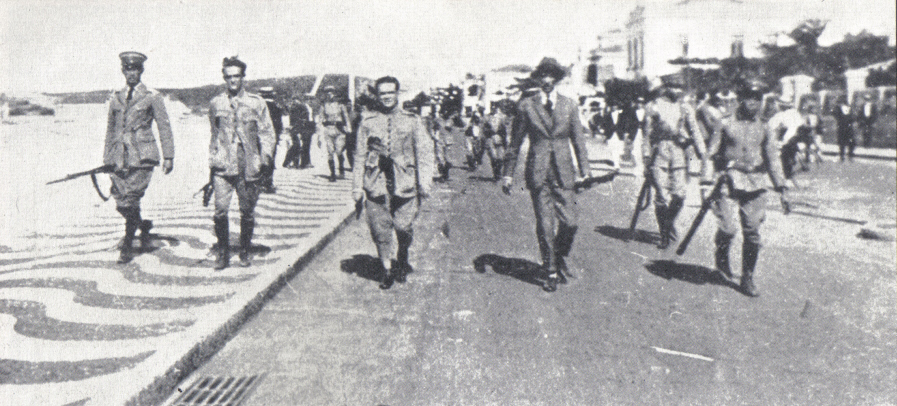
The tenentes leaders of the attempted 1922 coup
'The advance of industry and urbanization enlarged and strengthened both the industrial bourgeoisie and the working class....'
Keen Haynes, A History of Latin America, pg 359
As you will have read on the previous page, the Brazilian government acquired war powers - a decree issued by Brazil’s National Congress and sanctioned by the President, which recognized and proclaimed a state of war initiated by the German Empire against Brazil and which authorized the President of the Republic to adopt all protective measures for national and public security as the President deemed necessary.
This allowed the government to suppress protests by workers who were facing the impact of rising prices, scarcity of food and goods and high unemployment at the start of the war (see above). The killing of a young worker, Jose Martinez, a Spanish immigrant, by the police at the gates of a Sao Paulo factory sparked a series of demonstrations and strikes that disrupted the city for days. From then until 1920 the industrial sector was rife with protest rallies, strikes fermented by the government's failure to address the conditions of the workers. Women were key in organising these protests energising the labour movement with their demands for equal pay and improved conditions.
Trade Unions were also established and revolutionary groups such as the anarchists grew in number. For the government this situation was made more threatening by the success of the October Revolution in Russia.
Thus the events of the war, along with the global influence of the Bolshevik revolution, meant that an active political working class developed as a result of the war. Although the government kept power during this period, and continued to put down all industrial disputes with brutality, political discontent amongst all classes remained after the war. Not only did the industrialisation and urbanisation, which grew as result of the war, see the growth and organisation of the working classes, it also weakened the foundations of the old order which was based on the primacy of agriculture and dependent on foreign markets and loans. As Roderick Barman writes, the government 'never regained the sense of security and legitimacy it had enjoyed before 1914' . https://www.historytoday.com/archive/brazil-first-world-war
Although the government emerged from the war essentially intact, it was in a precarious situation and its survival proved to be only temporary. In 1922, the Brazilian Communist Party (PCB) was founded and in the same year the the Brazilian Federation for the Advancement of Women was established to promote the vote for women. The movement also advocated state intervention against market forces and called on the government to protect 'female labor which has been subject to inhuman exploitation, reducing women to an inferior position in the competition for industrial and agricultural salaries.'
The military also came out of the war strengthened as a political force; the young tenentes (officers from the lower middle classes who wanted social justice and political reforms) in particular called for more influence. In 1922 the tenentes carried out an uprising at the Forte de Copacabana in Rio de Janeiro and this was followed by a second rebellion in 1924 in São Paulo.
A successful revolt against the 'Old Republic' finally came in 1930 when Getúlio Vargas supported by the tenentes seized power (see 4. Populist leader: Getúlio Vargas)
Task Two
ATL: Thinking skills
From what you have read above, explain why and in what ways the government 'never regained the sense of security and legitimacy it had enjoyed before 1914' (Barman)
Task Three
ATL: Thinking skills
What, according to this source, was the aim of the tenentes in the revolts of the 1920s?
The revolts fought against the system of “Café com leite” [coffee with milk] politics that had held sway throughout the Old Republic. The name refers to the principal crops of São Paulo and Minas Gerais; the president would come alternately from one of these two regions, with the oligarchical central government and regional powers rigging the results to make sure these two powerful states and the political interests within them were placated. This left all but the wealthy elites powerless to make any changes through the political sphere, and the growing discontent of the middle class was articulated through the petty officers’ revolts.
The First World War had a profound impact on Brazilian society which manifested itself in different ways.
- As you have read above, the working class grew and became more organised
- the urban bourgeoisie also grew rapidly
- The more fluid and open political environment meant that the women's suffrage movement became more organised with the establishment of the Brazilian Federation for the Advancement of Women in 1922 founded by Bertha Lutz
- As in other countries, a new artistic movement developed which rejected traditional forms of art. Avant-garde painters, sculptors, writers and composers developed a new national style of Brazilian art. In February of 1922, the intellectuals organised a Modern Art Week to commemorate the centenary of Brazilian independence; they rejected the Western models, and stressed the need to develop an indigenous Brazilian culture.
'In the early 1920s, there arose a many-faceted movement for the renovation of Brazilian society and culture. Intellectuals, artists, junior military officers, professional men, and a small minority of radical workers participated in this movement. But they had no common program and did not comprehend the convergence of their aims and work'. Keen Haynes, A History of Latin America, pg 360
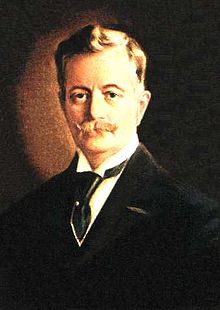
Despite its limited involvement in the war, Brazil was allowed on the basis of its population size to send three delegates to the Paris Peace Conference.
One of its delegates, a congressman and soon-to-be President, Epitácio Pessoa, represented the countries of Latin America. He argued for a declaration of racial equality in the Convent of the League of Nations but France and Britain would not allow this to happen.
However he succeeded in making sure that the 45 German vessels that Brazil had seized after the declaration of war were recognized as Braziilian property. More importantly he was able to make sure that Brazil intensified its relations with the US and to enable Brazil's participation in the commission that wrote the League of Nation's covenant. As a result, Brazil received one of four non-permanent seats in the League’s Council. And since the United States did not participate, Brazil was the most important American country in the League.
However, when it became clear that the League of Nations was focused only on the interests of the key European powers, Brazil left the League in 1926 after failing to get a permanent seat in the Council while the newest member, Germany, was directly elected a permanent member. Brazil argued that it was better to play no role than one of insignificance. Brazil's new global influence was thus short-lived.
Task Four
ATL: Thinking and self-management skills
Refer to your notes/infographic that you have created on the impact of the war on Brazil for Task One
Discuss in groups:
- Which changes do you consider to be the most significant and why?
- In what ways are the economic and political consequences connected?
- Which changes were most long-lasting? Which were relatively short-lived?
 Twitter
 Facebook
 LinkedIn