
 IB Docs (2) Team

1. Changing alliances in Europe 1871 to 1907
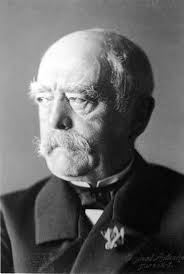 The creation of the German Empire in 1871 caused a major shift in the European balance of power. Over the next two decades, Germany's Chancellor, Otto von Bismarck, worked hard to consolidate Germany's new and potentially powerful position by stabilising Europe. Understanding that further conflict and wars could only threaten the security and political structure of the empire, Bismarck used diplomacy to maintain a European equilibrium and ensure that the other powers did not form alignments that would be hostile to Germany. To a certain extent he was successful; however Wilhelm II, who became Kaiser in 1890 had a different approach to international relations which was to result in Germany's position becoming far less secure by 1907.
Guiding questions:
How did Europe change after 1871?
Why was the Ottoman Empire indecline and what was the impact of this?
What was the significance of the Congress of Berlin?
How did imperial rivalries impact European diplomacy before 1900?
What was the impact of Wilhelm II on the European alliance system up to 1907?
Long-term causes: how far did events in the years up to 1907 contribute to tensions in Europe?
1. How did Europe change after 1871?

We begin our study of the long-term causes of the First World War by looking at the impact of the Franco-Prussian War in 1871. This was the final war of German unification, led by the Prussian Chancellor Otto von Bismarck. The war with France between 1870 and 1871 led to the establishment of a strong and powerful German empire in central Europe.
It caused tension in Europe for several reasons:
- Unification was achieved through ‘blood and iron’, in other words through waging successful wars against other European states [Denmark, Austria-Hungary and France].
- It triggered an arms race in continental Europe as the other powers realised that they had to improve the training and equipment of their armies and to improve the infrastructure to move mass armies to the front lines in a war.
- It destabilised the ‘balance of power’ in Europe as it established a new economic and military power in the heart of Europe
- It led to insecurity and the search for alliances between nations
- It led to the establishment of the ‘revanche’ movement in France; the key agenda of this political movement was revenge on Germany and the reclamation of Alsace and Lorraine which had been ceded to Germany at the end of the war.
However, despite the tension caused by the Franco-Prussian War, Germany under Kaiser Wilhelm I and his chancellor, Bismarck did not continue with an aggressive foreign policy. Rather, Bismarck worked at creating a web of alliances that would protect Germany from future attack and allow it to consolidate its position in Europe. Germany's main aim was to keep France isolated and stay allied with Russia to prevent a two-front war. Thus his first alliance was the Dreikaiserbund or Three Emperor's League which joined Germany, Austria-Hungary and Russia together. The three monarchs identified republicanism and socialism as common enemies and promised to consult on matters of common interest.
Task One
ATL: Research and communication skills
It is important to understand the nature and characteristics of the different European powers in 1871 before going any further.
Divide into groups. Each group will research one of the following countries and prepare a presentation to the rest of the class on the following themes:
- Economic strength
- Foreign policy
- Key aims/fears
- Key strengths/weaknesses
- Political system
- Socio-economic problems
France, Germany, Great Britain, Russia, Austria-Hungary
While each group presents, the rest of the class should take notes. You may want to complete a grid such as the one attached below as a follow up task.
Click on the eye for information to get you started with this task
Task Two
ATL: Thinking skills
Look at this cartoon called The Three Emperors Or, The Ventriloquist of Varzin from the British publication called Punch.
What is the message of this cartoon? Refer directly to the details in the source in your answer.
2. Why was the Ottoman Empire in decline and what was the impact of this?
Note that this issue is covered in more detail under the Paper 3 topic of the Ottoman Empire: 1. Challenges to Ottoman Power in the early 19th Century and 2. The Eastern Question and Crimean War

https://www.britannica.com/place/Ottoman-Empire/The-empire-from-1807-to-1920
Bismarck's Dreikaiserbund was soon undermined by events in the Balkans. The Balkans was a sensitive and volatile corner of Europe. Turkey, which ruled over this area, was in decline and this was to have major repurcussions for not only the Balkans but the relations between European powers.
The Ottoman empire had continued to expand until 1683. Its expansion in Europe was checked when the Ottomans lost the siege of Vienna in 1529 to the Habsburg Empire. Indeed, by 1571, the Ottomans had lost dominance in the Mediterranean to Spanish and Italian fleets and over the course of the 1600s and 1700s it contined to decline in influence. Why was this?
Political issues
The Sultans were weak and ineffectual in responding to political tensions within the empire. There was an increase in nationalism across its multi-ethnic territories during the 19th century. The Ottomans failed to redress the rise of nationalism:
- Attempted political reforms; these did not work in suppressing Balkan nationalism (see below)
- In 1880s they attempted to promote ‘pan-Islamism’ [to appeal to the Arab territories]
- Moved to Turkish nationalism in 1908 with the Young Turks.
Economic issues
- The Ottomans' economy was failing; it had to sell assets to Europeans e.g. Anglo-Persian Oil company 1908
- Nationalists however were enraged that resources had been ‘sold off’ to profit Ottoman elites
What was the European imperialist interest in Ottoman territory?
The European powers were interested in acquiring Ottoman territories:
- For strategic reasons Britain and France were interested in Ottoman territories; they wanted ports [see map above]
- The Europeans also had economic aims; in 1900, oil was discovered in Persia [Iran & Iraq]
- The British wanted to secure Afghanistan; this was the ‘gate way to India’ and Afghanistan had close relations with Ottomans
- Russia wanted Constantinople and to conquer Holy Lands
- Russia wanted to influence and control over the Balkans
Task one
ATL: Research skills
The Crimean War: October 1853 - February 1956
A conflict arose due to a dispute over control of access to religious sites in the Holy Land between Catholic France and Orthodox Russia. In 1853 rioting in Bethlehem, in the Ottoman Empire, led to the death of a number of orthodox monks. The Russian Tsar blamed these deaths on the Ottomans. This in turn led to an international crisis when the Russians demanded the right to protect orthodox Christians in Holy Land. When negotiations collapsed, Britain, France and Ottomans declared war on Russia in 1854.
1. In small groups briefly investigate the causes, course and effects of the Crimean War.
Go to this page to help you:
2. Discuss with your group how this conflict suggests that the decline of the Ottomans was leading to tension and conflict between the European powers.
The Eastern Question
With the decline of the Ottoman Empire, Austria and Russia both saw potential to extend their own lands and power in the Balkans region. At the same time, however, the Slav people who predominated in this region were becoming fiercely nationalistic and were encouraged by Russia in their demands for an independent Slav state. The issue of how to sort out conflicts in the Balkans was known as 'The Eastern question'.
Austria Hungary, driven out of both Italy and Germany during the unification of Germany, was determined to resist Russian ambitions so close to its own territories. It was also worried that any encouragement of Slav nationalism would encourage other national groups within the Austrian Empire to follow this example and demand independence. Such rivalries between Austria and Russia were bound to undermine Bismarck's Dreikaiserbund and indeed were the cause of its collapse in 1878.
Between 1875 and 1877 the Sultan of Turkey was faced with revolts in Bosnia, Herzegovina, Bulgaria, Serbia and Montenegro. The Turks inflicted severe reprisals including the slaughter of some 10,000 Bulgarians in 1876 and this prompted the Russians to aid its fellow Slavs.
In April 1877 Russia declared war on Turkey, having secured Austrian neutrality with a promise to respect Habsburg interests in the Balkans. Eleven months later the victorious Russians imposed the severe San Stefano Treaty on the Turks. This got a hostile reaction from both Austria and Britain who objected to Russia's proposal to create a Greater Bulgarian state from former Turkish territories in the Balkans; they regarded this as a Russian attempt to to establish a Balkan client state with a strategically important Aegean coastline. Historian M. S. Anderson called the treaty 'the fullest practical expression ever given in Russian foreign policy to the Panslav ideal'.
A British fleet was sent to Turkish waters, troops were recalled form India, and Russia was faced with the options of war or of revising the San Stefano Treaty.
Task Two
ATL: Thinking skills
What, according to this source, were the concerns of the British regarding Russia?
In particular, [the British] were worried about Russian ambitions in the Bosporus. This is one of the world’s most strategic waterways and it connects the Black Sea with the Mediterranean. The Russian Tsar Alexander II had ambitions, to capture Constantinople. This would have allowed the Russian navy access to the Mediterranean and this was seen as a threat to French and British interests. Britain in particular, believed that if Russia was to dominate the Bosporus Straits it would threaten its ‘sphere of influence’ in the Mediterranean.
https://dailyhistory.org/Did_the_Congress_of_Berlin_create_a_more_unstable_Europe%3F
2. What was the significance of the Congress of Berlin?

Map from The Great Powers, 1814 to 1819, Wilmot, 1992, Nelson
In an attempt to defuse the crisis the Powers agreed at Austria's suggestion to discuss the issue at a congress in Berlin where Bismarck was to mediate. The revision of the San Stefano Treaty proved acceptable to all the Powers with the exception of Russia. Russia had hoped that Bismarck would offer them his support but this did not happen.
- The large state of Bulgaria was divided into 3 parts. The largest was the core-state of Bulgaria which officially became a self-governing principality under ultimate Turkish control
- Romania, Montenegro and Serbia were recognised as independent states.
- The strategic province of Macedonia was to remain part of the Ottoman Empire
- Austria-Hungary was given the right to occupy but not to annex Bosnia and Herzegovina
As historian Langer writes, 'Russia could hardly have been more effectively checked even by war': 'big' Bulgaria was divided into three, the Turkish Empire still survived (though seriously weakened) and British power in the eastern Mediterranean was enormously increased. Slav nationalists bitterly criticised the Chancellor in the press and the Tsar described the Congress as 'a coalition of the European powers against Russia under the leadership of Prince Bismarck'. Bismarck had succeeded in his goal of preventing another conflict but he was now in a potentially dangerous position with the collapse of his alliance with Russia and Austria.
Task One
ATL: Thinking Skills
Watch the following documentary which gives more detail on the decline of the Ottoman Empire and its impact in the Balkans. Watch from 3:28 – 20 minutes.
Answer the questions below (click on the eye)
Questions:
- What was the nature of the Ottoman state in 19th century?
- What was the millet system?
- Why does Historian Mark Mazower suggests that this would be a problem in a ‘political world’
- When did the Greeks rebel and go on to fight a war of independence?
- Why was Greek important to the European powers of Britain, France and Russia?
- According to historian Cristina Koulouri, what was the reason for the rivalry between Britain and Russia over the future of Greece?
- Why was Greek independence so damaging for the Ottomans?
- What were the 1839 reforms - the Tanzimat, and what were their aims?
- According to historian Hamit Bozarslan what accelerated the nationalist process within the Balkans?
- What were the issues within Bosnia and what happened in 1875?
- How did the European press report the massacres in Bulgaria?
- What happened after the key crisis in the East in 1876 – the Bosnian Revolt?
- When did Abdul Hamid II become Sultan?
- What liberal reforms did the new Sultan implement?
- The Sultan trusted that these liberal reforms would solve the empire's problems and prevent an intervention by European powers – but which power declared war on the Ottomans in 1877?
- Historian Francois Georgeon argues that Russian was the big problem for the Ottoman empire, which movement had had a significant influence on the Russian leadership?
- How were the Ottomans humiliated by the Congress of Berlin?
- After the war, Abdul Hamid ended the liberal era by removing what?
Task Two
ATL: Thinking and self-management skills
Read this article from Daily History, 'Did the Congress Berlin create a more unstable Europe?'
Using the information in the article, along with your own research, discuss in pairs what each of the following countries would have thought about the results of the Congress of Berlin. Consider if each country would have viewed the results as a failure or a triumph, and why.
Britain
Russia
Germany
France
Austria-Hungary
Turkey
Serbia
Do you agree with the conclusion of the article that 'The Congress actions ultimately sacrificed long term stability in favor of a short term easing of political tensions'?
Also see an essay plan on the Congress of Berlin here: 4. Europe and the First World War: Essay frames and writing exercises
A major consequence of the Berlin Congress was the destruction of the Dreikaiserbund or Three Emperors' League. This led Bismarck to look for a defensive alliance with Austria alone; indeed over the next few years Bismarck sought to ensure the security of Germany by setting up a series of alliances.
The Dreikaiserbund or Three Emperors’ League (1873)
The Dreikaiserbund joined Germany, Russia and Austria-Hungary into an alliance. Its terms were very vague, but it served Bismarck’s purpose of keeping France isolated.
The Dual Alliance (1879)
Austria-Hungary and Russia came into conflict over events in the Balkans and the Dreikaiserbund collapsed. In its place, Bismarck made a separate treaty with the Austrians. This alliance was part of Bismarck’s system to limit the possibility of war between the European powers, and was primarily defensive. Germany and Austria-Hungary agreed to assist one another if Russia attacked them. Each country also agreed to remain neutral if the other was attacked by another European country.
The Three Emperors’ Alliance (1881)
Russia, feeling isolated in Europe, turned back to Germany, and Bismarck drew up a revised version of the Drieskaiserbund. Again, this offered Bismarck security. The terms of the alliance included an agreement that if either Russia, Germany or Austria were at war with another power, the others would remain neutral. The alliance also tried to resolve Austro- Russian disputes in the Balkans.
The Triple Alliance (1882)
This alliance was between Germany, Austria-Hungary and Italy. If any of the signatories were attacked by two or more powers, the others promised to lend assistance.
The Reinsurance Treaty (1887)
The Three Emperors’ Alliance fell to pieces due to Balkan problems in 1885. Thus, this separate treaty with Russia was drawn up in order to avoid any risk of a war on two fronts. Bismarck had to make new arrangements to ensure that Germany stayed friendly with Russia.
Task Two
ATL: Research skills
Copy out and complete a grid such as the one below to show the participants, terms and aims of each of the following alliances established by Bismarck. The information above will help you but research further each alliance (or keep reading below!) to find out the extent of its success/failure.
 Grid to show alliances 1879 to 1890
In addition to the alliances above, Bismarck encouraged the conclusion of a second Mediterranean Agreement, in December 1887, between Britain, Austria-Hungary and Italy. The three powers reaffirmed their intention to maintain peace and the status quo in the Near East, to preserve the freedom of the Straits and to uphold Turkish authority in Asia Minor; this served as a warning to Russia that any expansionist moves would be resisted.
Task Three
ATL: Thinking skills
Consider the following extract by Christopher Culpin and Ruth Henig.
1. In what ways had Bismarck helped to maintain peace in the international system?
2. In pairs discuss the 'long-term problems' that he had 'bequeathed to his successors'.
By the time of his departure from office in 1890, Bismarck had ..secured his diplomatic objectives in Europe. France still remained diplomatically isolated, agreements had been concluded with both Austria-Hungary and Russia, and a Mediterranean compact covered Italy and Great Britain. For the time being at least, European stability had been achieved and this was no mean achievement, but...it is possible to argue that Bismarck's diplomatic strategy and tactics bequeathed to his successors serious long-term problems'.
Modern Europe, 1870 to 1945, Longman, pg 14
3. How did imperial rivalries impact European diplomacy before 1900?
 Starter:
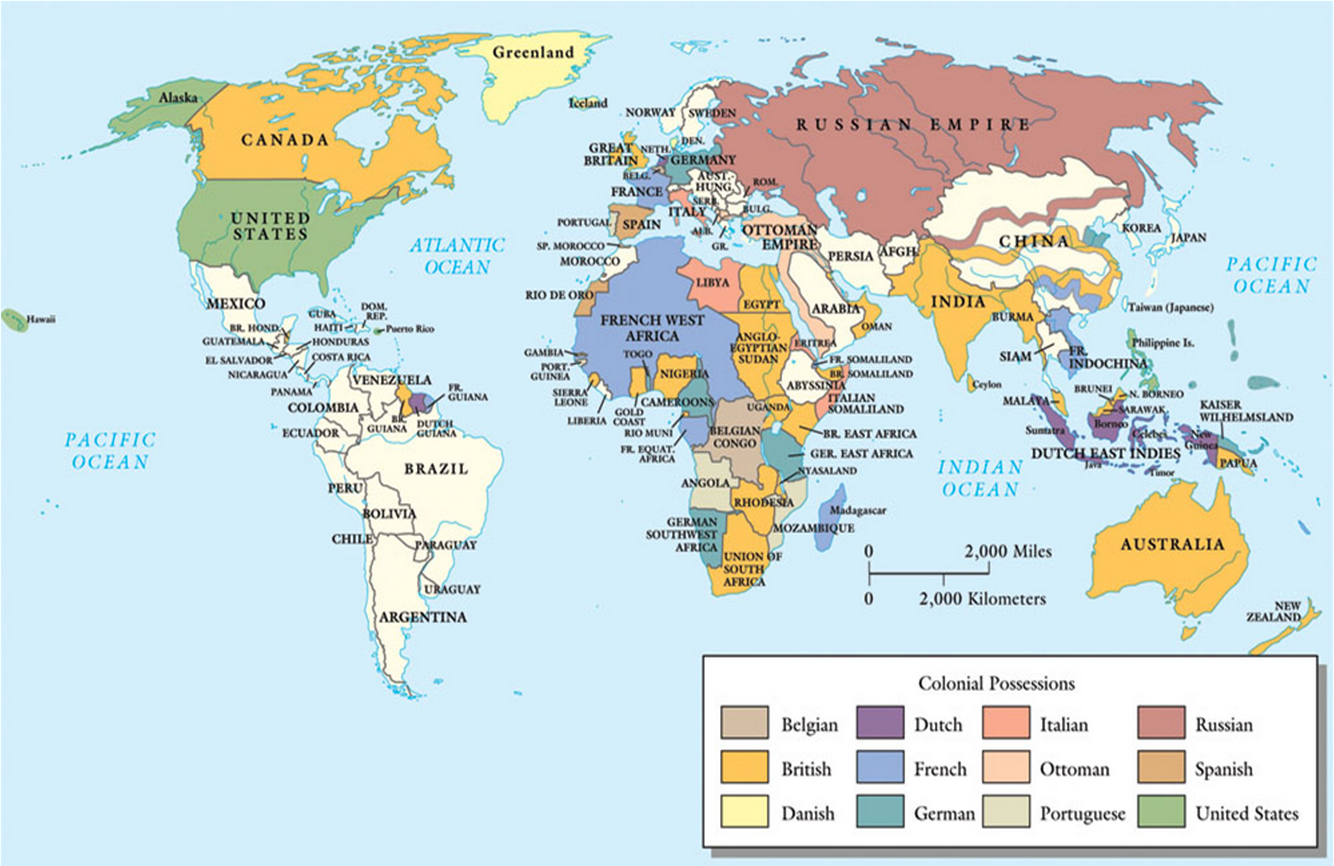
By 1914 which European powers had the largest empires?
Where did Germany have colonial possessions? how significant was its empire compared to other European powers?
Why would the existence of colonial empires by European powers be a potential source of conflict?
One of the main causes of tension between the European powers after 1880 was colonial rivalry. Over the course of the 19th Century, the Europeans had increased their domination of countries in Africa and the Far East and competed to build vast empires. These ventures were initially driven by economic motives but over the course of the century territorial acquisition increasingly occurred due to a mixture of the Social Darwinian belief that the spread of Western civilization was 'God's work' and also nationalistic competition with the other European powers.
Germany was late in the race to gain colonies. However, in 1884 - 85 Bismarck acquired a colonial empire five times the size of the German Reich. This was a reversal of his earlier view that colonies were an expensive luxury which a new state like Germany could not afford. Why, then did he change his mind?
- He needed to protect German trade in South West Africa and the South Seas
- Britain, with its policy of 'splendid isolation' made it easy for Germany to move into areas which Britain regarded as its own sphere of interest
- German public opinion and the pressure of the National Liberal Party and the newly founded Kolonialverein was calling for colonies
- As with other European leaders, Bismarck saw that a colonial policy could also unite the German people behind him and act as a diversion from domestic problems
Thus, in the the spring of 1884, the German government granted formal protection for German trading stations in South West Africa, the Cameroon, Togo land and New Guinea to keep the British out of these areas.
Task One
ATL: Thinking skills
1. Go to this page (PBS learning media) and watch the video on the Berlin Conference of 1884 - 85. Make notes on the aims and the impact of this Conference.
2. Follow up by reading 'Berlin 1884: Remembering the conference that divided Africa' which focuses on the impact beyond Leopold's Belgian Congo. Add to your notes regarding the short and long term impact of this Conference.
Task Two
ATL: Thinking skills
What is the message of this cartoon of the Berlin Conference of 1884 - 85?

Germany's desire to make its influence felt outside Europe was to bring it into conflict with the more established colonial powers, particularly Britain. An example of this effect occurred in 1896, when the German Kaiser caused great offence in Britain over his response to the so-called Jameson Raid of December 1895. This was a failed attempt by Britain to incite a rising against the Boer Republic of the Transvaal in southern Africa. Following the failure of this raid, Germany sent a telegram to the Boer leader congratulating him on resisting the attack and 'restoring peace ..in the face of armed bands which have broken into your country as disturbers of the peace and have been able to preserve the independence of your country against attacks form outside'.
The telegram caused public outrage in Britain.
Task Three
ATL: Research and communication skills
- Research the European acquisition of colonies in Asia in the 19th Century.
- What examples are there of imperial rivalry in Asia before 1900?
- What other examples are there, other than the Boer telegram incident, of imperial rivalry in Africa before 1900?
4. What was the impact of Wilhelm II on the European alliance system?
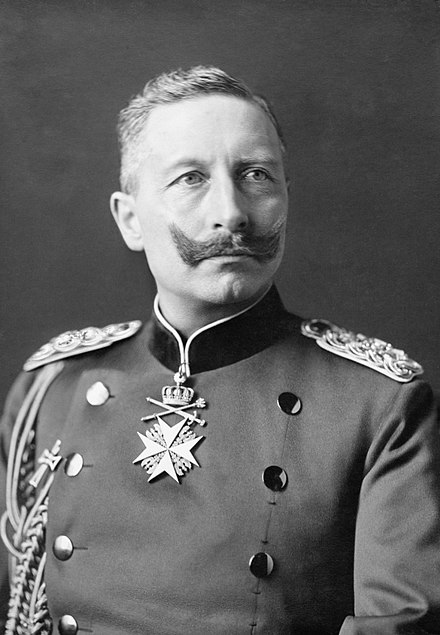
In 1888, the young and ambitious Wilhelm II came to the throne in Germany, and Bismarck was replaced as Chancellor by Leo von Caprivi in 1890. Kaiser Wilhelm II and Caprivi took German foreign policy on a 'new course', also known as 'Weltpolitik,' that would overturn Bismarck's system of alliances.
Task One
ATL: thinking skills
Watch this video (1914 - 1918 A BBC History of the Great War, Episode 1, Explosion) from 6 minutes to 14 minutes
- What image is created here of Wilhelm II's character?
- What was Wilhelm's style of ruling?
- What were his aims and why were these likely to cause tensions in Europe?
- Why was Wilhelm supported by many Germans?
- What was the diplomatic impact of building a new navy?
As you saw from the video, Germany's policy of Weltpolitik brought it into conflict with Britain which responded to the threat to its naval supremacy by abandoning its policy of 'splendid isolation'. In 1902 it made an alliance with Japan giving it an ally in the Far East which allowed it to bring back warships from this area. This alliance was followed by an entente with France. Although this entente was not a formal alliance, it settled rivalry between the two nations over colonial issues, and set a new direction for Anglo-French relations
In 1907, Britain and Russia reached agreement over their relationship with Persia, Tibet and Afghanistan, again reducing British concern over security in India and the Far East (see next page for an explanation of how this came about); France had already secured Russia as an ally following Germany's failure to renew the Reinsurance Treaty of 1887. Now Russia, France, and Britain joined together in the Triple Entente. German naval expansion had thus forced Britain into seeking an agreement with its former colonial rivals, leaving Germany concerned that it was becoming 'encircled'.
The other impact of the Kaiser's actions in creating a navy was that it started a naval arms race. Two Navy Laws of 1898 and 1900 laid the basis for a powerful German battle fleet. Britain responded by launching a super-battleship, the Dreadnought in 1906 and ordering the construction of eight battle ships in 1909. The naval race also impacted on British attitudes; the British public now saw Germany as the new enemy threatening Britain.
Task Two
ATL: Thinking skills
- According to historian Gordon Craig what was the Kaiser's aim in creating a powerful navy?
- Why did this plan prove to be totally misconceived?
The new naval programme was, in short, from its very inception directed against Great Britain...the Risk theory..envisaged a German fleet stationed in home waters that was so strong that in the event of a war with Great Britain it could take offensive action against the British home fleet...As the German navy grew in size, the British would..be inclined to avoid conflict with Germany or..seek an accommodation with it on terms that would strengthen Germany's continental position..'
Craig, Germany, 1866-1945 (1981)
Task Three
ATL: Thinking skills
Consider the following question. Write down your ideas on your own first. Then share these ideas with a partner.
To what extent was Germany's position in 1907 less secure than it had been in 1890?
There is an essay planning exercise on this question on the essay planning page for this topic.
As mentioned in the video, the Kaiser saw himself the embodiment of the 'new' Germany. Germany had developed dramatically since its creation in 1871; the economy had expanded on a massive scale and German society had undergone a dramatic transformation. Millions of people migrated to the expanding industrial centres in the Ruhr, in the Saar Valley and in Upper Silesia. As economic output soared, Germany became a dynamic, modern state leading Europe in the production of key raw materials. The rapidly changing economic and social structure brought new challenges to government which included the development of the largest socialist party in Europe, massive urbanisation, and demands for more participation in government and better working conditions.
Task One
ATL: Thinking skills
Continue watching the video above (1914 - 1918 A BBC History of the Great War, Episode 1) from 25. 45 until 32.10 and note down the forces at work in German society that were impacting on foreign policy.
Task Two
ATL: Thinking and social skills
In pairs, consider the following domestic events in Germany after 1871. (click on the eye or download the activity sheet)
1. Create a timeline from 1871 to 1914 with these events below the line
2. Add foreign policy events that were initiated or which impacted on Germany above the line.
2. Discuss the extent to which domestic events had an influence on German foreign policy.
3. To what extent would you agree with historian Imanuel Geiss that 'German Weltpolitik was partly created by a domestic policy, which aimed at diverting the attention of the masses from social and political problems at home by a dynamic expansion abroad'? (July 1914, 1966)
 How far did domestic events in Germany influence foreign policy
5. Long-term causes: how far did events in the years up to 1907 contribute to tensions in Europe?
Task One
ATL: Thinking skills
In pairs, review the key themes on this page and discuss how far each contributed to long-term tensions in Europe in the years to 1907:
- Situation in the Balkans
- Alliances
- Kaiser Wilhelm II and Weltpolitik
- The Naval Race
- Imperialism and the race for colonies
 Twitter
 Facebook
 LinkedIn