
 IB Docs (2) Team

7. Involvement of Canada in the First World War
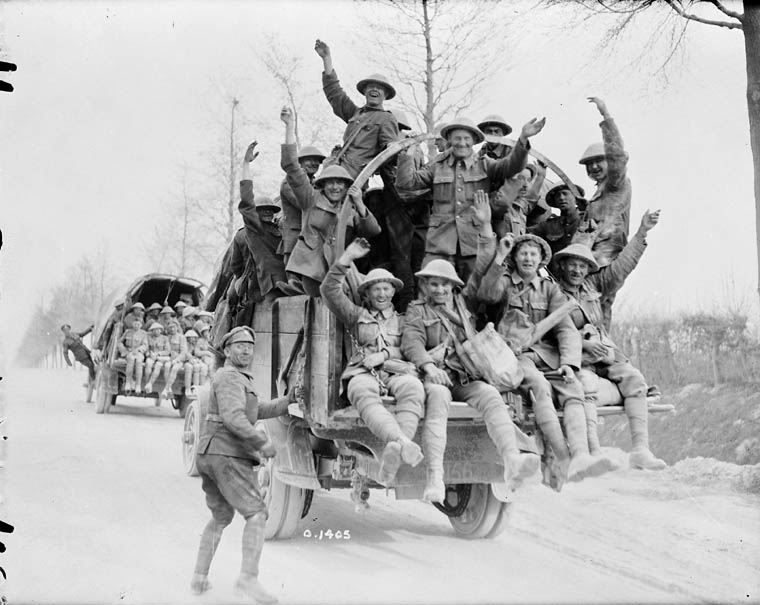 As part of the British dominion, Canada entered the First World War as soon as the British had declared war on Germany.
 Guiding questions:
What were the reasons for Canada's involvement in the First World War?
What was the nature of Canada’s involvement in the First World War?
- What was the nature of Canada’s involvement in the war on the land?
- What was the nature of Canada’s involvement in the war at sea?
- What was the nature of Canada's involvement in the war in the air?
What was the role of non-white Canadians during the First World War?
How did Canada mobilise its human and economic resources?When Britain is at war, Canada is at war. There is no distinction.’
Prime Minister Sir Wilfrid Laurier. 1910.
Starter
Watch this video which gives an overview of Canada’s involvement in the First World War from 0 – 16 minutes and answer the questions (click on the eye)
- What marked the beginning of Canada’s ‘nationhood’ and position on the world stage?
- What events in Europe led to the outbreak of war in August 1914?
- What did Canada’s Prime Minister Robert Bordan immediately offer to Britain?
- Why was Canada automatically at war?
- In what ways was Canada ill-prepared for war?
- The government called for 25 000 volunteers – how many turned up to enlist?
- Over the next 4 years how many more followed?
- When did the 1st Canadian division arrive in France and what issues did it face?
- Where did Canadians hold the lines for 48 hours incurring a loss of a 1/3 of their forces?
- When did the 2nd division join the Canadian Corps?
- After Ypres in the summer of 1915, Prime Minister Bordon visited England and decided that Canada needed to provide more what? How many more Canadian troops were promised on New Year’s Day 1916?
- What was the size of the Canadian population at the time?
- How did the Canadian government attempt to fund the cost of the commitment to the war?
- What was the attitude of French Canadians to the calls to enlist?
- How did the war transform Canadian industry?
- What was the impact of involvement in the war on the roles of Canadian women in society?
1. What were the reasons for Canada’s involvement in the First World War?
 Prime Minister Sir Robert Borden in office: October 1911 – July 1920
Britain declared war on Germany on 4th August 1914 and this meant that legally Canada (albeit a self-governing dominion), as part of the British empire was at war - as was the independent colony of Newfoundland. Indeed, although Canada controlled its own domestic affairs the British retained control of foreign affairs. Nevertheless, the Canadian government would decide the nature and extent of its commitment in the war and this led to intense debate on the home-front.
Canadian Prime Minister Borden had 200 local militias he could call on to volunteer at the outbreak of war. On 18 August 1914 parliament approved a 25 000 strong overseas force and an appropriation of $50 million to fund the war effort. At first there was a patriotic response from both the English and French speaking communities in Canada and by September 4th almost 32 000 men had volunteered; nevertheless most of these were of British descent. As military training centres were not ready, thousands were then sent to Britain to be trained and armed.
- By the end of the war - almost 620,000 Canadians enlisted from a population of just 8 million (7%)
- Hundreds of thousands were also involved in the war effort on the home front
Task One
ATL : Thinking skills
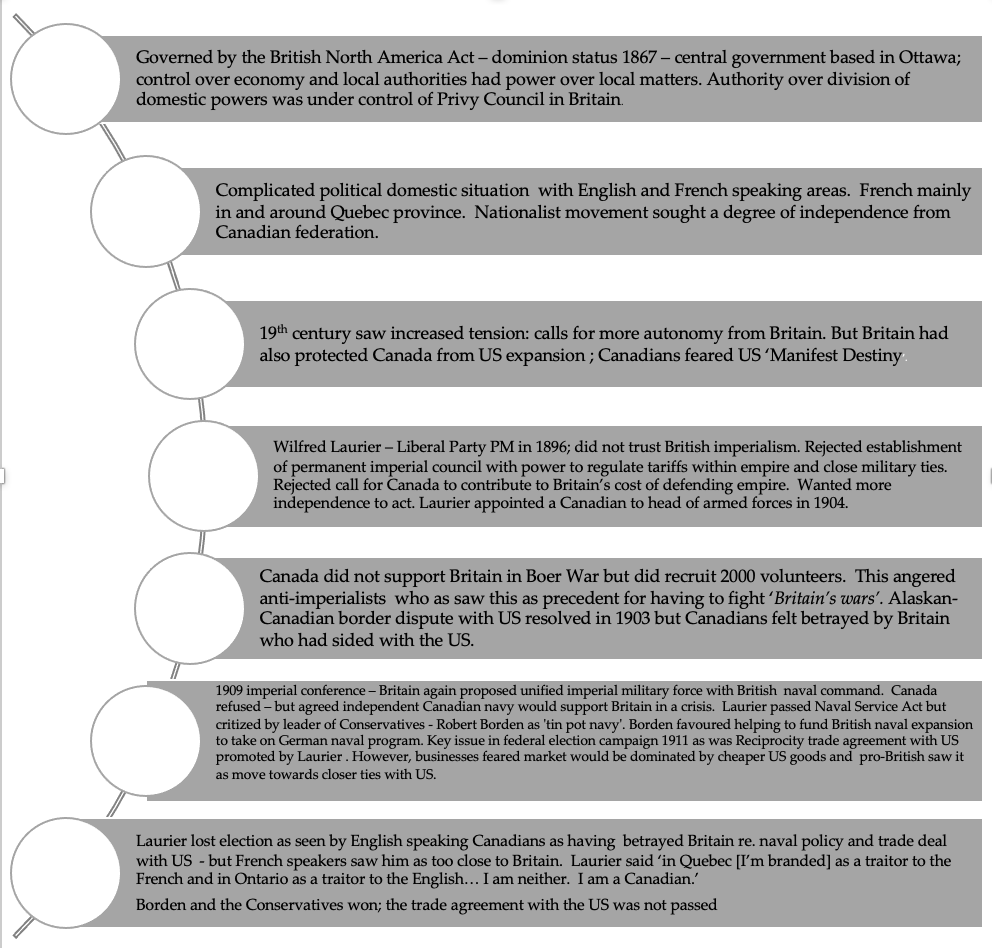
In pairs read through the chart below and discuss a] the nature of Canada’s relationship with Britain and b] domestic tensions between English-speaking and French Canadians in the pre-war period.
Task Two
ATL: Thinking and self-management skills
In small groups review the material above and your notes from the video activity.
Discuss the reasons for Canadian involvement in the First World War.
2. What was the nature of Canada’s involvement in the First World War?

Task One
ATL: Thinking skills
Watch this video which gives an overview of Canada’s involvement in the First World War from 16 minutes to end and answer the questions (click on the eye)
- When was the Canadian Royal flying corps established and by the end of the war what proportion of pilots in British planes were Canadian?
- What role did Canada play in the war at sea?
- Which Canadian forces fought in the ‘bloodiest of battle of the western front’ at the Somme in July 1916?
- The Allies incurred 600 000 casualties at the Somme, of these how many were Canadians?
- In 1917 the Germans withdraw to the defensive Hindenburg line, which vital part of German defence system was targeted by the Canadians?
- What preparations were made by Canadian commanders for the attack on Vimy Ridge?
- Vimy Ridge was a victory, and considered the first major breakthrough in 2 ½ years –what was ‘born’ among Canadian troops following this battle?
- What were the implications of the promotion of British commander Byng?
- Which Canadian general protested at the potential casualties that would be incurred if Britain went ahead with an offensive to capture Passchendaele?
- Why was Canadian recruitment trailing off by the end of 1916?
- Prime Minister Borden was convinced that Canada could not replace losses with volunteers, so which act was introduced in 1917?
- This Act divided Canada, which French Canadian spokesperson declared that: ‘No conscription. No enlistment – Canada has done enough.’?
- The Act also split the government – which two groups did Borden give the vote in order to ensure a victory for the conscription party?
- What limits were put on votes for women?
- When was conscription introduced in Canada?
- What new technology was used for the first time successfully at Cambrai in November 1917?
- What was the new method of attack deployed by the Germans in the spring of 1918?
- Why has the period between August 4th and November 11th 1918 come to be known as ‘Canada’s 100 days’?
- What was the result of Prime Minister Borden’s insistence on a separate seat for Canada at the Paris Peace conference in 1919 and in the League of Nations?
- Where had Canadian troops fought during the First World War?
- From a population of only 8 million how many Canadians had been sent to war?
- What had Canada won from its involvement in the First World War?
‘Whenever the Germans found the Canadian corps in the line they prepared for the worst.’
British wartime Prime Minister Lloyd George.
As you will have seen working through the activities above, before the outbreak of war Canada’s land forces were based on militias and it had a regular army of just over 3 000 men and its navy consisted of only two obsolete cruisers with fewer than 350 sailors. Borden told the Minister of Militia and Defence, Sam Hughes, to recruit and train an overseas force. The Canadian Expeditionary Force - a new land army – was set up under the Ministry of Overseas Forces. The Canadian corps would become a highly respected force on the Western Front.
In September 1915, after the arrival of the 2nd Canadian Division in France, the Canadian Corps was established. This was then expanded in December with the 3rd Canadian Division, and then again in August 1916 with the 4th Canadian Division. The Canadian Corps was under the command of the British and dispersed through the whole army, but there was pressure for Canadians to fight as a unit particularly after the blood-bath of the battle of the Somme. As you will have seen in the video clip above, Canadian divisions had been under the command of British Lieutenant General Julian Byng until he was promoted in 1917; the command was then taken over by the first Canadian commander General Sir Arthur Currie.
Task One
ATL : Thinking and communication skills
Note that this video is also an excellent overview of the Canadian experience in the First World War with first hand accounts which will also be useful for the task below:
In pairs read through the chart below and discuss the factors that led the Canadian Corps to become a highly respected force on the Western Front by the end of the First World War.
You may to do further research on each of these Battles and the role of Canadians in each case.
The Canadian War Museum website is an excellent starting point for further research.
.png)

The achievement at Vimy Ridge has become a defining event in modern Canadian history. It has been seen as a turning point in Canadians' sense of national identity and a key step on the path to full independence from Britain. The Canadians had succeeded where the Allies had failed at huge cost before them. It had taken four horrific days of fighting, incurred 10 600 Canadian casualties and all four divisions of the Canadian Corps had fought together for the first time.
Task Two
ATL : Thinking and communication skills
In pairs or small groups watch the following clip and discuss why the battle of Vimy Ridge was significant for Canada and Canadians.
Then create a propaganda piece to celebrate the anniversary of the great victory for Canada at Vimy Ridge.
Why the battle of Vimy Ridge matters
https://thediscoverblog.com/2016/05/31/canadians-at-the-naval-battle-of-jutland-may-31-june-1-1916/
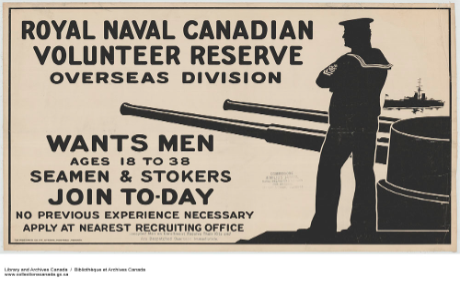
At the beginning of the conflict Canada’s navy was small and somewhat outdated. It had only two obsolete cruisers, HMCS Rainbow and HMCS Niobe, with fewer than 350 sailors. The British navy was tasked with defending Canada’s coast. During the war, the Canadian navy would expand in response to the threat of German U-Boats. In addition, 100 small private vessels were pressed into service. By the end of the First World War Canada’s navy had steadily grown to 9 000 officers, and the conflict had cost the lives of 150 Royal Canadian navy sailors.
The navy did play a role in the war at sea in helping to organise allied shipping, defending ports, assisting British warships and monitoring wireless communications. Canadians could chose to enlist with the Royal Navy or the Canadian equivalent.
In the autumn of 1914, HMCS Rainbow was sent to patrol the waters from the west coast of North America to the coast of Panama. After the British destroyed the German East Asiatic squadron in the battle of the Falkland Islands in 1914, the Rainbow’s crew was sent to the east coast for the rest of the war. The HMCS Niobe also took part in the British blockade of Germany and patrolled the coast of New York, but was retired in 1915 as it was considered unfit for service. Two submarines, the HMCS CC-1 and HMCS CC-2 were involved in patrolling the Pacific between 1914 and 1917 before being withdrawn from service. German U-boats raided the east coast in the summer of 1918, but the most significant naval disaster was the sinking of the Canadian hospital ship HMHS Llandovery Castle in June 1918.
Canadian civilian seamen played a key role in the war. The government set up the Canadian Government Merchant Marine [CGMM] at the beginning of 1918 to support Allied merchant shipping which had incurred heavy losses from German submarines. It was tasked with working with British shipping to maintain supplies of Canadian goods across the Atlantic
Task One
ATL: Research skills
Investigate further the impact of the sinking of the hospital ship HMHS Llandovery Castle in June 1918
When war broke out in August 1914 aircraft were relatively new as a military weapon, but the role of aircraft would become increasingly important. At the end of the war, airpower was being harnessed to fight the war on the land and the war at sea with increasing success and the Royal Canadian Air Service [RCNAS] was set up in September 1918.
Training schools had been established throughout the war; the largest in Canada was the Curtis Flying School in Toronto. Its main role was to use flying boat patrol aircraft to carry out anti-submarine operations. In 1917, 6 airfields were built by the Royal Flying Corps to recruit Canadian air crews. The schools partially trained airmen who were then accepted into the British forces. During the war 22 000 Canadians served in the British flying services, and when the war ended in November 1918, 25% of the British Royal Air Force were from Canada.
Task One
ATL: Thinking and self-management skills
In pairs create an infographic that highlights the key ways Canada’s armed forces contributed to the Allied war effort.
3. What was the role of non-white Canadians during the First World War?
 Non-white people were not initially welcomed into the Canadian armed forces
- Black volunteers from Nova Scotia were told: ‘this is a white man’s war’.
- Some segregated units were set up. By the end of the war, 1 000 black Canadians had served in segregated units in army and navy.
- Indigenous people were permitted to enlist from 1915 – has been suggested that 3 500 went on to serve in Canadian forces
- The Canadian Japanese Association set up a volunteer force of over 200 men
Members of Canada’s No. 2 Construction Battalion. Left to right: William Thomas Jackson, Peter Browning, and Elery Elias Jackson. (Courtesy of Chatham-Kent Black Historical Society)
Task One
ATL: Thinking and communication skills
In pairs read through this article 'How Black Ontarians fought to serve in World War I', and identify the key points made regarding the army’s racist policies on Black Canadians in the First World War.
4. How did Canada mobilise its human and economic resources?
Human mobilisation
Conscription
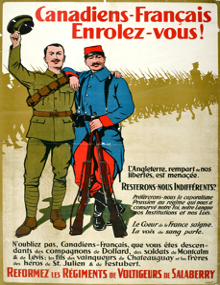 As you have seen in the previous activities, after the initial enthusiasm to join up (of mainly Canadians of British descent) the numbers began to trail off as the war continued. But the tensions between French and British Canadians came to a tipping point when prime minister Borden introduced the Canadian Military Service Act in 1917. Many French Canadians did not want to fight ‘Britain’s war’. In Quebec, where opposition to the bill was most strong, nationalist leader Henri Bourassa, supported by Laurier, campaigned against conscription.
The Union election campaign shamelessly bashed French Canada for its low enlistment rate. If Laurier’s Liberals won the election, one Unionist pamphlet said, “the French-Canadians who have shirked their duty in this war will be the dominating force in the government of this country. Are the English-speaking people prepared to stand for that?”
Nevertheless, the act passed as Borden won the election that year. By the end of the war in November 1918, 120 000 men had been conscripted, but only 47 000 had served overseas. One lasting legacy of the Great War on the home-front was continued division between the French and British Canadians on the issue (see page on impact of the war on Canada).
Role of Women
 Women played a key role in the Canadian war effort; due to increasing labour shortages as men were away fighting, they worked in factories, were sent overseas as field nurses, volunteered to work in supplying front line troops, worked in banks, the civil service and transport. However, women were paid less for taking on the same jobs as men. After the introduction of conscription, women took on more skilled and dangerous roles – for example, working in munitions factories. These wartime changes made women more independent and respected. By the end of the conflict the Canadian women’s suffrage movement, as in other belligerent countries, had won the argument. An Act to confer the Electoral Franchise upon Women was passed on May 24 1918, through which women were given the right to vote in federal elections.
Saboteurs on the home-front
There was anxiety during the war that there would be acts of aggression and sabotage on the Canadian home-front. The German government did consider plots to attack British interests in cross border attacks from the US. A plan to deploy a force of 650 000 men across the border (dressed not in military uniforms but as cowboys!), drawn from German military reservists and German Americans with support from Irish Americans was rejected by the German government – but only because it could violate US neutrality in the war. A more concrete plan drawn up by Franz von Papen and Arthur Zimmerman was to attack the Canadian Pacific railway which could carry Japanese troops to be sent to France. Agents were recruited to blow up 5 railway bridges but again the plan was aborted as only 3 agents turned up to execute the plot. Plans by the German government continued – and would lead to the Zimmerman Telegram at the beginning of 1917 (See this page: 4. United States and the First World War: from neutrality to involvement ).
Task One
ATL: Thinking and research skills
In small groups research the impact of the nature of Canadian involvement in the war on its economy. You should consider how the government attempted to fund the war, how industry and agriculture was affected and the extent to which the economy was changed by the conflict.
A good starting point would be to go to Unit 4 on this website from the Canadian War Museum: Life at home during the war
 Twitter
 Facebook
 LinkedIn