
 IB Docs (2) Team

e. Roosevelt and the New Deal
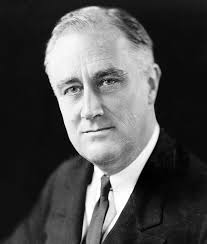 Roosevelt introduced a series of proposals which tackled the problems of the Depression in a radically different way to any previous actions of a US government. For the first time, the federal government began to take responsibility for its citizens; Hoover's ideas of 'laissez-faire' and relying on 'rugged individualism' were now abandoned. Roosevelt had promised the people of America a 'New Deal' and now he was elected, he was in a position to do this.
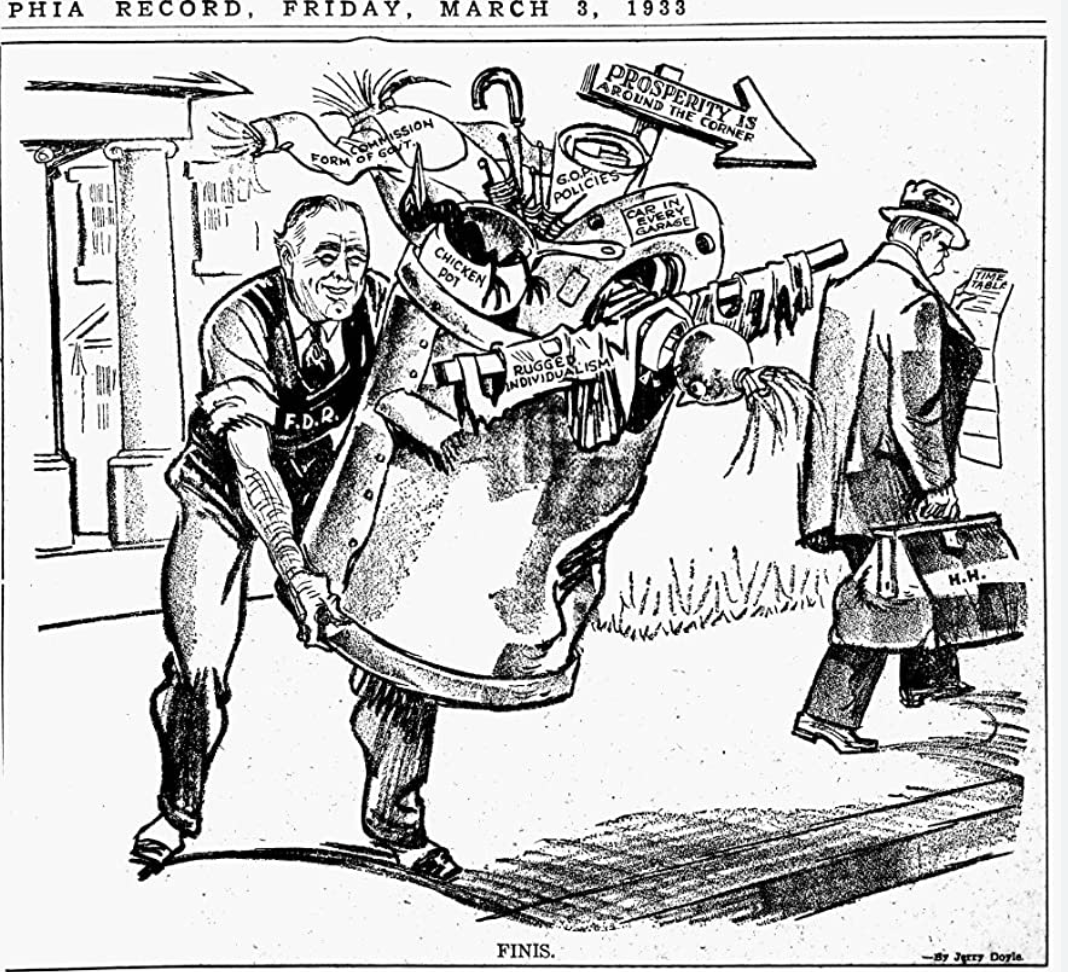
Where Hoover had promoted lower taxes, resisted national welfare and had placed the responsibility for aid on state governments and the voluntary sector, Roosevelt’s slogans promoted the three ‘R’s – Relief, Recovery and Reform (see below). He had suggested that the US needed new legislation to redress the crisis, a New Deal, but he had offered very little in terms of specific policies for his plan. In fact, the platform on which his party had stood was a call to reduce federal spending by 25%, balance the federal budget, remove government from private enterprise and end the ‘extravagant’ farm programs of Hoover.
In his inaugural address FDR the president stated that the US has ‘nothing to fear but fear itself.’ There was fear in the US that the economy might not recover, and genuine hope that the optimism of the new president would made a difference. In his address FDR blamed ‘unscrupulous money changes’ for the depression, but did not suggest that the federal government's failures and limitations were responsible.
In pairs watch and listen to FDR’s inaugural speech and make notes on its content and tone.
You can find a transcript of this speech here
What do you think the impact of this speech would have been on the American people?
In his first Hundred Days, Roosevelt used all his powers under 'The Trading with the Enemy Act' (which had been passed during the First World War to give the President extraordinary power without asking for congressional ratification) to pass fifteen bills and set the future direction of the first part of the New Deal. The first job was to deal with the banking crisis; Roosevelt then went on to establish the Alphabet Agencies. He said he wanted to deliver 'the 3 R's:
- Relief for those suffering the effects of the Depression
- Recovery of the country to creating more jobs
- Reform by passing laws to ensure that the people would protected from such an economic disaster happening again.
Watch this video (Roche Productions part 2) from 22 minutes to 29 minutes (this is also on the video page with timings for the whole video)
- What was the state of America by the time Roosevelt is elected?
- Why does Roosevelt close the banks?
- In what ways is Roosevelt different to Hoover in his approach to the crisis?
- In what ways was this a 'New Deal'?
- Why does Roosevelt appoint Joe Kennedy in charge of the Securities and Exchange Commission?
- What talents did Roosevelt have for dealing with this crisis?
Also watch this video (The New Deal, BBC History File) from 5 minutes in to 10 minutes 30 seconds.
1. What tactics does Roosevelt use for reassuring the Americans?
2. Make a note of the Alphabet Agencies that were set up in the first 100 days and what each aimed to achieve.
Divide the class into groups.
Each group should research one of the following measures implemented by Roosevelt's administration in 1933 as part of his first New Deal.
Examine aims, how the measure was implemented and its impact (also highlight any criticism of the measure)
Produce a brief presentation to the class and a one page write up on your key points which can be distributed to all students.
- Emergency Banking Act and Economy Act
- Agricultural Adjustment Act (AAA) and Farm Credit Act
- Civilian Conservation Corps (CCC)
- Federal Emergency Relief Agency (FERA)
- Tennessee Valley Authority (TVA)
- National Industrial Recovery Act (NIRA), including the National Recovery Administration (NRA)
- Public Works Administration (PWA)
You may also want to use this grid to summarise your findings:
 Grid summarising first New Deal
Based on the presentations that you heard in the previous task, discuss in pairs how the New Deal impacted on the following groups:
- The banking and financial sectors
- Businesses
- The unemployed and the poor
- Farmers
2. How far had the measures in the first New Deal addressed the 3 R's mentioned above?
Historians have suggested that FDR’s banking and financial policies actually saved the capitalist system in the US, and historian Paul Conkin argues that policies such as the establishment of the TVA proved the ‘efficiency, flexibility and social concern’ possible in government. Overall, the First New Deal brought an end to economic decline in the US and it was popular with the public. In mid-term elections the democrats increased their majority in both the senate and the house of representatives.
However, there were limitations and failures. The left wing in US politics criticized it for not going far enough. It had merely propped up a failing economic system. Others claimed that the New Deal had gone too far and had introduced a form of socialism or fascism.
Read through the following list of limitations to the new legislation (click on the eye to see these)
Identify groups in US society which did not benefit from the FDR’s first New Deal.
- President Hoover had argued that the causes of the depression were global and therefore a solution to the crisis may be found if the major industrial countries work together. Hoover had hoped that the London Economic Conference, to be held in July 1933 would be the start to working on an international solution. However, Roosevelt believed the issues facing the US were rooted in domestic causes and his policy of devaluing the US$ derailed the entire London conference. The other countries wanted to stabilize currencies.
- FDR’s attempt to use monetary policy and changes in the money supply to ignite a recovery had only a limited impact. In addition, his banking and finance reforms were relatively conservative and FDR aimed to support and preserve the economic system in the US, not to transform it.
- There was some overlap in what the different agencies aimed to achieve and which groups they attempted to support. Some agencies had contradictory aims.
- The Civilian Conservation Corps [CCC] March 1933 offered temporary employment with no guarantees of work after.
- Hopkins, leader of the Federal Emergency Relief Administration [FERA] May 1933, was forced to directly take over relief programs in six states.
- The vast majority of jobs offered by Civil Works Administration [CWA] November 1933 were in low-skilled labor, only 10% were white collar.
- FDR was concerned about the cost of CWA which ran at $200 million per month and closed CWA in March 1934.
- The PWA created in June 1933 was accused of creating ‘boondoggle’ jobs, i.e. jobs with no real purpose but to employ the unemployed.
- Many of the codes set up by the National Recovery Administration [NRA] June 1933 were unworkable and excluded agricultural workers and domestic servants [a high proportion of whom were African-Americans]. It failed to resolve trusts that controlled whole industries and price fixing damaged smaller businesses. The NRA was declared unconstitutional in 1935.
- The Agricultural Adjustment Administration [AAA] May 1933 reduction in cultivation and production led to a corresponding reduction in the need for farm laborers. This had a negative impact on sharecroppers and migrant workers. To deal with this consequence - The Resettlement Administration was set up in 1935. The Supreme court declared AAA unconstitutional in January, 1936.
‘[The Second New Deal] was the most comprehensive program of reform ever achieved in this country’
Walter Lippmann
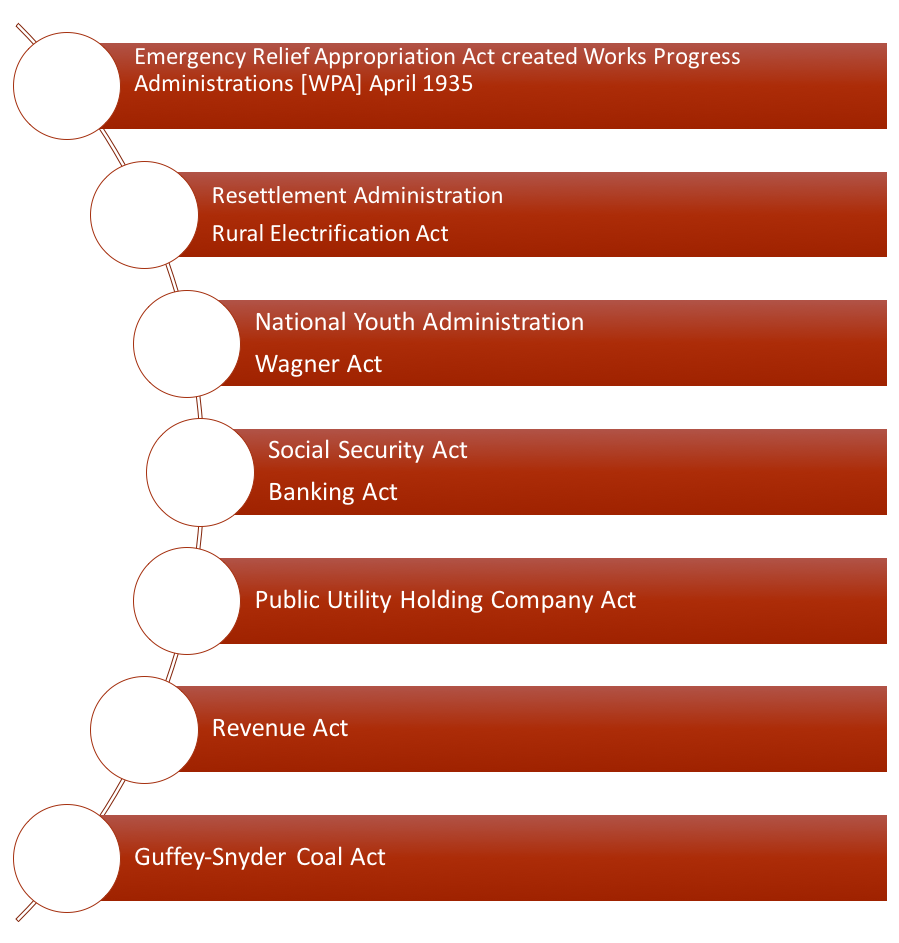
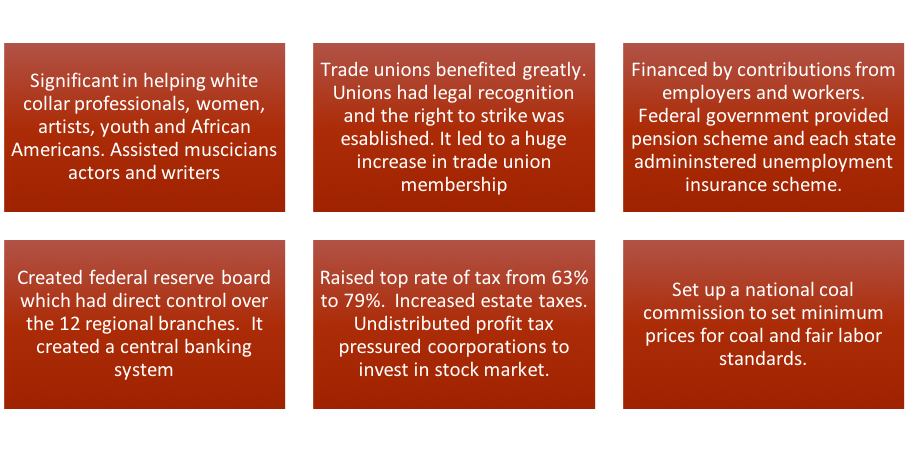
FDR had stated before he became president that the nature of his policies towards the economic crisis would consist of ‘bold experimentation’ and, indeed, experimentation seems to underpin the key acts passed by the Roosevelt administration in the First New Deal. From 1935, FDR then embarked on a Second New Deal which would result in major changes to the social and economic structure of the United States. It would also lay the foundations for a welfare state. As you will have seen, the Supreme Court had challenged the elements of the First New Deal and declared some of its acts unconstitutional. However, after the increase of Democrat control of the Congress and Senate after mid-term elections, and pressure from more radical elements of his party, Roosevelt was able to put forward another series of measures that formed the Second New Deal. FDR had stated before he became president that the nature of his policies towards the economic crisis would ‘bold experimentation’ and experimentation seems to underpin this Second New Deal.
1. In pairs or small groups research the following measures in the chart below which were implemented as part of FDR’s Second New Deal in 1935. Identify who benefited from each measure and again highlight any criticisms that were made against the measure. What other measures were enacted as part of the Second New Deal?
2. To what extent did the Second New Deal aim to extend the provisions of the first New Deal?
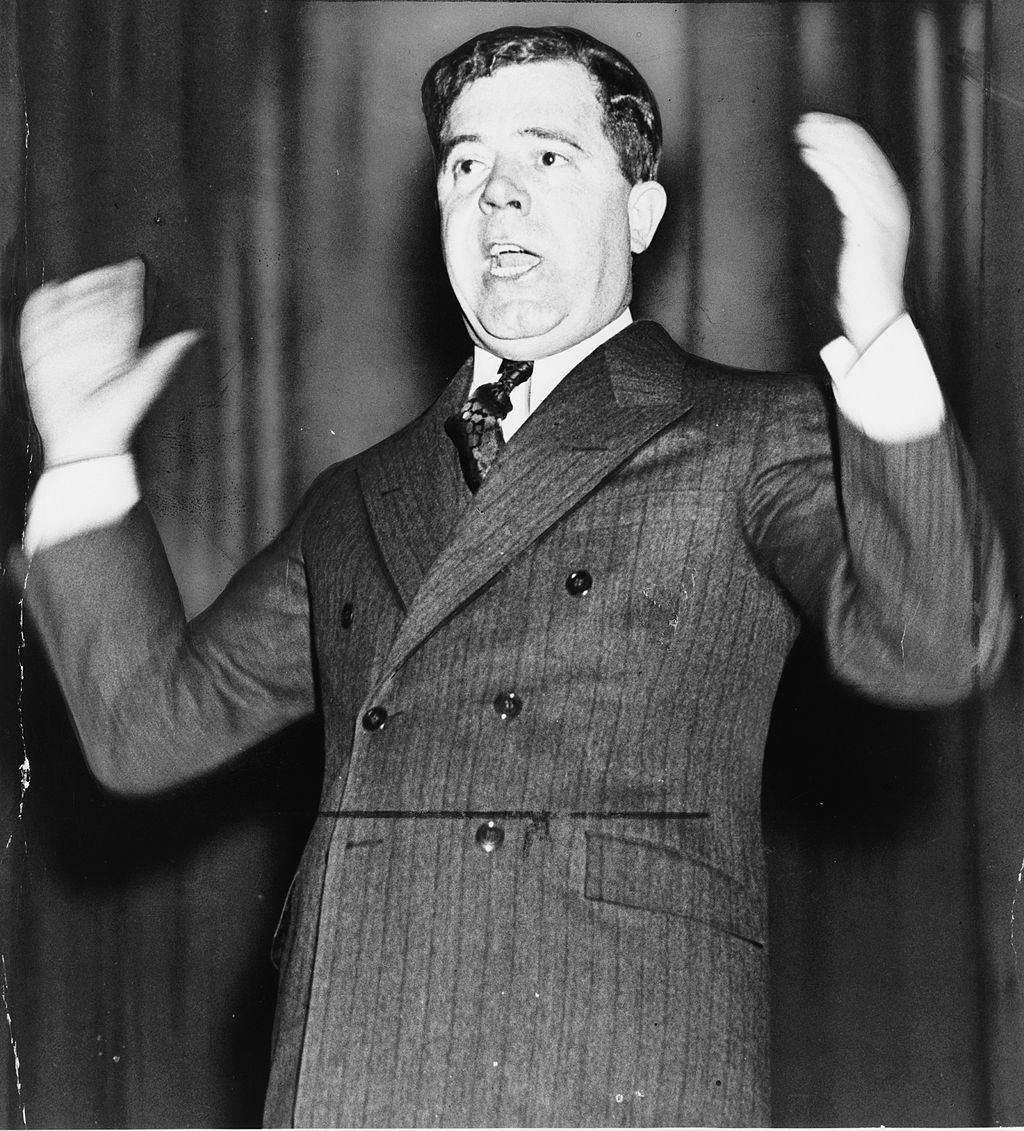
Huey Long: a vocal critic of Roosevelt's policies
Despite a landslide victory in 1936, Roosevelt had political enemies. The main attacks came from:
- conservative politicians from within both parties and businessmen
- individuals such as Huey Long, Father Charles Coughlin and Dr Frances Townsend
- the Supreme Court.
 Teacher only box
Note that there is an alternative activity for this topic on the essay planning page: 7. The Great Depression and the Americas: essay planning
In groups of four research the role and actions of the following in opposing the New Deal. Identify the reasons for their opposition, actions taken, degree of support and the impact on Roosevelt.
To understand the growing opposition of business, watch the above video (Roche Productions part 2) from 32 minutes; this deals with the unionisation of workers and growing unrest which alienated many businessmen who feared the collapse of capitalism.

The most serious opposition to Roosevelt came from the Supreme Court.
The nine judges of the Supreme Court can decide whether laws passed by Congress are 'in harmony with the constitution'. If they decide that a law is not, they can veto that particular law. This was to be a real problem for Roosevelt as the Supreme Court was dominated by Republicans who opposed the whole idea of the New Deal as you have researched in the task above.
Out of sixteen cases concerning the 'alphabet agencies' which were tried by the Supreme Court in 1935 and 1936, the judges declared that in eleven, Roosevelt had acted unconstitutionally.
The 'Sick Chickens' case,
In 1935, the Schechter Poultry Group broke one of the NRA codes by selling diseased chickens. The NRA took the company to court and the Schechter company was found guilty. The company appealed against the decision and the Supreme Court upheld their appeal, ruling that the NRA had no right to interfere in state affairs, in this case, the New York poultry trade. The NRA code was declared illegal.
The implications of this ruling was that all the other 750 NRA codes were now also illegal.
The US v Butler Case
In this case the Supreme Court ruled that the Agricultural Adjustment Act was illegal. The judges decided that giving help to farmers was a matter for each state government, not the federal government. As a result all help to farmers stopped. Another 11 Alphabet Agencies were also declared 'unconstitutional'.
In the 1936 election, Roosevelt won a massive victory. This indicated that public opinion was behind the New Deal and so Roosevelt decided to take action against the Supreme Court.
In 1937, he threatened to retire any judge who was over 70 and to replace them with younger ones who would support his policies.
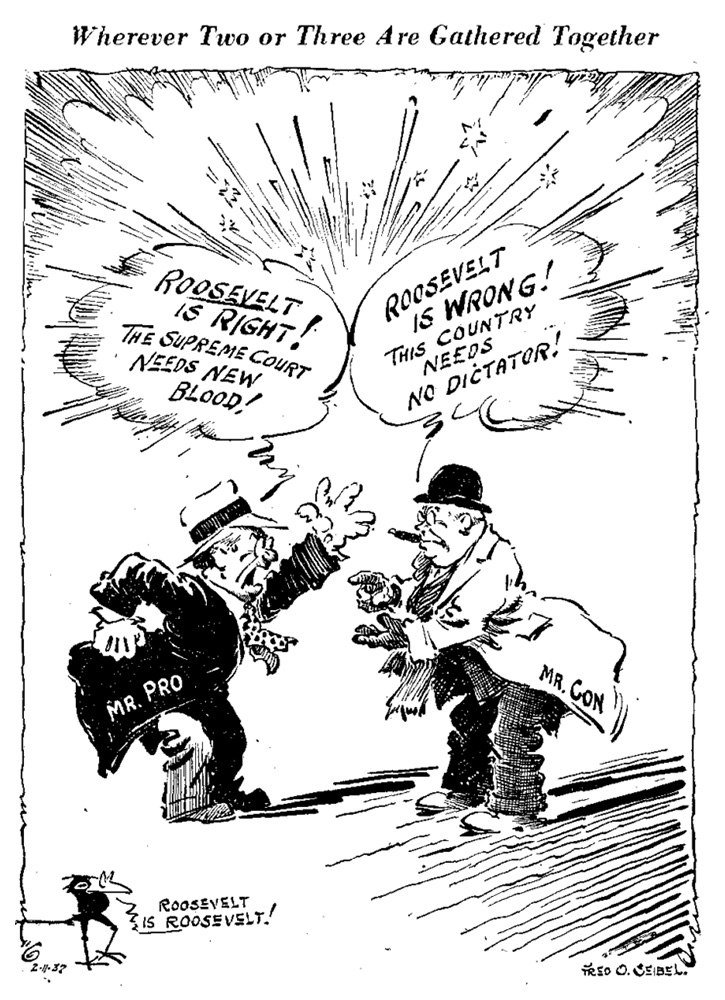
This proposal was greeted with outrage and consternation by many who saw this as a totally unconstitutional act; he even got opposition from within his own party who had not been consulted about this proposal. Thus Congress refused to pass the Bill.
However, from 1937, the Supreme Court judges no longer opposed the New Deal Legislation. In March, 1937 the supreme Court reversed the 'Sick Chickens' decision and accepted his Social Security Act which brought i old-age pensions and unemployment insurance. This indicates that Roosevelt's threat to the Supreme Court had positive consequences; nevertheless the episode damaged Roosevelt's reputation - many felt that he was acting like a dictator.
- What do the two cartoons below indicate about reaction to Roosevelt's proposal for the Supreme Court?
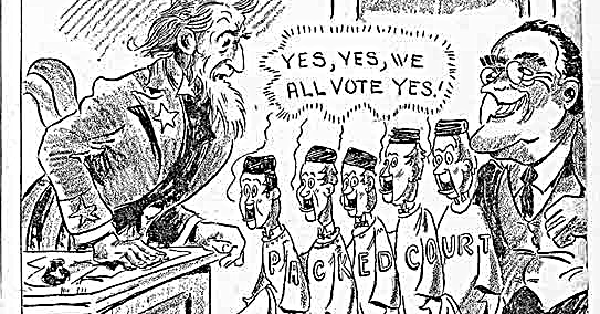 A 1937 political cartoon with the caption 'Do We Want A Ventriloquist Act In The Supreme Court?'
8. To what extent were FDR’s policies effective in dealing with the impact of the depression in the US?
Starter:
Continue watching the video on the Great Depression (Roche Productions part 2) from 40 minutes to the end. Write down the points raised by the historians and economists re the impact of the New Deal on the economy; also any other points re the impact of the New Deal.
Why was the outbreak of the Second World War key for ending the Depression?
In assessing the efficacy of FDR’s policies in dealing with the depression you have found that some commentators and historians claim that Roosevelt had saved the US from economic collapse, put millions of Americans back in work, made society more equal, empowered the trade unions to improve worker conditions and laid the foundation for modern US farming and more prosperous farmers. Indeed, during his administration trade union membership trebled and these gains were to be long term. Historian Michael Parrish deems the Wagner Act as a ‘Magna Carta’ for the workers.
Furthermore, historian William Leuchtenburg argues that the New Deal policies brought fundamental change and the Social Security Act had laid foundations of a national welfare system. FDR’s aims were to strengthen the economic system and distribute its benefits more fairly and many of his reforms had had to be compromises to pass Congress. There is also no doubt, that Roosevelt had greatly increased both the power of the president and of federal government.
However, some initiatives were not regulated by state or federal government and this meant large corporations hindered improvements to workers’ conditions. Millions of Americans were not covered by the Social Security Act as they were in jobs that were not covered in the legislation and the pension scheme only came into effect from 1940. Critics ridiculed the WPA by referring to it as ‘We Piddle Around’ and cited the example of WPA workers in Kentucky being employed to catalogue 350 different ways to cook spinach. Indeed, by ‘creating unproductive jobs’ the New Deal policies may have prolonged the effects of the depression. There was little progress made in civil rights for African Americans and critics claim FDR was too concerned about southern white opinion. This was also the case for women’s rights, where the traditional views on the role of women in society as the mother and homemaker remained unchallenged.
From 1937, Roosevelt began legislation for a Third New Deal. This had only marginal impact as unemployment began to rise again in the US. This period is sometimes known as the ‘Roosevelt recession’.
Task One
ATL: Research and thinking skills
For some orthodox historians of the Great Depression, FDR’s policies saved the US from the debacle caused by free markets and government inaction. Roosevelt moved as far as was politically possible towards social reform in the US. The revisionist view may be summed up as perceiving the New Deal as a short term defensive action undertaken by a basically conservative administration. FDR’s policies were pursued for political reasons rather than a genuine desire for social reform or to help the poor. Some argue the policies were based on ‘political profitability’ and cite evidence such as the larger national grants which were awarded to ‘swing states.’
In pairs explore the historiography on the policies pursued by President Hoover and President Roosevelt during the 1930s.
You should attempt to gather a range of opinion that includes:
- Perspectives from left wing historians
- Perspectives from center right historians
- Perspectives from the 1940s through to 2010s
Reflect on your inquiry into the policies and efficacy of each president in dealing with the economic crises and discuss with your partner which historians’ views you agree with.
This PBS website has interviews with different historians on the New Deal
Note that there is also a discussion of historians' views on the lasting impact of the New Deal on this page: 3. Political, economic and social impact of the Depression
 Twitter
 Facebook
 LinkedIn