
 IB Docs (2) Team

3. Nazi Germany Part II (1933 - 1939)
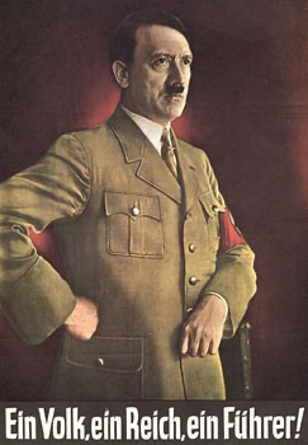
This page continues with content and activities on Hitler's policies in Germany 1933 to 1939.
For Hitler's consolidation of power and policies towards youth, workers and women go to the previous page: 2. Nazi Germany (1933 - 1939) Part I
Guiding questions:
Which groups were excluded from the Volksgemeinschaft?
Where did power lie in Nazi Germany?
How was fear used to keep control?
What methods of propaganda were used in Nazi Germany?
What actions were taken against the Jews of Germany after 1933?
How successful were Nazi economic policies?
Why was resistance against the Nazis ineffective up to 1939?
7. Which groups were excluded from the Volksgemeinschaft?
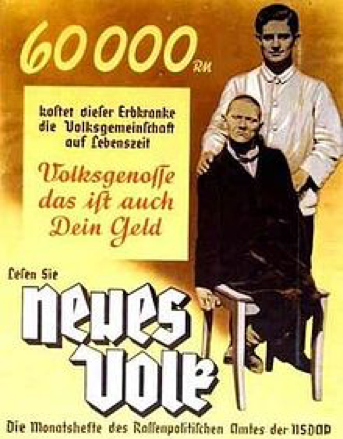
A propaganda poster promoting the T4 Euthanasia policy
"This person suffering from hereditary defects costs the community 60,000 Reichsmark during his lifetime. Fellow German, that is your money, too."
Starter Activity:
What is the message of this propaganda poster?
To be a member of the Volksgemeinschaft it was essential to be a ‘true’ German, both in terms of loyalty and racial purity. Many Germans were excluded because they were regarded as Untermenschen by the Nazis.
Task One
ATL: Research skills
The following groups were not part of the Volksgemeinschaft.
For each group research why it was excluded from the Volksgemeinschaft and the actions taken by the Nazis to ensure that they did not 'contaminate' German society. You will find this website useful for your research: http://hmd.org.uk/genocides/nazi-persecution
- Asocials. (These were people who did not follow the ‘social norms’ imposed by the Nazis and included beggars, criminals, prostitutes, alcoholics.)
- Homosexuals
- Black people
- The mentally ill or physically disabled
- Religious sects
- Racial enemies: the Roma and Sinti
8. Where did power lie in Nazi Germany?
German propaganda created the impression that Hitler seemed to be the all-powerful and in control of all aspects of the Nazi state. (see Task Three under Section 10 below). However, in reality, the day-to-day running of the state was done by his ministers and Hitler remained detached from this aspect of domestic policy. However there was no clear plan for ministers to follow, no written constitution and no clear division of powers; ministers often competed for power between themselves and made decisions based on brief conversations with Hitler in which he set out his overall vision but not the details of how it should be implemented.
This allowed certain ministers to become very powerful, for example Himmler who was in charge of the police and Goebbels who was in charge of propaganda. Nevertheless, Ian Kershaw has argued that Hitler still remained all powerful in that it was his ideas that always prevailed. His ministers and subordinates competed with each other to 'work towards the Führer'.
Task One
ATL: Thinking skills
Read about the structuralist versus intentionalist debate here
Summarise each interpretation. Find quotes from the historians who support each interpretation.
Task Two
ATL: Thinking skills
Listen to the podcast of the BBC Radio 4 programme 'In our Time'. (You can also listen to it on YouTube here).
You will hear three historians - Ian Kershaw, Mary Fulbrook and Niall Ferguson discussing Hitler's rule and the Intentionalist versus Structuralist debate (from 9 minutes 15 seconds). It's a fascinating discussion between three leading historians.
Ferguson says that the Intentionalist versus Structuralist debate is a 'false dichotomy'? What evidence is given to support this view?
Note that Ferguson uses the 'counter-factual' question of what would have happened if Hitler had been killed. What point is her trying to make? (How useful is it to use counter-factual scenarios to help our understanding?)
What points are made re why so many people supported Hitler? (note other historians who are mentioned)
Make notes on any other interesting points made by the historians.
BBC Radio 4 - In Our Time, Hitler in History (BBC)
Melvyn Bragg examines Adolf Hitler and Nazi Germany though historiographical theories.
9. How was fear used to keep control?
After 1933, there was no constitution in Germany. Hitler’s word was law. There were no longer legal safeguards to protect individual citizens and judges were no longer an independent force; they were expected to make judgements in line with Nazi beliefs and aims. Individuals could be arrested and tried without trial; new courts and police organisations were introduced to ensure that opponents to the regime were swiftly dealt with. In particular, the SS, with its secret police offshoot the Gestapo, became a powerful tool of control and of terror under Heinrich Himmler.
The SS
It was the SS that had carried out the Night of the Long Knives (see previous page). Following this event, the role of the SS expanded. By 1936, it controlled the entire police system. It aimed to eliminate all enemies of the Regime, whether political or racial and was in charge of the concentration camps. It also established a vast economic empire
By 1939 there were 240,000 members organized into various divisions; the Death’s Head Formations administered the concentration camps and formed Panzer units; the Waffen SS was mainly a military organization.
The Gestapo
The Gestapo or Geheime Staatspolizei was a relatively small organisation with only 20,000 officers in 1939. However, it managed to create an atmosphere of fear and suspicion within the German population by using Nazi informers in the general population to gain information. Each ‘block warden’’ was in control of a block or unit of a town and would visit every home in their area each week collecting donations and checking up on people. In addition, many of the public voluntarily denounced their neighbours, though this was probably inspired more by personal than political reasons. In fact, there were so many denunciations that the Gestapo were unable to investigate them all and so arrests and custody became increasingly random.
The SD
The Sicherheitsdienst (SD) was the intelliegence gathering agency of the SS. it was responsible for the security of Hitelr and other top Nazis
Task One
ATL: Self-management skills
Copy and complete this grid to show the different roles and actions of the different police organisations.

Task Two
ATL: Thinking and communication skills
Watch the following video showing the Auschwitz Concentration camp.
Discuss with a partner your impressions and thoughts about this camp and what the remains of it today tell us as historians about the aims and functions of the camp.
10. What methods of propaganda were used in Nazi Germany?
The other powerful department of the Nazi Regime was the Propaganda Ministry under the control of Goebbels. In addition to influencing culture (see below) Goebbels oversaw the press and radio. The radio in particular was a powerful means of indoctrination. This was helped by the mass production of radios which were sold at subsidized prices; by 1939 70 percent of households owned one. There were also public loud speakers in communal areas which broadcast Hitler’s speeches and important ‘national monuments’.
Another aspect of the propaganda machine was the creation of a new social ritual; the Heil Hitler greeting with the Nazi salute. Along with public festivals to celebrate key Nazi achievements, this was intended to strengthen the populations’ identification with the Nazi regime.
Goebbels’s propaganda machine was also key for creating the ‘Hitler myth’; that Hitler was uncompromising in his fight to defeat the nation’s internal and external enemies, that he was a political genius who had masterminded the recovery of Germany after the post war humiliations and that, in addition to all of this, he remained a man of the people living a simple life and devoting himself to the welfare of his people. So successful was the propaganda promoting this image of Hitler by the late 1930s an estimated 90% of Germans admired him.
As Ian Kershaw has argued, Hitler’s popularity was key to securing his position and then allowing him to carry through his ideas:
'Hitler’s huge platform of popularity made his own power position every more unassailable, providing the foundation for the selective radicalization process in the Third Reich by which his personal ideological obsessions became translated into attainable reality’
Ian Kershaw, The Hitler Myth, p. 1
Task One
ATL: Thinking and research skills
1. Look at the following links which show a wide range of visual Nazi propaganda.
https://www.bytwerk.com/gpa/posters2.htm
http://www.bbc.co.uk/history/worldwars/wwtwo/nazi_propaganda_gallery_02.shtml
Choose 4 different propaganda posters. Identify the message of the poster and how that message has been achieved.
2. Investigate further the role of the Nuremberg Rallies. Use this link:
Nuremberg Museum: What were the Nazi Party Rallies?
What was the purpose of these rallies and what methods were used to fulfil this purpose?
3. Research the other types of Nazi propaganda: newspapers, radio, film
You may find this website useful for speeches and newspaper articles:
https://research.calvin.edu/german-propaganda-archive/ww2era.htm#Posters
Identify how each was used to spread Nazi ideas.
4. Which of the types of propaganda that you have investigated do you think would have been the most effective in spreading the Nazi message?
Cultural policies
Culture was also used as a form of propaganda; after 1933 the arts were made to promote Nazi ideology and to encourage the development of a Volksgemeinschaft. The innovations in art, architecture and other areas that had taken place during the Weimar years were regarded as 'degenerate' by Hitler.
The Reich chamber of Culture was established in1933 and it was supervised by the Propaganda Ministry. One of the first symbolic actions in May 1933 was the burning of books written by Jews, socialists and other ‘undesirables’ in Berlin. Over 2,500 authors emigrated between 1939 and 1945 including Thomas and Heinrich Mann and Bertold Brecht. Art was also attacked and Weimar’s cultural awakening labelled as ‘degenerate’ and symbolic of the spiritual decline of Germany in the post war years.
In the place of this era of experimentation Nazi culture was dominated by an emphasis on realism in painting and grandiose schemes in architecture. All art was expected to stress the values of Nazism such as glorification of war and the supremacy of the Aryan race.
Film played a special role under the Nazis; it was used for both relaxation and propaganda. It was extremely effective to show the masses newsreels that glorified the achievements of Hitler and the Nazi state – and newsreels were shown before all feature films. However, Goebbels also realised the importance of film as an entertainment form. Between 1933 and 1945, over one thousand feature films were produced, with only about one sixth being overtly propagandist It was probably only in this area that culture under the Nazis achieved anything notable due to the work in particular of Leni Riefenstahl. Her movies such as Triumph of the Will, had a strong propagandist message, but one that was conveyed subtly using innovative cinematic techniques.
Task Two
ATL: Research and communication skills
Divide the class into groups. Each group should research one of the following areas of culture looking at:
- Nazi expectations for this area of culture
- How these expectations were different to what had happened in Weimar Germany
- The results for German culture in this area
Art
Architecture
Theatre
Music
Film
Task Three
ATL: Thinking skills
Read this article written by Goebbels to celebrate Hitler's birthday.
What image of Hitler is created in this speech?
Make a list of the adjectives that could be used to describe Hitler based on Goebbel's description.
 Teacher only box
It may be best to print this source off and get students to work in pairs to highlight the key points - also see the Silent Conversation teaching idea on this page: 2. Source work activities )
11. What actions were taken against the Jews of Germany after 1933?
Hitler's obsessive hatred of the Jews dominates his writings and speeches from the early 1920s. Once in power, he was able to translate this hatred into policy. From 1933, the Nazi regime began an intensive campaign of persecution and legal discrimination against a backdrop of violence towards Jews. At the same time, Goebbels used his propaganda to prove to the German population that German Jews were in fact not true Germans, that they were linked to anti-German forces such as Marxism and that they needed to be eliminated from German society.
Several measures were taken against the Jews after 1933. The first of these, the boycott of Jewish shops and businesses was quickly called off after meeting with popular disapproval. However, the legalisation of discrimination with the ‘Law of the Restitution of the Professional Civil Service’ met with little protest. This law had a severe impact on the middle class Jews in Germany and led to increased numbers of Jews emigrating. At the same time violence against the Jews continued at the hands of the SA with beatings, torture and killings. The burning of so-called Jewish books took place in Berlin in May 1933. Meanwhile, Nazi teachers took the lead in segregating Jewish children from other pupils.
Legal discrimination was stepped up with The Nuremburg Laws of 1935. The Reich Citizenship Law saw Jewish Germans being reduced to second-class citizenship which meant that they now lacked full civil and political rights. Under the Law for the Protection of German blood and German Honour, Jews could no longer marry Aryan Germans; the employment of women under 45 in Jewish households was also forbidden. Germans were encouraged to denounce to the Gestapo anyone who continued with ‘race defilement’ or being a ‘slave to the Jews’.
In the years that followed the Nuremburg Laws, Jews were systematically excluded from professions, education and from public and cultural life. From 1938, anti-Semitic policies moved into a more radical phase which coincided with Hitler’s expansion in Europe. New identification papers were marked with the letter ‘J’ for Jude (Jew) and women had to take the middle name of Sarah and men take the middle name of Israel to indicate their Jewish identity. The ‘Aryianisation’ of the regime continued with Jews forced to sell their shops and businesses for minimal prices thus removing all forms of livelihood. By the end of the year, Jewish children had been excluded from German schools and Jews had been banned from public baths, theatres, cinemas and museums; in parks, they could only sit on certain benches.
In November, 1938, the Reichskristallnacht (Night of Broken Glass) saw the biggest single outburst of organised violence against the Jews; on the night of the 9th, party radicals attacked 7,000 businesses and destroyed 267 synagogues as revenge for the shooting of a German Embassy official by a Polish Jew who was protesting at the mistreatment of his parents. Official party figures reported ninety-one Jews killed but many more died due to arrest and imprisonment. Many also committed suicide. Jews were forced to pay compensation for the destruction of property themselves and to forfeit their insurance claims. Many Germans were actually appalled by this level of violence; however, they did little to protest against the discrimination which now continued apace.
Many Jews continued to emigrate and indeed, emigration was actively encouraged by the Nazi regime both for German Jews and Austrian Jews who became part of the Reich with the takeover of Austria (Anschluss) in March 1938. However, Jews found it increasingly hard to find the money necessary for the ‘emigration tax’ while other countries made it clear that they were unwilling to take unlimited numbers of Jews. When war broke out in 1939, emigration became almost impossible and the persecution of Jews entered a new far more radical phase. As Kershaw writes the ‘The war ..offered the opportunity, and created the context of brutalisation in which [Hitler’s key ideological issues] could ..take genocidal shape’. (pg 151 Hitler, Kershaw)
Task One
ATL: Research and self-management skill
Complete the attached grid to show the impact of the measures taken against the Jews after 1933. For the last column also note if there was any significant reaction by the German population.
 Grid on measures taken against the Jews 1933 to 1939
Task Two
ATL: Thinking skills
1. What does the following directive by Müller indicate about the nature of the violence on Reichskristallnacht?
An order sent by Heinrich Müller to all regional and local commanders of the state policy, 9th November 1938
"(i) Operations against Jews, in particular against their synagogues, will commence very soon throughout Germany. There must be no interference. However, arrangements should be made, in consultation with the General Police, to prevent looting and other excesses. (ii) Any vital archival material that might be in the synagogues must be secured by the fastest possible means. (iii) Preparations must be made for the arrest of from 20,000 to 30,000 Jews within the Reich. In particular, affluent Jews are to be selected. Further directives will be forthcoming during the course of the night. (iv) Should Jews be found in the possession of weapons during the impending operations the most severe measures must be taken. SS-Verfügungstruppen and general SS may be called in for the overall operations. The State Police must under all circumstances maintain control of the operations by taking appropriate measures."
12. How successful were Nazi economic policies?
Starter Activity
What, according to this source, are Hitler's plans with regard to the German economy?
I consider it necessary that, from now on, with iron determination we attain 100 per cent self-sufficiency in all these areas such as steel and coal so that we will not be dependent on foreign countries for these important raw materials, and that thereby we will also be able to save the foreign currency we require during peacetime in order to import our foodstuffs. I thus set the following tasks:
I The German armed forces must be operational within four years
II The German economy must be fit for war within four years…The extent of the military development of our resources cannot be too large, nor its pace too swift (underlining by Hitler)
An extract from the Four Year Plan Memorandum, August 1936
When Hitler took power in 1933, he had certain clear aims of what he wanted to achieve, though no clear overall plan of how they should be achieved. This aims included:
- Reducing the number of unemployed, which was one of major problems faced by Germany as a result of the Great Depression
- Creating an economy that would allow Hitler to pursue Lebensraum
- Autarky or self-sufficiency which would allow Germany to be prepared fo a war
How successful was Schacht’s economic strategy?
Until 1937, Nazi economic policy was in the hands of Hjalmar Schacht who was President of the Reichsbank (1933 – 39) and Minister of Economics (1934 – 7). Schacht was a respected international financier and this reassured the conservative economic elite. Under Schacht, deficit financing was adopted in order to boost the economy and reduce unemployment
Public works
In what the Nazis called the ‘battle for work’, the state increased government expenditure and investment, and it tried to stimulate consumer demand. Large sums of money were spent on public work schemes such as the building of autobahns (motorways) and public buildings, reforestation and land reclamation. This led to a dramatic increase in jobs.
In 1935, a Reich Labour Service was introduced under which unemployed men were forced to six months labour in farming or construction. The introduction of military service further reduced unemployment as did Hitler’s rearmament programme.
The ‘New Plan’ of 1934
By 1934, Germany was experiencing a trade deficit. It was importing more than it was exporting and so its foreign currencies, which were needed to buy the imports, were running low. To solve this problem, Schacht introduced controls on imports which now had to be approved by the government. He also initiated a series of bilateral trade agreements with countries such as the Balkan states through which Germany paid for food and raw materials with German Reichmarks which could only then be used to buy German goods.
The use of ‘Mefo’ bills
In order to finance rearmament, Schacht introduced Mefo bills or credit notes. Companies that supplied goods or services to the government were given these Mefo bills which they could then exchange for cash at the Reichsbank. However, there was an incentive to delay asking for this cash as there was a 4% per annum interest on the bills if they kept them for five years. Thus, the government could start the rearmament programme without actually having to finance it, and it also prevented the danger of inflation by reducing the cost of government expenditure. This method also allowed the rearmament programme to go unnoticed as the expenditure did not show up in government accounts.
By 1936, there still a balance of payments problem and a growing budget deficit. There were also food shortages. Schacht wanted to encourage exports in order to gain foreign exchange and also slow the increase in arms expenditure. However, this was not acceptable to the Nazi leadership. The debate over where priorities should lie within the German economy became summed up in the phrase, ‘Guns or Butter?’.
The question was resolved, as you can see in the memorandum above, by Hitler himself. Schacht’s caution was overruled. He was marginalized and Hermann Goering was put in charge of a Four Year Plan which would focus on economic autarky. For Hitler this was crucial if Germany was to be geared for war and avoid the crippling effects of an economic blockade such had been imposed on Germany by the Allies in the First World War.
Autarky was to be achieved by creating a managed economy which would control labour supply, prices, raw materials and foreign exchange. It would also involve cutting exports by increasing Germany’s own production of key commodities such as iron, steel and also food and developing substitutes for products such as rubber and coal. However, the Four Year plan failed to meet production targets in key areas such as fuel and rubber and by the time that war broke out in 1939, Germany was still dependent on foreign supplies for one-third of its raw materials.
Task One
ATL: Thinking skills
Make notes on each of these measures mentioned above:
- Measures taken by Schacht to reduce unemployment
- The 'New Plan' of 1934
- The significance of Mefo bills
- The Guns vs Butter debate
- The Four Year Plan, 1936
2. Identify the successes and failures that resulted from these economic measures.
You will find more discussion of Hitler's economic policies here
13. Why was resistance against the Nazis ineffective before 1939?
In the years following 1933, many Germans did not see the need for opposition or resistance to the Nazi regime. They saw the Weimar Republic as having been ineffective and they had suffered too much under the impact of Depression; the provision of work under the Nazis was key for winning many people over to the regime. In addition, the power of the SS and the work of the Gestapo made it difficult to express opposition while propaganda was relentless in highlighting the success of the Nazi state and in glorifying the role of Hitler. Many Germans thus just got on with their lives and kept out of trouble; they may not have whole heartedly supported Nazi policies but they were not prepared to openly attack or oppose the regime.
There were of course significant exceptions to this. You have already researched about opposition from some individual Church leaders and the rebellious nature of some youth groups and the brave, resistance of the White Rose movement. Socialists and Communists were of course opposed to the regime, but both organisations were brutally dealt with by the Nazis and, in addition, failed to organise themselves effectively or to work with each other.
Interestingly, the only effective opposition came from the upper classes who dominated the civil service, and in particular from the highest ranks of the army. The conservative elites had initially supported Nazism because of its attacks on the socialists and communists, its restoration of authoritarian rule and its overturning of the Treaty of Versailles. The army was also won over to the regime following the Night of the Long Knives. However, from 1937 they became concerned with Hitler’s foreign policy aims which they feared might result in Germany having to fight a war on two fronts. Hitler’s purge of conservative army leaders in 1938 and his increasingly personal control over the army, intensified concerns and some army leaders considered the possibility of a coup 1938 – 1939. However, any attempts at resistance were deflected by Hitler’s success in foreign policy 1938 – 39, and then, once war started, by the need to support the government in time of war.
Task One
ATL: Thinking and communication skills
In pairs, discuss why you think that there was no serious opposition in the years 1933 - 1939. Structure your discussion under the headings: the Church, the work of the police state, impact of propaganda, youth resistance, economic policies.
For each of these areas consider the factors that contributed to a lack of opposition. You may want to summarise your discussion in the form of a mind map.
 Twitter
 Facebook
 LinkedIn