
 IB Docs (2) Team

3. The League of Nations and Europe in the 1920s
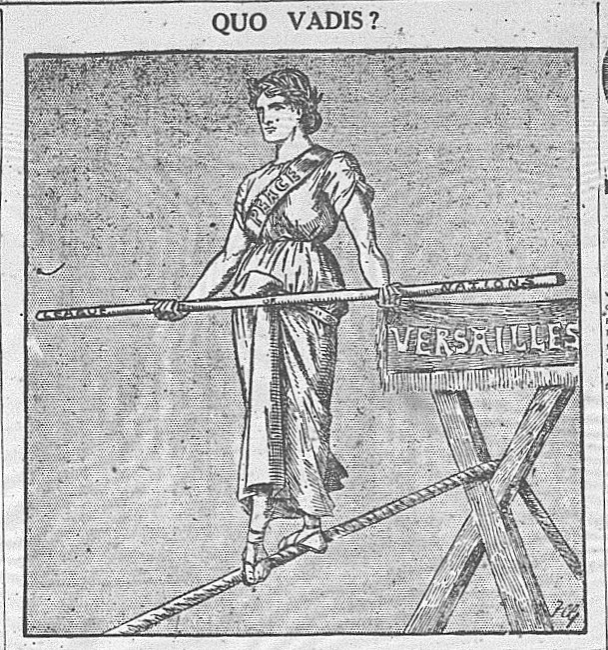 Throughout the 1920s the League of Nations dealt with various disputes arising mainly from the territorial changes of the Versailles settlement. It had both successes and failures in its handling of these disputes.
Guiding questions:
What were the strengths and weaknesses in the League’s structure and organisation?
How successful was the League in the 1920s?
What were the developments in the successor states of central and eastern Europe?
US President Woodrow Wilson’s 14 points outlined the aim of establishing an international organization that would prevent another general war between states. Wilson believed that a League of Nations would be the mechanism for collective security whereby conflicts could be resolved through international agreement and resolutions, and aggressor states would be contained by international pressure and economic sanctions. The League would also be able to oversee global disarmament and prevent the development of alliance systems and hostile blocs. If there was a dispute between countries it would be referred to the League’s Assembly; if this body could not find a resolution the Council could then impose moral pressure or economic sanctions to force a state to comply to its resolution.
Starter:
Watch The League of Nations: Wilsons League for Peace and make notes on the ideals, achievements and failures of the League.
1. What were the strengths and weaknesses in the League’s structure and organisation?
Collective security was the idea that peace could be preserved by countries acting together – collectively – to prevent one country attacking another. Collective security was to be made possible through membership of the League of Nations. When there was a dispute between countries they would refer the issue to the League’s Assembly. If that body could not find a resolution, the Council could make decisions in order to gain compliance. The League had three key ways to enforce its resolutions:
- First impose moral pressure
- Second, the Council could impose economic sanctions to force the country that was considered to be in the wrong to comply with its decisions.
- If the first two methods failed, member states could allow their armed forces to jointly impose the League’s resolution
The League met for the first time in Geneva in December 1920. Its key objective was to keep the peace and avoid future conflict by advising on and settling international disputes.
It also aimed to promote disarmament, supervise the mandated territories, and promote international goodwill and cooperation through its various organizations dedicated to social and economic development. The initial membership of the League was 32 Allied states and 12 neutral states; however, by 1926, all ex-enemy states had joined. The USSR was not admitted until 1934; the USA never joined.
There were 26 articles in the League’s Covenant (including amendments made in December 1924), which prescribed when and how the League was to operate.
- Articles 1–7 were concerned with the membership and organization of the League, its Assembly, Council, and Secretariat.
- Articles 8–17 were concerned with the prevention of war.
- Articles 18–21 concerned with treaty obligations and the League’s expectations of its member states.
- Article 22 concerned the mandated territories.
- Article 23 concerned humanitarian issues such as labour conditions, health concerns, the trafficking of women, children, drugs, and arms.
- Article 24 concerned the commissions.
- Article 25 promoted the Red Cross.
- Article 26 set down how amendments to the Covenant were made.
It was set down in the Covenant that member states should refer disputes to one of the following:
- the Permanent Court of International Justice
- arbitration (having a neutral person or group of people listening to and judging a dispute)
- an investigation or inquiry by the Council.
If member states failed to refer their disputes to the League, or failed to follow its recommendations, the League could then impose economic sanctions, the main tool for the League against aggressors. In the aftermath of World War One, in which the economic blockade of Germany had been effective, this economic weapon appeared to have the potential to be effective in forcing compliance with the League’s decisions.
In theory, the League could call for military action as a last resort against an aggressor. Yet the League did not have its own armed forces, and in reality member states did not want to put their sovereign forces under international control. In addition, the Covenant was rather ambiguous as to when and how such armed forces should be used. France had wanted an armed force, or League Army, but Britain had resisted this option. Thus the League lacked military teeth.
Two largely independent organisations that worked with the league was the International Court of Justice and the International Labour Organisation. League also set up a number of agencies, committees and commissions to deal with issues that arose from the settlement and to redress social and economic issues.
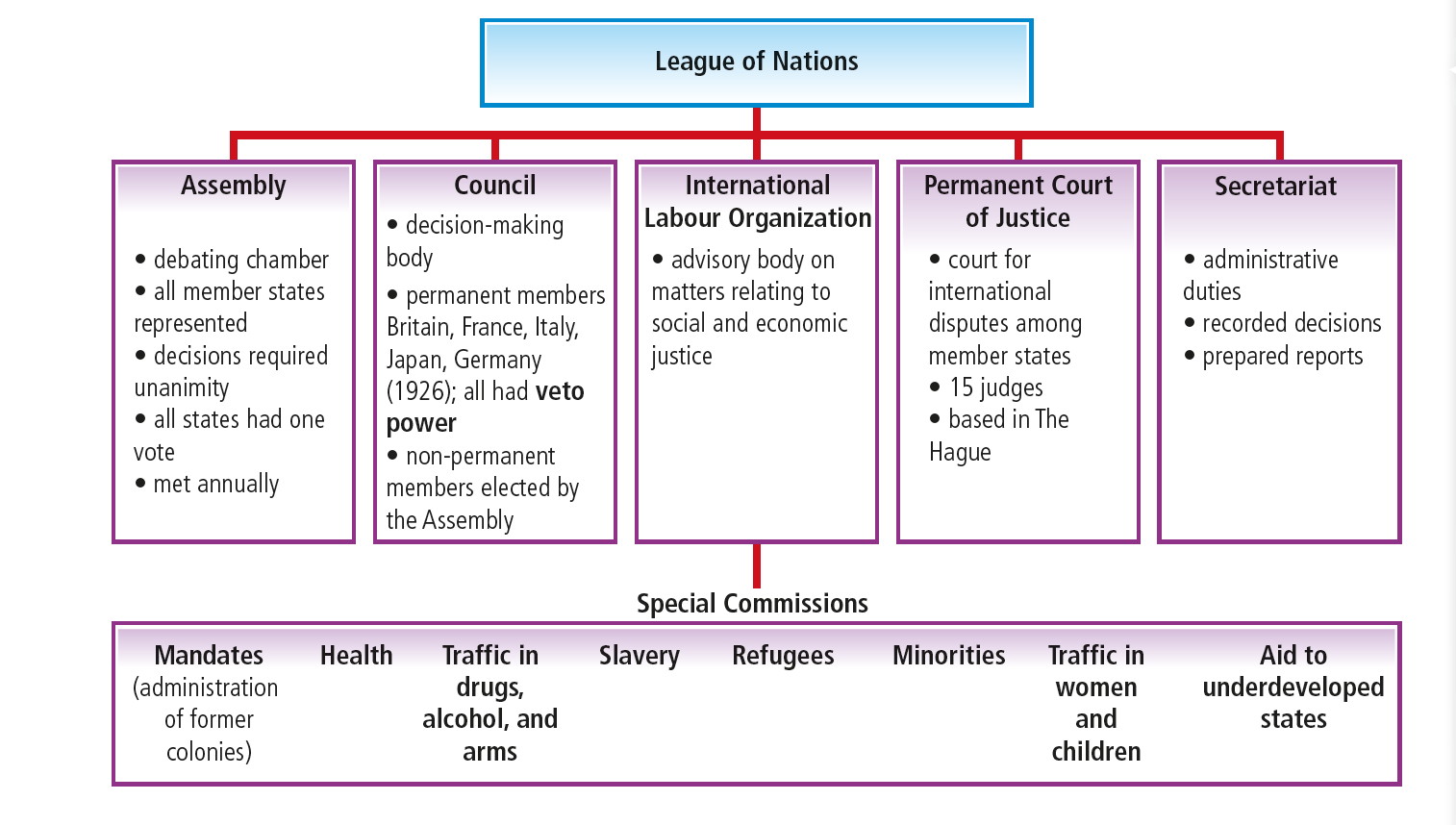
Task One
ATL: Thinking skills
In pairs or small groups review the material above and read through the chart below. Discuss what structural and organizational issues faced the League in pursuing its aims as set out in the Covenant.
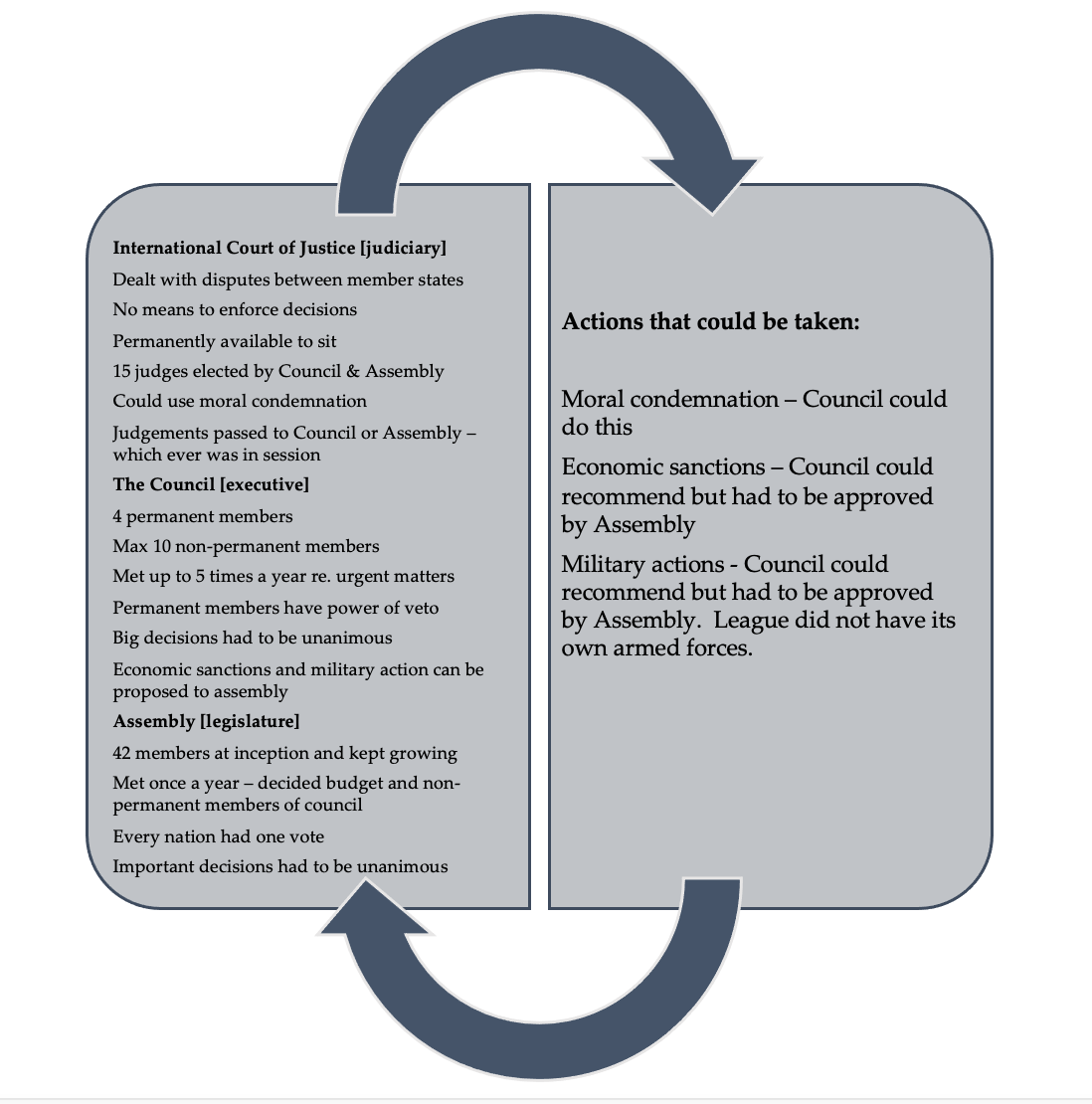
Task Two
ATL: Thinking skills
In pairs read through the following sources and explain the problems faced by the League.
Source A
Historian Hugh Brogan. 2001.
[the League] depended on the goodwill of the nations to work, though it was the absence of good will that made it necessary.
Source B
Historian Ruth Henig. 1995.
British governments took care to limit any specific political or military commitments they might make to western Europe although under article 10 that had undertaken to act ‘against external aggression’ towards all members of the League
Source C
Historian AJP Taylor c.1960
Rival states can be frightened into friendship only by the shadow of some greater danger
US
Perhaps the key weakness of the League of Nations organisation was the absence of major powers. This had a decisive impact on its work and influence. It has also been seen as the key reason for the League ultimately failing to prevent another world war.
The most important absent major power was the US. The League had been promoted by the Americans and had been championed by President Woodrow Wilson in his 14 points. The US Congress, however, was too concerned that membership would drag the Americans into more disputes and conflicts in Europe, and after the war it returned to a policy of isolationism. The US had played a pivotal role in bringing the First World War to an end, but it did not want to play a central role in the post-war period and in the fall out from the Versailles settlement.
The absence of the US seriously weakened the League’s ability to use ‘collective security’ against aggression, for several reasons:
- World’s most powerful economy would have given the League’s economic sanctions real weight, but without it these were undermine.
- Without the USA, the permanent members (except for Japan) were European and this meant it lacked the appearance of a genuinely ‘worldwide’ organization.
- It highlighted that the new organization may not stop old-style agreements and treaties, as this was clearly how the US was going to secure its future relationships.
- The League was primarily led by European powers that were arguably in decline.
USSR
The USSR was excluded from the League of Nations. The new communist government was seen as a threat to Europe and Asia and the western powers and Japan had invaded the country after the Bolsheviks had seized power. There was real fear the ‘revolution of the workers’ would spread and the intention was to isolate the regime.
But the exclusion of Russia further weakened the League, as it could be claimed by the USSR that it was merely a ‘club for capitalists’ – which real aims was to protect and promote business interests and empires at the expense of the exploited masses. Soviet leader Lenin called the League ‘a robbers’ den which would exploit the ‘unjust spoils of Versailles’.
Germany
Germany was initially not permitted to join the League and this suggested that the League was a ‘victors’ club’ – the four permanent members of the Council were the victorious Allies. In addition, the exclusion ignored the fact that Germany remained a strong power in 1920, despite the war and the treaty. It had a geographically important position in Europe and retained much of its economic power. It would also have been more effective to include Germany in the League so that it could work towards some negotiation and revision of the Treaty of Versailles within the confines of the League’s machinery.
Interesting point: It has been claimed that the League of Nations was a British, not an American idea. The Liberal Party in Britain had taken the country to war, however military conflict went against their ideology. Goldsworthy Lowes Dickinson was very upset by Britain’s involvement in the war and within 2 weeks of its outbreak he had devised the idea for a League of Nations. He wrote extensively about the potential for this organisation to prevent another major conflict and his work shaped public opinion. His ‘League for Peace’ would resolve issues between states through arbitration and conciliation. In 1916 he went on a lecture tour about the League in the US.
Task Two
ATL: Thinking skills
- In pairs explain the issue that Marcel Cachin, below, highlights about the League’s membership.
- What is the message of Source B?
Source A
French politician Marcel Cachin’s response to the US’ decision not to join the League. 1920.
America’s place will remain empty at Geneva and the two countries that dominate, France and Britain are divided on almost every one of the topics to be discussed.
Source B

The weakness of states in central Europe
The collapse of the Austro-Hungarian Empire at the end of the First World War led to the establishment of a number of smaller states based on the principle of nationality. However, as you saw on the previous pag, many of these states struggled politically and economically to achieve stability. This meant that that the League had to deal with smaller states that required more support, particularly in terms of economic development and territorial security. These states, when joining the organisation could not offer the League much support in return.
2. How successful was the League in the 1920s?
Throughout the 1920s, the League dealt with many disputes that arose from the territorial changes of the Versailles settlement and the post-war situation in Europe:
Aaland Islands, 1920: These islands were populated mainly by Swedes, but, following the collapse of the Russian Empire, Finland had claimed sovereignty over them. The conflict was taken to the League and Sweden accepted the League’s decision to give the islands to Finland.
Vilna, 1920–1923: Both Poland and Lithuania wanted control of the town of Vilna. It had once been the capital of Lithuania, but its people were Polish. The League was unable to prevent the Poles from seizing and retaining Vilna by force. Finally, the Conference of Ambassadors awarded Vilna to Poland.
Upper Silesia, 1921: Both Germany and newly formed Poland wanted control of the important industrial area of Upper Silesia. The League decided to split the area between the two.
Ruhr crisis January 1923: When Germany defaulted on reparation payments in 1922, the French (with Belgium) took military action outside of the League and occupied the Ruhr in order to seize payments in goods. The response of the German government was to order workers there to strike. Economic turmoil ensued as Germany faced hyper-inflation.
Corfu, 1923: Three Italian army officers were shot while working on a boundary dispute between Greece and Albania. Mussolini blamed Greece and ordered compensation. When the Greeks did not pay, Italian soldiers occupied Corfu. Greece appealed to the League, but the Italian government ignored the Council’s ruling and left only when compensation had been paid.
Mosul, 1924: The area of Mosul was claimed by both Turkey and Iraq. The League considered the problem and awarded the area to Iraq, a decision that was accepted.
Bulgaria, 1925: Following a Greek invasion of Bulgaria, the League ordered both armies to stop fighting. An investigation by the League blamed Greece for starting the dispute and ordered it to pay damages. Greece accepted the blame and was ordered to pay compensation.
Task One
ATL – Thinking skills
Examine the disputes faced by the League of Nations above and answer the following questions:
- Which of these disputes can be regarded as a success for the League and which disputes can be regarded as a failure?
- Are there any common factors that help to explain the successes and failures?
- What do the failures suggest to you about the weaknesses of the organisation?
- What lessons could be drawn for the 1930s from the challenges that had faced the League in the 1920s?
- Study the Punch cartoon called 'The Gap in the Bridge' which can be found here.
What is the message of this cartoon? Does your investigation into the League’s impact in the 1920s support this message?
Two attempts were made, in 1923 and 1924, to strengthen the machinery of the League of Nations. These were both initiated by France. The first of these initiatives was the Draft Treaty of Mutual Assistance, which would have required all members of the League to come to the assistance of a victim of aggression. Next, the Geneva Protocol of 1924 would have made arbitration compulsory in all disputes. Both initiatives were rejected by Britain, its Dominions and the Scandinavian powers, who believed that members would not be willing or able to carry out the huge commitment that would result from such a role.
The League thus remained divided between those states that wanted a strong League to enforce the existing territorial agreements, and those that wanted to be more selective in dealing with aggression. This division also arose because of the difference in vulnerability of the various states. While France felt highly vulnerable, others were not so worried and were not prepared to take on what they saw as extra commitments. These differences were to be highlighted further by the Ruhr Crisis, which would deeply undermine the principle of collective security.
3. Was the League of Nations a failing supranational organization by 1929?
Task One
ATL: Self-management and communication skills
Divide the class into two groups to debate the following motion:

Click on the eye for hints:
The structure of the debate could could be as follows:
There should be three speakers for each side.
The first speaker should set out the main arguments that their team will be putting forward and give some evidence for at least two of these arguments.
The second speaker should respond to any points made by the first speaker on the other side and then go on to develop at least two more points.
After the first two speakers on each side have spoken, the debate should be opened up to questions from the floor and anyone who has not given a speech should ask a question.
Finally, the last speaker on each side should speak. They should address questions that were raised from the floor as well as refuting any arguments from the other side. They should summarise their team's key points again.
Note that your teacher will be deciding which side wins and points will be given for valid arguments backed up with precise evidence. Credit will also be given for using the views of historians to support your points as well as responding to arguments from the opposing team and to questions from the floor
3. What were the developments in the successor states of central and eastern Europe?
Task One
ATL: Thinking and research skills

1. With a partner find a map of pre-First World War Europe and compare it to the post war map above. What are the key differences?
2. Get into groups of seven. Each student will research one of the following ‘successor’ states:
- Finland
- Estonia
- Latvia
- Lithuania
- Czechoslovakia
- Yugoslavia
- Poland
You need to develop a ‘guide to’ your successor state in the inter-war period, from its establishment after the First World War through to the outbreak of the Second World War in 1939. You MUST include information and details on the following:
- Political nature of the state [e.g. democracy, military dictatorship etc]
- Economic situation [including the key strengths, limitations, evidence of stability and growth and evidence of issues]
- Social developments [this could include, education, the arts, the role of women in society, the role of religion in society etc]
- Foreign policy [this could include aims, fears, treaties, alliances and other developments]
Present your findings to your group.
3. As a group discuss the following questions:
- Which states seemed to be the most successful politically, economically and socially in the inter-war period?
- What were the main ‘aims’ and ‘fears’ of the successor states?
- Which states pursued an ‘aggressive’ or ‘expansionist’ foreign policy?
- To what extent were the successor states ‘stable and viable’ countries in the long term?
 Twitter
 Facebook
 LinkedIn